- Key Takeaways
- Airbnb tracks more than 500 amenity tags behind the scenes, but guests only ever filter by a small visible subset of them.
- Amenities split into three tiers: Essentials guests assume you already have, Standard amenities guests actively filter for, and Standout amenities that justify a higher nightly rate.
- An untagged amenity behaves exactly like a missing one in search, even if the feature is sitting in your photos. Airbnb’s filters read your tags, not your pictures.
- The right amenity can move nightly rate by a wide margin. A hot tub alone has been tied to revenue premiums well above 40% in some markets, though the number swings hard depending on where you’re located.
- Keeping your amenity tags accurate matters more than adding every option available. Overclaiming an amenity you don’t actually provide risks guest complaints and, in Airbnb’s own words, listing penalties.
Airbnb amenities are the features, supplies, and services provided by a host to make a guest’s stay comfortable and convenient. Airbnb amenities are a tagging system Airbnb uses to decide whether your listing even shows up when a guest filters their search, and that distinction changes how you should think about every amenity you have. Amenities improve guest confidence, reviews, and conversion, which then supports ranking.
According to Airbnb’s host insights, listings offering cooking basics uplift roughly 17% higher host earnings. Pet-friendly listings get 6% more bookings.
Hosts working with STR Assistance have seen drastic change in their ranking and revenue once we fixed their amenities tag accurately. Today we will be sharing all about Airbnb amenities, how the tag system works, and not just describing features. Also, how amenities impact Airbnb search rankings, and the specific amenities that drive the revenue.
What Are Airbnb Amenities? Understanding Airbnb's Amenity System
An Airbnb amenity is any feature or item your property offers that guests can filter for in search, and it only counts toward that search once you’ve tagged it inside the listing editor.
Whereas Airbnb’s amenity system is the way Airbnb lets hosts show what a place has. So, guests can filter and compare listings based on those features. Also, to help guests quickly find the right stay and to standardize listing information, Airbnb groups amenities.
How Airbnb's System Works
You can add amenities in the listing editor, and those selections become structured listing data rather than just a free-text description. That’s the only place Airbnb actually reads this information from for search purposes, regardless of what your description says or what your photos show.
- Hosts go to the Listings tab, then Your space → Amenities, and add the features their place has.
- Guests can filter by amenities in search, which means amenities are part of the discovery layer, not just the listing description.
- Airbnb also groups some things as essential amenities expected for a comfortable stay, like toilet paper, soap, towels, pillows, and linens.
- Airbnb says adding every true amenity helps guests know what to expect and may help increase bookings.
Physical Amenities vs Airbnb Amenity Tags
The physical feature and the digital tag are two separate things. Only one of them affects whether guests find you.
This distinction trips up more hosts than almost anything else in amenity management. You can own a genuine hot tub, photograph it beautifully, and describe it in your listing text. Still be invisible to every guest filtering specifically for “hot tub” if that single checkbox was never ticked in the amenities section. The feature existing in your property changes nothing for search. Only the tag does.
Airbnb Amenity Categories Explained
Airbnb organizes amenities into three categories. As a host you need to understand which category an amenity falls into.
Essentials are the baseline guests assume exist without needing to ask, things like linens and soap. Standard amenities are the ones guests actively filter search results by, like Wi-Fi or free parking. Standout amenities are the rarer, higher-cost features, like a pool or a sauna, that can justify charging more per night rather than just getting you found in the first place.

Airbnb Essentials
The platform has an Essentials category for basic requirements. Airbnb’s own current guidance names five specific essentials every listing should have: toilet paper, hand and body soap, one towel per guest, one pillow per guest, and linens for every guest bed.
These aren’t optional extras. They’re the baseline Airbnb tells hosts guests expect for a comfortable stay.
Real guest expectations run a little further than Airbnb’s official list though. Working locks, reliable hot water, and basic safety equipment, a smoke alarm, a carbon monoxide alarm in any space with fuel-burning appliances, a fire extinguisher, all sit in the same category even though they’re framed separately in Airbnb’s guidance under safety rather than essentials.
Standard Amenities
These are the amenities that show up as actual, clickable filter options in Airbnb search, which makes them the ones directly responsible for whether your listing appears at all for a given guest search. Standard amenities guests filter for,
- Wi-Fi, close to universally expected at this point, and increasingly filtered specifically for speed by remote workers.
- Kitchen, one of the most consistently filtered amenities across every guest type and market.
- Parking, especially valuable when it’s free, which Airbnb’s own top-10 search list confirms directly.
- Air conditioning, frequently prioritized over Wi-Fi itself in guest surveys, which surprises a lot of hosts.
- Washer, particularly important for longer stays and family bookings.
- Dryer, usually filtered alongside the washer rather than separately.
- TV, still a searched-for amenity even in a streaming-first world.
- Self check-in, now expected by a large share of guests who don’t want to coordinate a meeting time.
- Pet-friendly, a filter that immediately narrows a guest’s entire search to listings that accept their animal.
Standout Amenities
Standout amenities are the features rare enough, and desirable enough, that they can justify pricing above nearby comparables rather than just getting you into more search results. These are conversion and revenue tools more than visibility tools.
- Pool, the single most searched-for amenity in Airbnb’s own data, and one of the strongest revenue drivers in warm-climate markets specifically.
- Hot tub, consistently one of the highest return-on-investment amenities across markets, and a genuine search filter accelerator in its own right.
- EV charger, a newer addition that’s grown fast as more travelers drive electric vehicles.
- Sauna, a wellness-category amenity that’s expanded well beyond its traditional cold-climate markets.
- Gym, more relevant in longer-stay and business-travel markets than leisure ones.
- Dedicated workspace, a genuine differentiator for the remote work segment specifically.
- Waterfront, a location-based standout that can’t be added after the fact, only marketed correctly once it exists.
- Beach access, similar to waterfront, location-dependent rather than something you install.
- Indoor fireplace, strongest in cold-climate and cabin-style markets, less relevant elsewhere.
How Airbnb's Amenity Tagging System Works
Amenity tags are the structured labels hosts add to their listings to describe available property features. Airbnb uses these tags to enrich the database and try to understand exactly what a host is offering to guests. Airbnb uses the selected amenity data to help guests compare listings and decide whether a place fits their trip.
However, Airbnb has expanded its amenity system over time to include hundreds of tags across categories such as essentials, accessibility, safety, entertainment, outdoor spaces, and standout features.
There are also amenity options in grouped lists, such as Guest Favourites, Standouts, and category-based sections, so hosts can tag features consistently.
We often see that most hosts don’t have any clear idea about amenity tags, and they cannot add proper labels for their extra add-ons. This is one of the reasons many don’t get many bookings despite having a lot to offer.
Why Amenity Tags Matter Even If Your Property Has the Feature
Airbnb only knows about a feature if you add the amenity tag to your listing. For example, if your property has a dishwasher, EV charger, or dedicated workspace but these aren’t selected in your listing settings, guests using those filters may never see your property in their search results.
Also, the system is largely self-reported: hosts choose the amenities, and Airbnb’s interface and search systems rely on that input. Also, it improves discoverability, helps guests make informed booking decisions, and reduces the risk of negative reviews. That’s why accuracy matters.
When a host comes to us with listing ranking issues, more than a dozen have inaccurate tag settings, and once we fix them, it shows a significant impact on their listing performance.
The Difference Between Airbnb's 500+ Amenity Tags and Guest Search Filters
Airbnb tracks over 500 individual amenity tags across its listing system, covering everything from a specific coffee maker type to accessibility features to outdoor structures. Guests never see anywhere close to that number as actual search filters.
Only a small, curated subset of those 500-plus tags become filter options guests can actively select, things like Wi-Fi, kitchen, pool, and free parking. The rest still matter. They show up in your listing’s amenities section when a guest is already looking at your property, and they still factor into the general quality signal Airbnb evaluates; they just don’t function as a search gate the way the visible filters do.
A hidden tag isn’t wasted, but it works differently than a filter tag. Think of visible filters as the amenities that decide whether you show up at all, and hidden tags as the ones that help convince a guest once they’re already looking at you.
How Airbnb Amenities Affect Search Rankings
Airbnb has said directly that search results are influenced by quality, popularity, price, and location, and amenities feed into that quality signal while also acting as a direct filter guests apply themselves. That means amenities work on two separate levels at once, not just one.
Every untagged amenity is a missed search opportunity. An amenity that exists but isn’t tagged behaves, from Airbnb’s search engine’s point of view, exactly like an amenity that doesn’t exist at all.
When our SEO expert Shawon runs an amenity audit on a new client property, he mentions the single most common finding isn’t a missing feature. It’s a feature the host genuinely has that was simply never ticked in the amenities section. Fixing that one gap alone has moved listings into search results they’d been invisible to for months.
The fix: Pull up the ten highest-reviewed comparable listings in your immediate area and look specifically at their amenity tags. Note what they’ve tagged that you haven’t, and note anything you offer that none of them have tagged either, since that’s a genuine differentiator worth highlighting rather than burying.
Why Amenity Accuracy is Important?
Getting your tags right matters more than getting your tags complete. Over-tagging and under-tagging both create real problems, just in opposite directions.
- Over-tagging: Claiming an amenity you don’t consistently provide- a hot tub that’s often out of service, a kitchen missing basic cookware- sets an expectation your property then fails to meet on arrival.
- Under-tagging: Leaving real amenities untagged out of laziness or oversight, which quietly removes you from every search that filters for them.
- Guest complaints: Almost always trace back to a mismatch between what was tagged or described and what guests actually found, not to the amenity itself being bad.
- Review signals: Feed back into your ranking over time, so a pattern of amenity-related complaints does lasting damage well beyond the single stay that triggered it.
How Amenities Fit Into Airbnb's Ranking Algorithm
Amenities aren’t a standalone ranking factor in Airbnb SEO. there are factors like conversion rate, review quality, and listing completeness work together. An accurately tagged, fully described amenity set supports every one of those factors at once, rather than acting as its own separate lever.
If you want the full picture of how Airbnb’s ranking system works beyond amenities specifically, our complete Airbnb SEO guide breaks down conversion rate, click-through rate, and every other factor that determines where you show up in search.
The 10 Airbnb Amenities That Matter Most for Rankings and Revenue
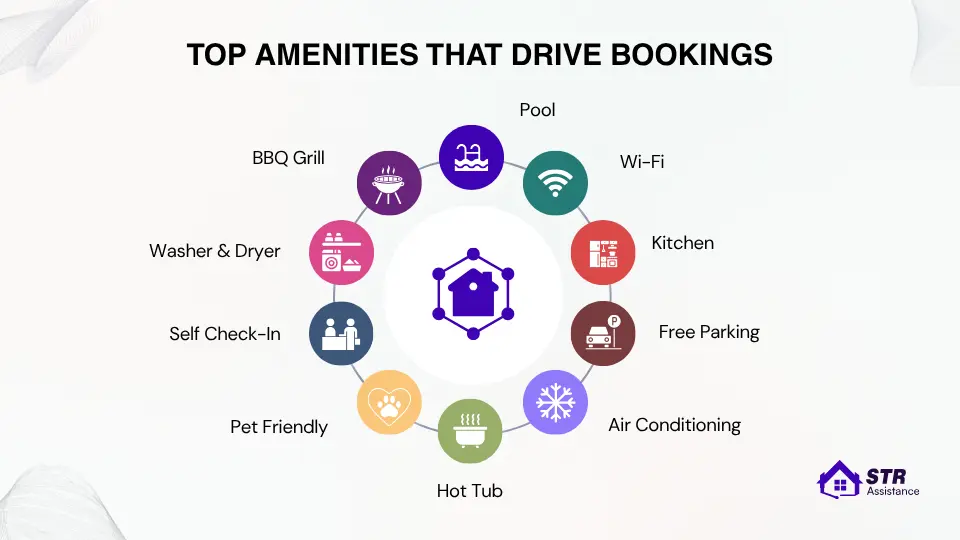
Airbnb’s own host resources list these 10 amenities as the most searched amenities. Check if your listing offers any of these, though you are offering that to your guests.
- Pool: The top amenity in Airbnb’s own most-searched data is pool. Also, many hosts suggest having a pool as one of the strongest revenue drivers in warm-climate and desert markets specifically.
- Wi-Fi: Close to a baseline expectation now, but still an active search filter guests apply.
- Kitchen: this is one of the highest-impact amenities for every guest type.
- Free parking: Offering free parking can work like a major differentiator in cities where parking is scarce or expensive.
- Air conditioning: Guest surveys have repeatedly shown travelers prioritizing this over connectivity itself.
- Hot tub: One of the clearest revenue-per-dollar-invested amenities available, and a genuine search filter accelerator on top of the rate premium.
- Pet-friendly: Immediately narrows a guest’s search to your listing and removes an entire category of travel friction for pet owners.
- Self check-in: Today, guests prefer self check-in where nobody would interrup into their personal space.
- Washer or dryer: Washer is valuable for longer stays, families, and guests trying to pack light. And those guests expect a dryer paired with the washer.
- BBQ grill: A popular outdoor amenity that family, friends group more prefer, especially at cabins, beach houses, and vacation homes.
Trending Amenities
A handful of amenities have grown fast enough recently that they’re worth watching even though they haven’t cracked the traditional top ten yet. None of these are required, but ignoring them in the wrong market means quietly losing ground to hosts who added them early.
- EV chargers, growing directly alongside electric vehicle adoption, and increasingly tied to measurable revenue premiums in markets with real EV ownership.
- Dedicated workspace, no longer a nice-to-have for remote workers, closer to a deciding factor for that specific guest segment.
- Fast Wi-Fi specifically, not just Wi-Fi guests are increasingly filtering by actual connection speed where that information is available.
- Guests today prefer smart home features, keyless entry, smart thermostats, and voice-controlled lighting.
Best Amenities by Guest Type
Amenity preferences can change depending on the guest type because a solo guest’s choices won’t be the same as those of a family group. Based on your property and the type of guests you are targeting, you should select the appropriate amenities. Here is a list of amenities you can tag depending on the guest type.
- Families: high chairs, travel cribs, baby safety gates, and a genuinely stocked kitchen matter more here than almost any standout feature.
- Business and remote workers: fast, reliable Wi-Fi and a real dedicated workspace, not a kitchen table pressed into service, decide bookings in this segment.
- Pet owners: a pet-friendly tag alone isn’t enough. Fenced outdoor space, hard flooring, and pet bowls signal you’ve actually thought about their situation.
- Couples and special occasions: hot tubs, fireplaces, and privacy-focused features carry more weight here than practical amenities like a washer or workspace.
Which Airbnb Amenities Increase Bookings and Revenue?
Getting found and getting booked at a strong rate are related, but different problems, and the amenities that solve each one aren’t always the same. Standard amenities such as Wi-Fi, a fully equipped kitchen, and free parking primarily improve bookings. Standout amenities like a pool, hot tub, and sauna help justify higher nightly rates, attract more clicks, and can increase booking conversions
Amenities That Can Increase Nightly Rates
Nobody can accurately predict the increase in bookings or revenue from adding a specific amenity, as it varies depending on the location, property type, competition, and other factors. However, here’s what we have found.
According to AirDNA’s amenity performance analysis:
- Hot tubs: Deliver an average 14.3% increase in ADR.
- Waterfront access: Can command approximately 13% higher nightly rates.
- Pools: Generate an average 9.5% ADR premium.
- Saunas: Are associated with around 7.4% higher nightly rates.
- EV chargers: Can provide an average 6.8% ADR uplift.
- Fire pits: Contribute to around 5.1% higher ADR.
- Washer access: Is linked to roughly 6% higher nightly prices.
- Dryers: Can achieve approximately 10% higher nightly prices.
- Accessibility features: May result in about 11% higher nightly rates.
- Family-friendly positioning: Can lead to around 10% higher nightly prices.
Understanding the ROI of Standout Amenities
A real example makes this better than any percentage can. Two nearly identical three-bedroom cabins in Gatlinburg, Tennessee, same neighborhood, same square footage, same guest ratings, ended up $25,000 apart in annual revenue. One earned roughly $20,700 a year. The other earned roughly $45,700. The entire gap traced back to one amenity: a hot tub that cost about $5,000 to install, paying for itself in under three months.
Location changes this math more than almost anything else. In Scottsdale’s desert climate, a pool alone can add an 83 to 94% premium to the nightly rate, with a hot tub adding another 41% on top of that pool baseline.
None of this accounts for what these amenities actually cost to run, and that’s the piece most amenity advice skips entirely. A hot tub or sauna needs regular chemical balancing, filter changes, and periodic professional servicing, and guest misuse- someone climbing in with muddy boots or overfilling it with bath products, is a recurring complaint we hear directly from hosts we work with.
Budget-Friendly Amenities That Deliver Strong Returns
Not every high-return amenity requires a five-figure installation. Here is what statistics shows,
- Cooking basics: about 17% higher host earnings
- Laptop-friendly workspace: about 14% higher earnings
- Self-check-in: about 13% higher earnings
- Pet-friendly listings: about 6% more bookings over the following year
- EV charging demand: searches increased 80%+ from 2022 to 2023, and listings with EV charging averaged about two extra nights booked per year
Check this list of budget-friendly amenities that can provide more return value.
Self Check-In: Installing a lockbox or smart lock is a one-time investment that can save you time on every booking. It also gives guests the flexibility to arrive whenever they want, making your listing more appealing.
High-Speed Wi-Fi: If you already have internet, upgrading to a faster plan is often an inexpensive monthly expense. Reliable Wi-Fi is one of the first amenities guests look for and can influence their booking decision.
Dedicated Workspace: You don’t need a separate office to create a workspace. A small desk, a comfortable chair, and good lighting are often enough to make your property more attractive to remote workers.
Free Parking: If your property includes a driveway, garage, or dedicated parking space, highlighting it costs nothing. In areas where parking is limited or expensive, this simple feature can give your listing an advantage over nearby competitors.
Luxury Amenities Worth Considering
Once the basics and the mid-tier amenities are solid, a smaller set of premium features can justify meaningfully higher rates in the right market specifically. Saunas, home theaters, and full outdoor kitchens fall into this category. They’re not universally worth adding. They’re worth adding when your specific market and guest type already show demand for them.
Wellness-category amenities in particular, saunas and hot tubs together, have been shown to support nightly rates 15 to 30% above comparable listings without them, with payback periods in the six-to-eighteen-month range being typical rather than exceptional. Treat these as a considered investment tied to your specific market’s guest profile, not a default upgrade every host should make.
Common Airbnb Amenity Mistakes to Avoid
Most amenity problems aren’t about having the wrong features. They’re about how those features get represented, or forgotten, over time.
- Forgetting to tag existing amenities: the single most common issue Shawon finds during a new client audit, a real feature sitting untagged and invisible to every search that filters for it.
- Listing amenities you don’t actually provide: whether that’s a hot tub that’s been broken for months or a workspace that’s really just a kitchen chair, this is the fastest way to generate a complaint-driven review.
- Never updating amenities after renovations: a kitchen remodel or a new appliance means nothing to Airbnb’s search until someone actually goes back into the listing editor and updates the tags.
- Not showing amenities in photos or descriptions: A tagged amenity with no photo is less trustworthy to a guest actively deciding between your listing and a comparable one down the street.
How to Audit and Update Your Airbnb Amenities
Amenities aren’t a set-it-and-forget-it part of your listing. Properties change, seasons change, and Airbnb’s own filter options shift over time, so treating this as a recurring habit rather than a one-time setup step protects your ranking over the long run.
How to Add or Edit Amenities
You’ll find this setting in the listing editor, under Your space, then Amenities. Tap the plus sign next to any feature your property genuinely has, and select Add to tag it.
Removing or editing an existing tag works the same way in reverse, find the amenity in the list and toggle it off if it no longer applies. The mobile app and desktop editor both offer this same set of options, though the desktop version tends to be faster for auditing a long list in one sitting, since scrolling and toggling multiple items is easier with a full screen and a mouse.
Changes apply within minutes of saving. Airbnb doesn’t require a review period for straightforward amenity tag updates, so there’s no real reason to batch changes and wait; update as soon as you notice something’s missing.
Seasonal Amenity Audits
Walk the property once a season with your actual amenity list open on your phone, checking off each item against reality rather than against memory. This catches drift that builds up slowly enough to go unnoticed otherwise.
The items that get missed most often on a first pass tend to be small: a coffee maker that quietly broke and got replaced with a different model, a board game that went missing after a family stay, an outdoor amenity that’s seasonal and needs its tag adjusted rather than removed.
Keeping Photos, Descriptions, and Amenities Consistent
Tagging an amenity without showing it anywhere weakens the signal, even though the tag itself still works for search filtering. A guest deciding between your listing and a comparable one trusts a claim more when a photo backs it up.
Closing this loop means checking all three surfaces together whenever something changes. The amenity tag itself, at least one photo showing it clearly, and a mention in the description if it’s significant enough to matter to a guest’s decision. Handle these one at a time, and they drift out of sync constantly.
Updating Amenities After Property Upgrades
The update most hosts skip after a genuine property upgrade isn’t the exciting part- new appliances, a remodeled bathroom- it’s going back into the amenities tab and actually reflecting the change there. A beautiful new kitchen does nothing for your search visibility until its specific features are tagged.
A simple habit fixes this. Whenever a contractor invoice or a delivery receipt for a property upgrade comes in, that’s the trigger to open the listing editor the same week, not “eventually.”
Room-by-Room Amenity Reference
Going amenity by amenity from memory misses things. Working room by room catches far more. Since a kitchen has an entirely different checklist than a bedroom or an outdoor space, and thinking about them together tends to blur the details of each.
For the kitchen specifically, our full kitchen essentials checklist walks through exactly what belongs in that space and how to tag it correctly. For everything else, bathroom, bedroom, and outdoor items included, our complete inventory checklist covers the rest of the property room by room.
How STR Assistance Optimizes Airbnb Amenities for Better Rankings
Most hosts don’t lose bookings because their property lacks good amenities. They lose bookings because good amenities never made it into the system Airbnb actually searches against.
AT STR Assistance our SEO expert Shawon’s team runs amenity audits precisely because this gap shows up so consistently across new clients. That audit checks every tag against what the property genuinely offers, flags anything overclaimed that could trigger a guest complaint, and cross-references photos and description text to make sure all three tell the same story.
If you’d like a structured reference to work through your own tags before you dive in, we put together an Airbnb Amenity Tag Reference you can download and use directly.
For ongoing management rather than a one-time pass, our Airbnb listing management service handles this as part of a broader listing optimization process. Our Airbnb virtual assistant handles the ongoing day-to-day work of keeping tags, photos, and descriptions aligned as your property changes.
Contact us at STR Assistance today.
Frequently Asked Questions
You need to actually provide them, not just tag them. Essentials like toilet paper, soap, towels, pillows, and linens are baseline guest expectations, and tagging something you don't genuinely supply leads directly to complaints and negative reviews once a guest arrives.
Yes. Airbnb's search filters read your amenity tags, not your photos. A feature that's clearly visible in your gallery still won't surface in a filtered search unless the corresponding tag has been added in the listing editor.
You risk guest complaints, negative reviews, and in Airbnb's own terms, potential listing penalties including removal for consistently misrepresenting what a property offers. Accuracy protects you here as much as it protects the guest.
Removing a tag for something you genuinely no longer offer won't touch your existing reviews. It may reduce how often you appear in searches that specifically filter for that amenity, which is the expected tradeoff of accurately reflecting what changed.
Update immediately after any real change, a renovation, a broken appliance, a new addition, and run a full seasonal audit at least once every few months even when nothing obvious has changed, since small drift tends to build up unnoticed otherwise. Waiting for a formal review period isn't necessary here; changes apply quickly once saved.
No. Standard amenities like Wi-Fi and kitchen access affect whether you appear in search at all. Standout amenities like a pool or hot tub affect pricing power and conversion once a guest is already looking at your listing. They work through different mechanisms, not the same one.
Airbnb's amenities list is a fixed set of options rather than an open field you can add freely to. Features that don't fit an existing tag still belong in your listing description and photos, even though they won't function as a searchable filter.
Wi-Fi, kitchen, free parking, and air conditioning consistently drive the most search visibility across markets. For actual conversion once a guest is looking at your listing, pools, hot tubs, and self check-in tend to move the needle the hardest.
Often significantly, though the exact return depends heavily on your specific market. Hot tubs have shown revenue premiums from roughly 47% to over 120% depending on location, and pools show a similarly wide range, with desert and warm-climate markets seeing the strongest returns.
Beyond the pet-friendly tag itself, hard flooring instead of carpet, a fenced outdoor area if your property has one, pet bowls, and clear house rules about pet policies all signal to pet-owning guests that you've genuinely thought through their stay, not just checked a box. That extra signal shows up in reviews from pet owners specifically, which then feeds back into future bookings from the same guest segment.
Standout amenities tend to be the rarer, higher-cost features that a meaningful share of guests specifically search for or are willing to pay more for, things like pools, hot tubs, and saunas, as opposed to Standard amenities like Wi-Fi that guests expect as a baseline rather than a premium. The dividing line comes down to whether an amenity gets you found or gets you a higher rate once you're already being considered.