Quick Answer
The Airbnb minimum stay is the fewest consecutive nights a guest can book for a listing on a given date range, and most hosts find at least 2 nights reasonable. Hosts set it in their calendar settings. They have control to customize it by check-in day or date range. Guests cannot book fewer nights than the applicable minimum. But a rule-set, custom check-in-day rule, calendar override, connected-software setting, or local-law requirement can override the listing’s standard minimum.
According to AirDNA, a lone Sunday is the most common empty night in 32 of the 50 markets. From the calendars we review, most of those gaps trace back to minimum stay settings rather than weak demand.
A minimum stay protects you from short, costly turnovers. Hospitable and IntelliHost analysed more than 4.1 million Airbnb listings and found that one-bedroom homes with a 4-night minimum earned a median $32,060 a year, against $23,822 for one-night minimums, almost 35% more, as reported by ShortTermRentalz in May 2026.
Hosts often get confused about what the right number is to set for the minimum stay, which is actually a tricky decision to make. We can say this because we’ve experienced it ourselves. We set the minimum stay to 1 night for some hosts, while for others, we set it to 4 nights. Different settings, but both groups saw a great increase in rental revenue and profit. The rule actually depends on the market, season, and turnover cost.
Below, we cover how to set the minimum in your calendar, why shorter bookings still get through, how to choose the right number, how to fill gap nights, and the templates our team uses.
What is the Airbnb Minimum Stay?
The Airbnb minimum stay is the fewest nights a guest must book. Airbnb has no fixed rule for this, so there are no fixed rules that can suggest the best number to set. Airbnb talks about the minimum stay and maximum stay in its Article 880. Each host can set it per listing under trip length. To set your minimum stays, make a checklist of demand, turnover cost, season, day of arrival, and local regulations.
Two related things to talk about. One is the maximum nights, which caps the longest stay. And a custom trip length, which overrides the minimum for chosen dates. According to Airbnb’s host resources, lowering the minimum helps a listing appear in searches for shorter stays. If you want guests who book for longer stays, you can raise the maximum to 28 nights or more. So, once you decide what type of stay you want for your Airbnb to get bookings, then you can manage your Airbnb calendar accordingly.
How Minimum Stay Works on Airbnb?
An Airbnb host have control over the minimum stay, and Airbnb do not interfere with it, neither have any specific rules. Here is how it works.
- Host-determined: You choose how many nights a guest must book. As we said, for shorter stays you can set it from a single night to 3-4 nights, and for longer stays set nights to several weeks or months.
- By check-in day: You can set 2 or 3 nights for a Friday check-in. Also, for weekends, you can set the minimum Airbnb stay to 1 night.
- By season or lead time: We suggest minimums should change with peak seasons, holidays, or how far ahead the guest books are.
- Search filtering: Your setup minimum stay nights can impact a guest’s search for dates. Airbnb hides listings whose minimum is longer than the nights they entered.
How to Set Your Minimum Stay on Airbnb
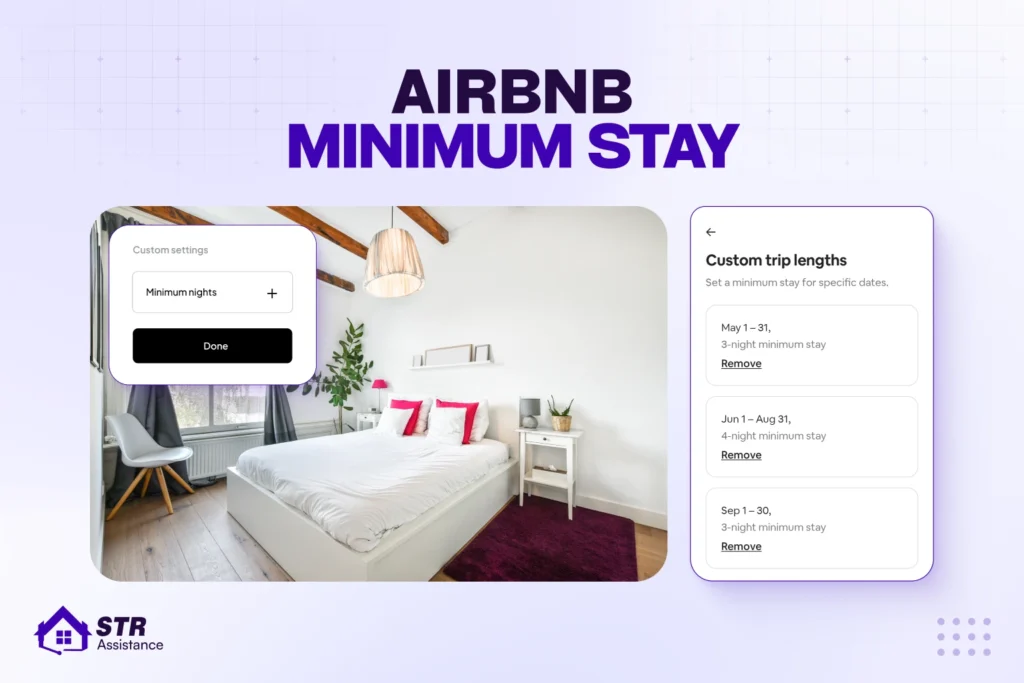
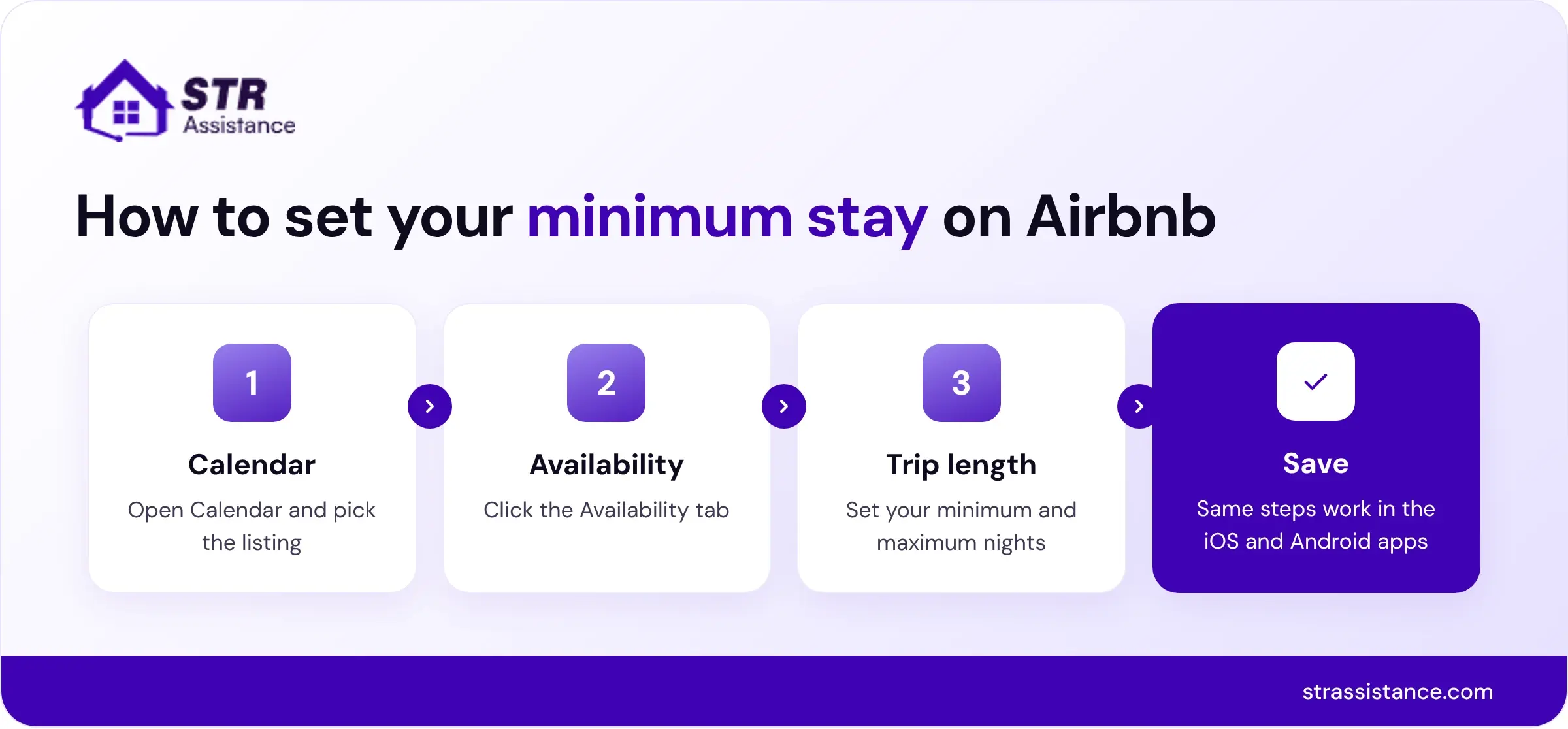
To set your minimum stay, click Calendar, select the listing, click Availability, update Trip length, then click Save. These are the steps in Airbnb’s Help Center, and they work the same in the iOS and Android apps.
Set Your Default Minimum and Maximum Nights

Your default minimum applies to every date you haven’t customized. Follow these steps:
- Click Calendar and select the listing calendar you want to change.
- Click Availability.
- Under Trip length, update your minimum and maximum nights.
- Click Save.
Minimum nights is the shortest stay a guest can book, and maximum nights is the longest. Base your minimum on what each turnover costs you.
Customize the Minimum by Check-In Day
Airbnb has the customization option for each day of the week for how the host wants to set it up. To do so,
Click Minimum Nights > Choose Customize by check-in day > Set a separate minimum for each weekday.
Airbnb’s own example is a 2-night minimum for Friday check-ins and a 1-night minimum for every other day.
You can also create custom minimum-night rules for a rule set.
Go to Trip Length > Select Customize Minimum Stay by Check-In Day > Edit the Rule Set.
Add a Custom Trip Length for Seasons or Specific Dates
Add a custom trip length to any date range you want to treat differently. For example, customize the length for a peak season or a holiday. Hosts also track local events. You set a different minimum for just those dates, and the default applies everywhere else. A shorter custom length is also a good way to open up gap nights.
Allow Requests for Longer Stays Than Your Maximum
Switch on this option if you would welcome a guest who wants more nights than your maximum. Those stays arrive as requests, so you approve or decline each one. Before you accept, check two other settings: advance notice, which protects you from late bookings, and preparation time, which protects you between back-to-back stays. Both work alongside your trip length, and they matter even more if you use Airbnb Instant Book.
Why Guests Can Still Book Fewer Nights Than Your Minimum
No, if the minimum-stay rule applies to the guest’s chosen check-in date and dates. But yes, sometimes a guest can book less than your usual minimum when another rule takes priority.
A guest may book fewer nights than your usual minimum because Airbnb minimum-stay rules can vary by check-in day, date range, rule-set, calendar override, or connected-software setting. A rule-set or calendar override can override the listing’s base minimum. Also, local regulations can affect the minimum allowed for certain dates.
These are the main reasons it happens:
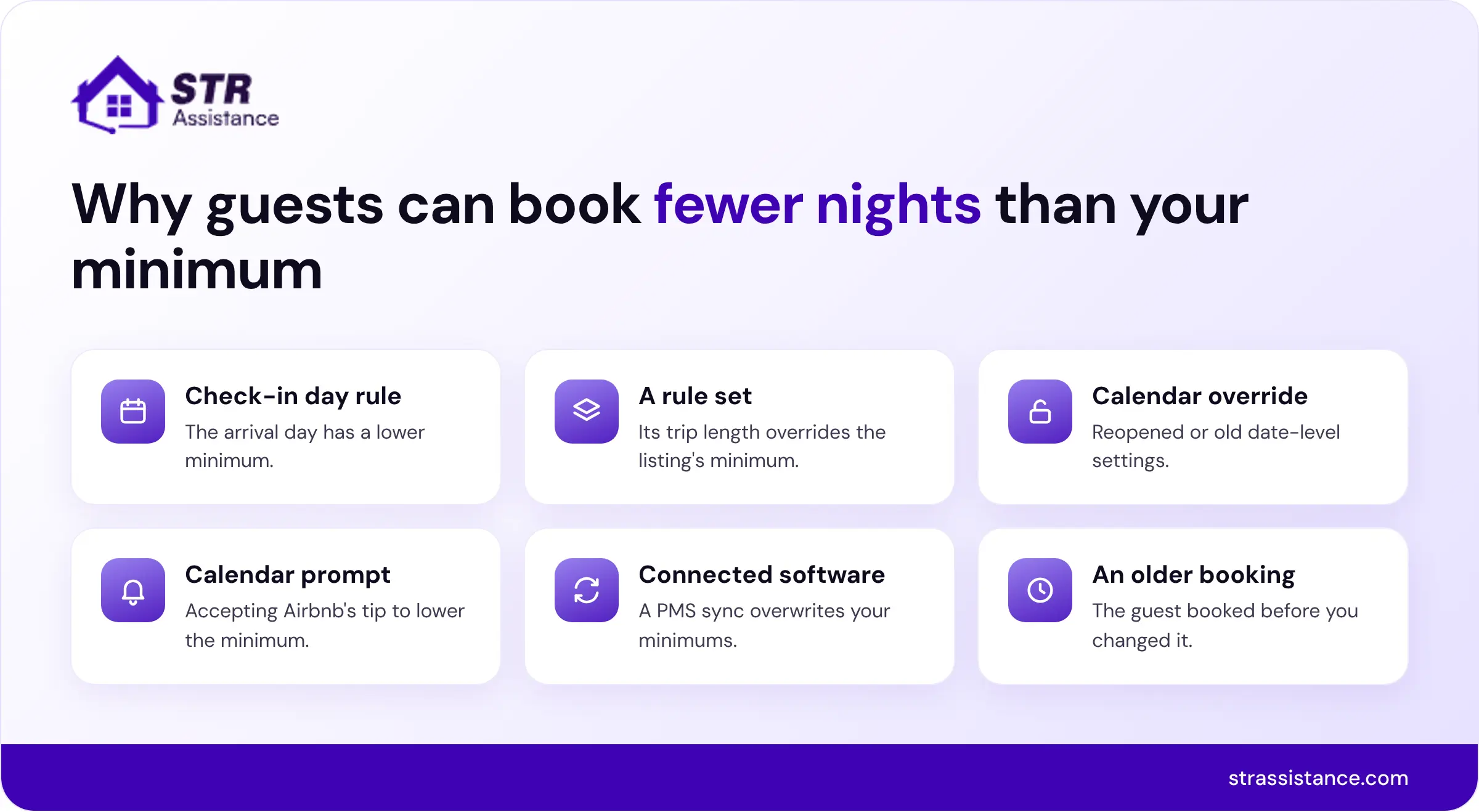
- A custom minimum by check-in day: Airbnb lets you set different minimums depending on the arrival day. If the guest’s booking starts on a day with a lower minimum, they can book fewer nights.
- A rule set overrides the listing: If you use Airbnb’s professional hosting tools, a rule set’s trip-length requirement overrides the listing’s existing minimum-night setting for the dates it covers.
- A calendar override opens specific nights: Airbnb says hosts can manually open blocked nights for selected dates. A guest may then book a shorter stay for those reopened dates. This can override settings such as minimum nights.
- Seasonal or date-specific rules: A rule set can set a shorter minimum for low season or holidays.
- Connected calendars or software: When your Airbnb is connected with a PMS or software, and you set availability rules on that platform, it can impact the minimum nights setting you set on the Airbnb platform.
- Local rules set a different minimum: Some cities ban shorter reservations.
- The booking predates your change: The guest booked the stay before you set up the minimum stay.
- The guest changed the stay after booking: Instant Book guests can add nights up to 72 hours before checkout, and trip-change requests alter the length later.
Airbnb Checks Only the Check-In Date
Airbnb applies the minimum attached to the check-in day and doesn’t count the nights inside the stay. So a holiday or event minimum isn’t a wall around those dates. It only decides when a stay may start.
Check-in day | Minimum set for that day | Booking Airbnb allows | Night left open |
Thursday | 2 nights | Thursday to Saturday | Saturday |
Friday | 3 nights | Friday to Monday | None |
Saturday | 1 night (default) | Saturday to Sunday | Friday, if not already booked |
Read the first row twice. A Thursday guest with a 2-night minimum leaves on Saturday, and your Saturday night becomes a one-night orphan. Airbnb support has confirmed this check-in day rule in the Airbnb Community.
Some other channels and property management systems use stay-through minimums, where every night inside the stay must meet the rule. A channel manager cannot change how Airbnb applies it, so Airbnb will still look only at the arrival day.
How To Close the Gap With Rule Sets
To close a Thursday-to-Saturday gap, create a saved rule set for peak weekends that allows Thursday check-ins and Sunday check-outs while blocking Saturday check-outs. Airbnb says rule sets can include trip-length requirements and check-in/checkout requirements, and that an applied rule set overrides the listing’s existing settings for those dates. Because restrictions can block good bookings, use this rule only for peak weekends and holidays, and turn off Smart Pricing first because Airbnb says it overrides rule sets.
A rule set is not only a minimum-stay tool. It can include:
- A rule set is not only a minimum-stay tool. Airbnb says it can include:
- Nightly price and weekend price adjustments
- Length-of-stay discounts for weekly or monthly stays
- Last-minute and early-bird discounts
- Trip length requirements, including minimum and maximum nights
- Check-in and checkout requirements
Airbnb says Smart Pricing overrides rule sets, so turn it off before applying one.
Important Airbnb Rules To Remember
- Rule sets override listing settings.
- They are desktop-only.
- They are saved and reusable.
- Smart Pricing must be off.
- Rule-set pricing applies first.
Since the rule sets are desktop-only and need to be set for every peak weekend, we have seen many hosts forget to set them up. In such situations, a virtual assistant for Airbnb has always proven the best solution to stay on track.
Other Ways a Shorter Booking Gets Through
A 1-night booking on a large home deserves extra care. It carries more party risk. It is better that you do Airbnb guest screening before you accept one. A few quieter routes also let short stays slip past a minimum:
- Alteration requests: A guest can ask to shorten a stay below your minimum, and you’re free to decline.
- Old date-level overrides: An override from an earlier change can keep a date open at a lower minimum.
- The calendar prompt: When your settings block unbooked nights, Airbnb suggests lowering the minimum for them, and accepting can open a 1-night window.
- Software overwriting Airbnb: A property management system can overwrite your minimums on its next sync.
When the Minimum Stay Is Not Fully Your Choice
Airbnb’s holiday party controls, local laws, and long-term stay rules can all override the minimum stay you chose for your guests. Let’s go through each point one by one so you can better understand before you set up any minimum stay.
Airbnb’s Holiday Restrictions on Short Stays
Airbnb does not impose a permanent, universal minimum stay for holidays. Instead, it activates temporary anti-party screening around selected holiday weekends, especially Halloween, July 4, Memorial Day, and New Year’s Eve, to block or redirect certain higher-risk one- and two-night bookings of entire homes.
In its May 2025 Newsroom post on holiday weekends, Airbnb said the system targets “one-to-two-night stays in entire home listings that could be higher risk for a disruptive party.”
Dates and rules change each year. So check the latest Newsroom post before every holiday.
The latest relevant Airbnb Newsroom post is,
“Cracking down on parties this Halloween weekend,” published October 26, 2026. It says Airbnb activated heightened anti-party defenses across the United States and Canada for Halloween weekend 2026, the sixth consecutive year it has done so.
Local Laws That Set a Minimum
Some cities set minimum-stay rules by law. For example, in New York City, under Local Law 18, renting an entire apartment or home for fewer than 30 days is generally prohibited. Stays under 30 days require the host to be present, share the home with guests, limit the booking to two paying guests, and hold a short-term rental registration. For this reason, many NYC hosts set a 30-night minimum for entire-home listings.
According to AirROI, across 78,458 active listings in 12 markets, the median minimum ranged from 2.1 nights in Gatlinburg, Tennessee, to 25.8 nights in New York City, a 12-fold spread driven largely by regulation rather than guest preference. San Francisco’s median was 14.7 nights, Los Angeles 20.7, San Diego 9.2, Scottsdale 8.4, and Austin 6.9.
Recording Law’s October 4, 2026 snapshot found 23,921. New York listings had a 30-night-or-more minimum, and 96.1% of them were set at exactly 30.
London works differently, with Airbnb capping entire homes at 90 nights a year, while Catalonia applies tourist-accommodation rules to stays of 31 days or fewer. Airbnb says trip length changes must follow local rules, and I’m not a lawyer, so check your own city’s rules, starting with the city’s registration page if you host in New York.
Stays of 28 Nights or More
Stays of 28 nights or more are monthly stays, and they follow a separate long-term cancellation policy. According to Airbnb’s long-term stay policies, hosts choose Firm or Strict. Under Firm, guests get a full refund if they cancel at least 30 days before check-in. Strict refunds in full only within 48 hours of booking and at least 28 days before check-in. Our guide to the Airbnb cancellation policy for hosts covers the standard ones.
Airbnb reports that listings open to both short and 28-night-plus stays earned an average of 45% more in 2022 than short-stay-only listings. Tax and tenancy rules can change at 28 or 30 nights depending on location.
How To Choose the Right Minimum Stay for Your Listing
3 things you need to consider when choosing the minimum stay for your listing: turnover and cleaning cost, weekdays and weekends, and holidays and seasons. Set the minimum stay once you figure out all these, and test it for a couple of weeks. You will get an idea whether your theory is working or not.
Here is a table that gives starting points, not rules, and the 34% figure earlier is an average, not a promise for your market.
Situation | Starting minimum to test | Why | What to watch |
City studio or 1-bedroom with weekday demand | 1 night weekdays, 2 weekends | Business guests book short stays | Turnover cost and party risk |
Leisure market (beach, lake, cabin) | 2 to 3 nights, longer in peak | Guests plan ahead and stay longer | Empty midweek nights |
Large group home (4+ bedrooms) | Longer on weekends, shorter on weekdays | Groups travel on weekends | More empty midweeks |
Peak season or major events | 3 nights or more | Protects longer, higher-value bookings | Orphan nights around the event |
Low season | Shorter, 1 night where it covers costs | Keeps the calendar moving | Margin after cleaning |
Far out vs last minute | Longer far out, shorter in the final weeks | Protects early, fills late | Discounting nights that would have booked anyway |
If the Airbnb bookings still don’t arrive, and the minimum may not be the problem, then it is better you do an audit of your overall listing performance.
Turnover Cost and the Cleaning Fee
A one-night stay only makes sense when the night pays for its own turnover. Say a turnover costs you $125 after the cleaning fee the guest pays. But the night nets $100. A single night loses $25. A two-night booking nets $200 against one $125 turnover and profits $75.
But if you are the one cleaning your own property, and there are no ads on or turnover for the cleaners, then a one-night minimum stay is suitable for you. But for the one dependent on cleaners, a single miscommunication can mess up the whole thing, and the guest may end up in a messy place. With our Airbnb cleaning management service, we keep our hosts stress-free by coordinating and making the place guest-ready on time.
Weekends and Weekdays
Guests book by arrival day, so a blanket minimum is a blunt tool. According to AirDNA, these are the U.S. patterns by check-in day:
Check-in day | What AirDNA found |
Thursday | 38% stay three nights, leaving Sunday; 21% stay four, through Monday. About 60% run through the weekend |
Friday | 49% stay two nights, departing Sunday; 23% stay three, leaving Monday |
Saturday | 27% are one-night stays, the only day where one night is most common; 15% stay seven |
Monday and Tuesday | 68% of Monday and 55% of Tuesday check-ins end by Friday |
Season, Events and Lead Time
Raise the minimum for peak dates and lower it as the date gets closer. A far-out festival booking deserves protection, but the same weekend still empty ten days out is a different problem. Event weeks such as South by Southwest in Austin show the pattern. [Add the AirDNA South by Southwest example once confirmed.
Go for dynamic pricing. Pair the minimum with your rates, because a strict minimum on an overpriced night leaves it empty.
What a Longer Minimum Does To Search Visibility
A longer minimum can shrink the searches your listing appears in. Airbnb says that “changing your trip length can open your calendar and help your listing appear in more search results.” That’s why Airbnb SEO matters more than most hosts can think, and you need to be very careful with listing optimization so it shows in the search results.
How Minimum Stay Creates Gap Nights
A gap night is an open night between two bookings that no guest can book because it is shorter than your minimum. Setting a strict minimum stay requirement such as a 3-night or 4-night minimum creates “gap nights.” This is also known as orphan nights. Incoming and outgoing reservations leave behind a short, unbookable window smaller than your rule.
AirROI, in its example, two orphan nights a month at Gatlinburg’s median nightly rate of $376.50 add up to roughly $9,000 of lost revenue a year.
The Gaps That Show Up Most Often
According to AirDNA, a lone Sunday is the most common gap in 32 of the 50 markets it studied. City markets tend to leave single nights between short stays. Getaway markets leave empty midweeks. Gaps get longer in low season, and larger homes carry more midweek gaps because groups travel on weekends.
How To Fill Gap Nights on Airbnb
The manual fix is a custom trip length on the gap dates, set low enough for the open nights to be bookable. Airbnb’s calendar even shows a tip when your settings block nights, such as a 5-night minimum with 4 open nights between reservations.
Pricing tools can automate gap rules, and our roundup of Airbnb tools for hosts lists the options. AirDNA found that hosts using gap rules booked about 2 more nights a month, though it sells a pricing tool of its own, so read that number with care.
The alternative is to sell the gap night to the guest next to it, as a late check-out or an early check-in.
When a Gap Night Is Not Worth Filling
If a turnover costs more than the night nets, leave the night empty or offer it to the adjacent guest. Take the same example: a $125 turnover against a $100 net night loses $25 with a new one-night guest, while a late check-out for the guest already in the home costs almost nothing extra.
How We Manage Minimum Stay and Gap Nights for Hosts
There is no fixed rule any host can tell you for minimum stay, and you have no option but to customize the setup for specific weekdays or weekends. We have understood this after working with 800+ properties and setting up their Airbnb minimum stay, protecting hosts against high operating costs and property wear-and-tear.
When we started reviewing host calendars, the same story kept repeating. A host had a sensible minimum, then a rule-set, a leftover override, or a synced system quietly undid it, and a lone Sunday sat empty for weeks.
So we built the routine around the gaps. Every day our team scans the coming weeks for single open nights and asks why each is open:
- A long minimum
- A check-in day rule
- A stale override
- Simply no demand
For peak weekends, we save the restrictions as rule-sets, so the next peak takes minutes.
When a gap is worth filling, we shorten the trip length for those dates or offer the night to the neighbouring guest. One of our multi-property Airbnb clients regularly had isolated weekday gaps between weekend bookings. Our Airbnb listing management team adjusted the minimum stay and check-in restrictions for those dates, making the empty nights available to shorter-stay guests and helping improve occupancy.
Want to avoid empty nights and make the most of every booking opportunity? Our team can help you manage minimum stays, and keep your Airbnb bookings running smoothly. Get in touch with STR Assistance to make your property work for you.
Minimum Stay Templates
Download the Airbnb
Minimum Stay Template
Our Airbnb guest communication team uses these templates to plan seasonal minimums and reply to guests, adjusting the tone for each host while keeping every listing consistent.
The five templates below cover planning, setup and messaging. Copy them into your notes, and keep every guest message inside Airbnb messaging. For more saved replies, see our Airbnb message templates.
1. Seasonal minimum stay plan
You can use these values as examples to edit for your market:
Period | Default minimum | Weekend minimum | Check-in and check-out restrictions | Notes |
Low season | 1 night | 2 nights | None | Keep the calendar moving |
Peak season | 3 nights | 3 to 4 nights | Block Saturday check-outs | Protects longer stays |
Holidays and events | 3 nights or more | 3 to 4 nights | Rule-set on exact dates | Lower it in the final weeks |
2. Weekend rule-set setup checklist
Work through this on desktop, where rule-sets are created:
- Turn off Smart Pricing on the listing.
- Create a rule-set and name it after the weekend or season.
- Under Trip length, choose Customize minimum stay by check-in day.
- Block the check-out days that would leave orphan nights, such as Saturday.
- Apply it to the right calendars and dates, test one date, then save it.
3. Saved reply for a guest asking to book fewer nights
“Hi [Name], thanks for your interest in [listing]. Our minimum for [check-in day] arrivals is [X] nights, which gives us time to prepare the home between stays. If your dates sit next to an existing booking, I can check whether a shorter stay fits and reply here today.”
4. Saved reply declining an alteration below the minimum
“Hi [Name], thanks for asking about shortening your stay. Because of the minimum for those dates and our cleaning schedule, I can't approve fewer than [X] nights, so I'll keep your booking as it is. If your plans change, I'm happy to look at other options here.”
5. Weekly gap night check routine
Set aside ten minutes once a week:
- Scan the next eight weeks for one-night and two-night gaps.
- Note why each exists: the minimum, a check-in day rule, an old override or a real lack of demand.
- Run the break-even test, then fill worthwhile gaps with a shorter custom trip length or an early check-in or late check-out offer.
- Remove temporary overrides once the gap is gone and log what changed.
Frequently Asked Questions
Yes, the minimum applies to both. Instant Book guests confirm at once and requests wait for your approval, but search results are filtered by your minimum either way.
No. The minimum governs new searches and bookings, so a confirmed reservation keeps its dates when you change it.
Yes, because you set the minimum on each listing's own calendar. Professional hosting tools on desktop also let you change trip length for several listings at once.
Airbnb counts nights. A booking from Friday to Sunday is two nights, and the minimum attaches to the check-in day.
I couldn't confirm in Airbnb's Help Center that a special offer can go below your minimum, so test one first. The dependable route is a custom trip length on those dates.
The Help Center articles I checked give no single ceiling, so check what your Trip length field accepts. Some cities add limits, such as Airbnb's annual night caps in London and Amsterdam.
Not automatically, because each platform has its own rules and some use stay-through minimums. See our guide to the best software to sync your Airbnb calendar before you trust a sync with your minimums.
Yes, for the basic minimum and maximum, since Airbnb says the steps apply in its iOS and Android apps. Rule sets can only be created and edited on desktop.
Conclusion
If you set up minimum stay properly for your Airbnb listings and customize based on demand, season, and timing, then it will protect your turnovers without blocking the guests who would fill your calendar. The best is to set it by check-in day, close the holes with rule sets, check holiday and local rules, and review gap nights weekly. If all these seem very hectic to you, but you also want to get those rental profits, our short-term rental virtual assistants handle calendars like yours every day.