If you’ve been thinking about starting an Airbnb business but you keep putting it off, this is for you.
Most people don’t fail because Airbnb is hard. They fail because they don’t know the steps. So they overthink everything and never start.
Also, thousands start Airbnb side businesses monthly via co-hosting/VA/arbitrage, but 70-90% fail in year 1 due to overlooked risks in a saturated 8M+ listing market.
Today, we are going to walk you through 10 beginner steps to get your Airbnb business set up. We will start from the idea stage on what type of Airbnb business you want to build. We will walk all the way till hitting publish on your first listing.
Let’s get into it.

Step 1: Decide What Type of Airbnb Business You’re Building
Before you do anything else, you need clarity on one thing:
- Are you hosting your own space?
- Renting a place to list (rental arbitrage)
- Managing properties for other owners (co-hosting)?
- Luxury / high-end hosting
- Boutique multi-unit (advanced)
These are completely different businesses. Hosting your own space means there is a lower risk, and easier to start. If the boutique multi-unit route interests you, it helps to understand how to create an Airbnb multi-unit listing before you commit, since it changes how you handle setup, pricing, and calendar management from day one compared to running a single property.
When you go for rental arbitrage, it will have faster growth potential, but it needs landlord approval and good numbers.
For the co-hosting, you need to spend little to no money upfront, but you need owners and trust.
The best is that you pick one. Don’t try to do all three at once. If you’re starting from scratch, these usually work best:
- Spare room
- The entire home occasionally
- Private suite/guesthouse
- Co-hosting (manage for others)
- Mid-term stays (30+ days)
Step 2: Choose Your Location
This is where beginners make the biggest mistake. Do not choose a location just because
- It’s a nice area.
- You like it there.
- Your friend said it’s good.
None of that matters when it comes to a profitable Airbnb business. What matters is demand, pricing, and rules.
Rather, you should look for a location with,
Steady tourism or business travel
A profitable Airbnb location should have steady tourism or business travel. There should always be real reasons for people to visit. This can be because the area is close to airports, offices, universities, hospitals, tourist attractions, or event venues.
Year-round demand (not just summer)
You should also focus on places that have year-round demand, not only busy during holidays or summer. Many beginners choose seasonal areas. Later, they struggle during the off months when bookings drop. A strong Airbnb market stays active during weekdays and weekends.
Competition that proves people are booking
Another key sign of a good market is competition that proves people are booking. Competition is not always bad. If many Airbnb listings are active, getting frequent reviews, and their calendars look booked, it means guests are already coming.
Clear short-term rental regulations
Finally, always choose a location with clear short-term rental regulations. This is extremely important because some areas have strict rules, permits, or even bans for Airbnb.
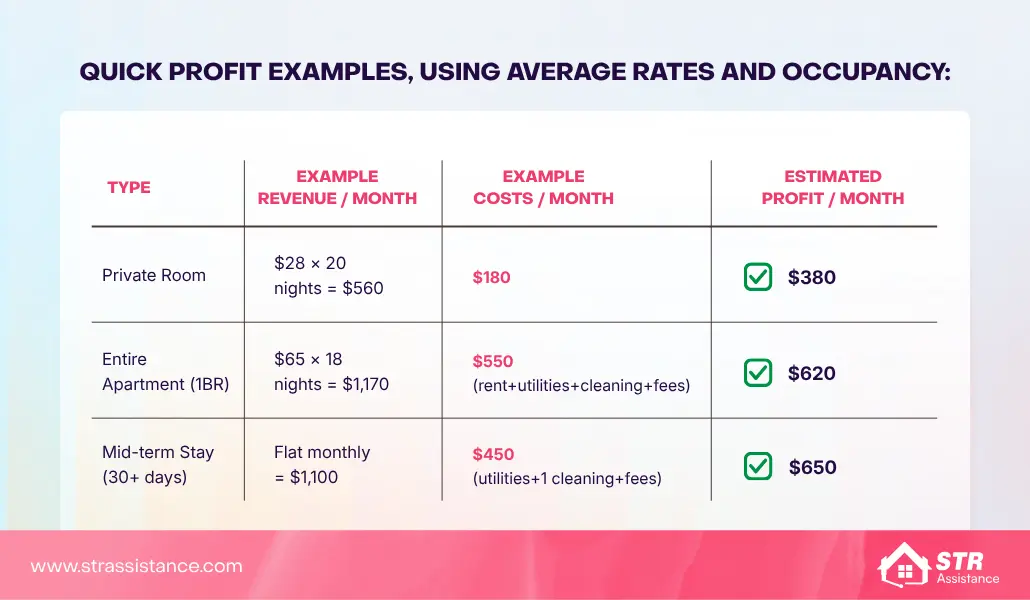
Step 3: Check the Numbers (This Is Non-Negotiable)
If the numbers don’t work, the business doesn’t work.
A lot of beginners get excited about the idea of Airbnb and forget one thing: Airbnb is a business, not a vibe. If your income can’t cover your costs consistently, you’ll end up stressed, losing money, or shutting it down.
You need to understand:
- Average nightly rate
- Average occupancy
Seasonality - Cleaning costs
- Utilities, Wi-Fi, or
- insurance
- Platform fees
- Furnishing budget (if needed)
A simple way to think about it: Revenue (per month) – Expenses (per month) = Profit (or pain).
And don’t use “best case” numbers. Use realistic numbers, and then stress-test it:
- What if occupancy drops 20%?
- What if you need to reduce your price to compete?
- What if a major repair hits?
Step 4: Set Up Your Business Basics (So You’re Not Winging It)
This part might feel boring, but it will save you a lot of stress later. Before you take your first booking, make sure you have the basics in place:
- A separate business bank account (so Airbnb income and business spending stay organized).
- A simple bookkeeping system (a spreadsheet is totally fine in the beginning).
- A clear way to track income and expenses every week or month.
If you mix Airbnb money with your personal spending, you’ll lose track of your profit, forget expenses, and tax time will become a headache. Keeping things separate from day one makes your business easier to manage and calculate real profit.
The same goes for your calendar. If you plan to list on more than one platform or take direct bookings, decide early how your calendars will connect. Understanding iCal vs API calendar sync before your listings go live helps you avoid double bookings from day one.
Step 5: Create Your Hosting “Standard”
Before you even get a property, you should know what kind of experience you are offering.
Are you going to offer a clean and affordable stay? Or the place would be cozy and aesthetic. Many hosts focus on family-friendly rental setups or go for luxury and premium stays.
If someone is in a location where people visit for business, the Airbnb should be more business travel-focused.
This matters because it affects the kind of furniture you buy, the amenities you provide, the photos you take, and the guest expectations (and reviews).
You’re not trying to appeal to everyone. You’re trying to attract the right guests consistently.
Step 6: Get Your Property Ready Like a Real Business
People don’t book Airbnbs because they want “a place.” They book because they want comfort, cleanliness, convenience, and something that looks better than a hotel. So think more about the systems, not vibes.
Airbnb Host checklist should include:
- Strong Wi-Fi (seriously)
- Good bedding (not cheap sheets)
- Enough towels and all other cleaning stuff.
- A fully stocked kitchen (basics, not clutter)
- A place to work (even a small desk)
- Easy check-in
And yes, you need safety basics too.
Step 7: Set Up Your Cleaning + Turnover Process (Don’t Wait Until Later)
If you don’t set this up properly from the beginning, you’ll burn out fast.
Because Airbnb isn’t just “hosting.” Its operations: cleaning, resetting, checking, and repeating again and again.
That’s why you need a turnover system that is:
- Consistent (same quality every time): Every guest should walk into a place that feels clean and ready, no matter who cleaned it or how busy you were.
- Easy to repeat (no guessing, no stress): Your cleaning process should be the same steps in the same order each time. No thinking, no missing items, no rushing at the end. When it’s repeatable, turnovers become fast and smooth.
- Easy to inspect (quick to confirm it’s done): You should be able to check the room in 2–5 minutes and know everything is perfect. Bed made, bathroom clean, trash removed, supplies refilled. This helps you catch mistakes before guests do.
- Easy to scale (someone else can do it later): Your system should work even when you’re not there. If you hire an Airbnb co-host or cleaner, they should be able to follow your checklist.
Even if you clean the room yourself at first, create a simple cleaning checklist so the process runs smoothly and doesn’t depend on your memory or mood. This way, when you eventually hire help. They can do the job properly without needing you to explain everything every time.
And if you can afford to hire a cleaner early, do it. Your time and energy are worth more than you realize.
Step 8: Get Your Pricing Strategy Right From Day One
Most beginners mess up pricing in one of two ways: They price too high and get no bookings. Or they price too low and attract difficult guests.
Your goal isn’t to be the cheapest. Your goal is to be competitive in your market so you get steady bookings and good guests.
Start by comparing your place with listings that are truly similar, including:
- nearby listings in the same area
- similar bedroom count and overall style
- similar amenities (Wi-Fi, AC, kitchen, balcony, parking, etc.)
- similar review count (new listing vs. well-established host)
If you’re brand new, use this simple approach:
Price slightly lower than similar listings to get traction, focus on earning your first 5–10 good reviews quickly, and then increase your price gradually as your listing becomes trusted.
Remember: reviews are part of your Airbnb marketing.
In the beginning, strong reviews are more valuable than maximum profit, because once people trust you, bookings become easier, and you can charge more.
Step 9: Create a Listing That Looks Like a Real Brand
Unoptimized and improper listing is where most hosts lose money, without even realizing it.
Because on Airbnb, your listing is your storefront. And if it doesn’t look trustworthy and descriptive with all the necessary information at first glance, people won’t click. It won’t matter how good your price is.
A high-converting listing needs:
- Strong photos (natural light, wide angles, clean styling).
- A title that sells the best feature (not generic words).
- A clear, reassuring description that feels easy and safe.
- Simple house rules (so guests know what to expect).
- Amenities that match your target guest (not random extras).
Here’s the rule: If your photos don’t stop the scroll, your price won’t save you.
So treat your photos like the sales page of your business, because that’s exactly what they are. Once your listing is performing, you can take the same branding further by choosing a website builder for your rental business and launching your own booking site. Read more details guide about airbnb listing management.
Step 10: Hit Publish and Have a Plan for the First 30 Days
We know that this is new for you; someone is saying hit the publish button and then have a 30-day plan, but surely, something that every expert in the rental industry should mention.
Hosts publish their listing and think, “Okay, now we wait.” But that’s not how momentum works.
Your first 30 days are when you build traction, collect feedback, and set the standard for future bookings.
Your goals in the first month should be in a checklist:
- Get consistent bookings.
- Earn 5-star reviews.
- Fix anything guests mention or complain about.
- Improve your messaging + check-in process.
- Update your listing based on the questions guests keep asking.
The golden rule and your main goal should be to respond fast. Because you are starting new, but you already have established competitors in the market. If you make your guest wait, they will end up going to other listings.
Here, what we recommed to most is having an Airbnb virtual assistant for guest communication. These professionals have the expertise in handling guests and never let them go to other listings with their convincing skills. In STR Assistance, our VAs for Airbnb have been doing this for years with a 1-minute response time rate.
Fast replies build trust, improve your chances of getting booked, and help you stand out as a new host.
Final Thoughts: Don’t overcomplicate it
If you follow these 10 steps, you won’t be “trying Airbnb.” You’re building an Airbnb business.
- Choose your Airbnb business model
- Pick a profitable location (based on demand + rules).
- Run the numbers (income vs expenses).
- Set up business basics (bank + tracking system).
- Define your hosting standard (the experience you offer).
- Prepare the property like a real business.
- Create a cleaning + turnover system.
- Set a smart pricing strategy from day one.
- Build a listing that looks like a professional brand.
- Publish + execute a strong 30-day launch plan.
And that mindset shift is everything. Because when you treat it like a business, you create systems. When you create systems, you become consistent. And when you become consistent, you can scale. When you’re ready to grow beyond Airbnb, you can design your vacation rental website to turn the brand you’ve built into direct bookings.