The career choice of becoming an Airbnb co-host is lucrative because of the flexibility, the option to work remotely also, and the attractive earning opportunities. However, most individuals are clueless about how to start.
The first step is to understand the role of a co-host clearly and in depth. Educate yourself about the short-term rental industry, learn why guests are the top priority, and understand how everything works together.
Many people start without proper knowledge and immediately pitch to hosts to get their first client. This is a big mistake, as they are not clear about their job responsibilities.
The next step is to start by helping people around you. This helps you build a portfolio and allows you to join the hosting community, where you can expand your reach and grow.
Hi, I am Nujhat. If I were to start again, I would begin with an agency to gain hands-on experience, where learning would be faster, and career growth would be quicker. STR Assistance helped me a lot, and I don’t want you to struggle the way I did.
So, if you want to start your career as an Airbnb co-host, follow the steps I’m sharing from my real-life experience, and see where I am today.
What Is an Airbnb Co-Host?
An Airbnb co-host helps the host with the property management tasks from guest communication, listing management, cleaner co-ordination and everything, but can not fully access the Airbnb account.
The host invites the co-host to the Airbnb account, sets specific permissions, which may be full or partial access depending on how much help the host needs. So, the core difference between an Airbnb host and a co-host is the control and access to the listing and the account.
As an Airbnb co-host, I’m basically the person who helps run the home like it’s my own, even if I don’t own it. I handle the day-to-day things that make the listing feel smooth for guests and stress-free for the host.
I reply to messages, coordinate check-ins, solve problems fast (like when a guest can’t find the lockbox at 11 pm), and make sure the place stays guest-ready. I’m the one paying attention to the small details behind the scenes so the reviews stay strong and the host doesn’t feel tied to the property 24/7.
Airbnb says, “A co-host can help you do things like manage your listing, respond to inquiries, or message booked guests, so you can focus on other things.”
However, besides these daily tasks, an Airbnb co-host works for the growth of the rental business and helps to generate more revenue.
Those co-hosts who can handle 5-10 listings can boost occupancy by 25-40%. The whole process of rental management becomes smoother and more efficient through time management.
Also, physical presence is not mandatory to handle the role, which is making co-hosting more popular as a profession among individuals.
How Airbnb Co-Hosting Works?
Airbnb hosts give partial or full administrative access via their own account to the co-host. This depends on the responsibility of the co-host. In return, the co-host is compensated with 10–30% of the nightly rate or a fixed fee per stay.
Airbnb Co-Host Access & Permissions
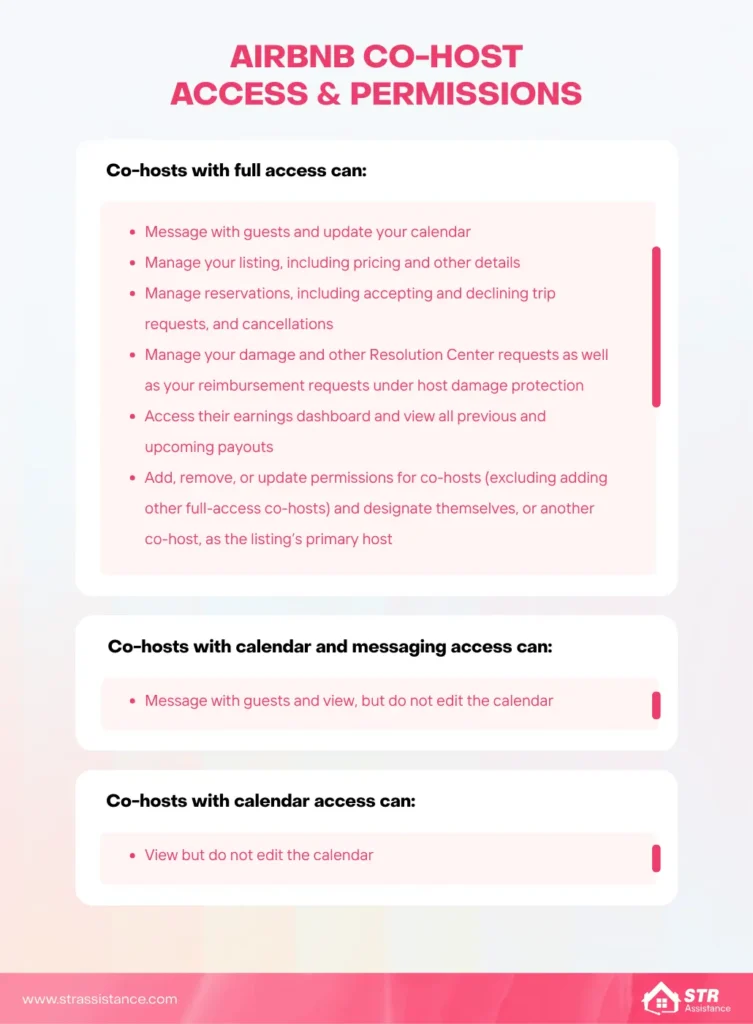
Hosts can invite co-hosts and assign specific permissions, like messaging guests, managing calendars, updating listings, or coordinating cleaning and maintenance.
Co-hosts with full access can:
- Message with guests and update your calendar
- Manage your listing, including pricing and other details
- Manage reservations, including accepting and declining trip requests, and cancellations
- Manage your damage and other Resolution Center requests as well as your reimbursement requests under host damage protection
- Access their earnings dashboard and view all previous and upcoming payouts
- Add, remove, or update permissions for co-hosts (excluding adding other full-access co-hosts) and designate themselves, or another co-host, as the listing’s primary host
Co-hosts with calendar and messaging access can:
➔ Message with guests and view, but do not edit the calendar
Co-hosts with calendar access can:
➔ View but do not edit the calendar
How Hosts and Co-Hosts Work Together?
Hosts and co-hosts collaborate by dividing responsibilities. They communicate regularly and work as a team for successful listing management.
The host and co-hosts on the same listing can communicate through Airbnb’s messaging system, regardless of permission level. They can send one-to-one messages, including photo and video attachments up to 60 seconds long.
Airbnb also provides a Co-host messages filter in the Messages tab. This way, it helps separate co-host conversations from guest messages for faster and clearer communication.
In real-life operations, most hosts prefer WhatsApp or Telegram for quick updates. Also, these apps are easy for daily task management, such as cleaner coordination, urgent issues, and voice notes.
Many hosts also rely on shared documents like Google Sheets or Notion to track guest schedules, cleaning checklists, inventory restocking, and maintenance logs.
Airbnb Co-Host Responsibilities (What You Actually Do)
An Airbnb co-host can handle the entire property management responsibilities if the Airbnb host and the co-host agree on the terms. Otherwise, co-hosts can work part time basis, or on specific tasks such as only communicating with the guests, or calendar management.
Here are some core responsibilities that, as a co-host, I have been handling for years.
Guest Communication & Support
The main and core responsibility of an Airbnb co-host is communicating with guests, solving their queries, checking on their stay, and making them feel supported, all with the intention of getting good feedback. This is where professional Airbnb guest communication services play an important role in maintaining consistency and quality across every interaction.
However, in 2026, many co-hosts are adopting more technology and AI to give guests faster and better responses. They integrate multilingual AI chatbots customized for local dialects, which reduces response time by 40%. They also use sentiment analysis tools on guest inquiries, turning potential complaints into upsell opportunities like late check-outs for 20% extra revenue.
Calendar & Booking Management
Most hosts hire an Airbnb co-host for an organized and updated calendar and an efficient booking management process because guest satisfaction mostly depends on this. If a guest ever falls into a double-booking situation, the chances are zero that they would come back.
Here, you have to stay super active with calendar availability updates. We use smart software to adjust prices and room availability based on demand, events, and competitors.
Pricing Optimization
Dynamic Pricing optimization can increase revenue or ruin the rental business if not done properly. For this, you need to do a lot of research and understand country-specific calendars, culture, and other factors.
We check the location of the property, demand, tourist visits, traffic patterns, weekdays versus weekends, and whether there is anything interesting nearby. We also consider the type of property, whether it is luxurious or simple.
Apart from this, we stay alert for occasions, festivals, times of the year, and seasons, and change pricing to generate the best revenue. Sometimes we lower the rate or increase it, depending on all these factors.
The trick is to study the calendar of each country where the host’s property is located, as this helps you understand demand patterns.
Cleaning & Maintenance Coordination
The host expects smooth coordination between guest turnover and cleaners. To maintain this process, you must have a list of trustworthy local cleaners, as effective Airbnb cleaning management is essential to keep operations running without delays.
There are many communities where you can ask for referrals from the neighborhood. Each time a guest leaves the property, the cleaner should arrive on time so the next guest finds the place clean and all amenities in place.
You can maintain a calendar and a sheet with the contact numbers of cleaners. It is also recommended to keep backup cleaner contacts in case of emergencies.
Reviews & Reputation Management
Review management does not only mean replying to positive reviews. You also need to handle negative reviews and guest objections. Some guests may leave false feedback that can harm the listing’s performance, and in such cases, you must respond proactively.
When you handle guests’ negative concerns properly, it increases the chances of repeat bookings. Guests start seeing you as a problem solver, which leads to a strong reputation for the Airbnb listing and helps achieve Superhost status.
But this is tough, and at STR Assistance, our short-term rental virtual assistant, especially our review removal experts, have been providing this Airbnb review removal service for years with an 80% success rate. We know the review removal policies, and based on that, we ethically help hosts remove negative reviews.
Airbnb Dispute Management
The new co-hosts most of the time do not have proper knowledge of how to handle dispute management. Because of this, they may fail to communicate with the guest through Airbnb messaging, which is very important for maintaining documented proof. Co-hosts who are able to win claims have much higher value. In fact, winning claims should be emphasized more, because the main and most important part of dispute management is successfully winning the claim.
Here are some points that you will need to handle such situations,
- Respond fast & stay calm (no emotions, keep it professional)
- Keep everything inside Airbnb chat (proof + protection)
- Collect evidence (photos, videos, receipts, timestamps)
- Clarify the issue clearly (what happened + when + impact)
- Offer a fair solution (refund/partial refund/repair/rebooking)
- Use the Resolution Center (request or send money officially)
- Follow Airbnb policies (damage, cancellations, house rules)
- Escalate to Airbnb Support if no agreement (open a case)
- Document every step (screenshots, invoices, cleaning costs)
- Prevent repeats (update rules, check-in notes, deposits, messaging templates)
What an Airbnb Co-Host Is Not Allowed to Do?
There are some restrictions for the co-host as they are not allowed to manage financial, tax, or legal aspects of a listing. The co-host does not have permission to change payout methods, access tax documents, or handle Resolution Center insurance/damage claims.
When working as a co-host, you cannot view the primary host’s personal travel itineraries, nor can they use Airbnb’s branding or intellectual property in unauthorized marketing.
These limitations are carefully incorporated to Airbnb platform and set specific restrictions of the host stay in full control of the listing and important financial decisions. But co-hosts can support the daily administrative operations.
- Payout method or taxpayer limitations: Only listing owners can set up or edit a co-host’s payouts. This means that co-hosts can’t view or change a listing owner’s or other co-host’s payout method or taxpayer info.
- Platform Access Limits: Airbnb co-hosts have restricted access to certain account and listing functions. They cannot manage insurance claims or submit damage requests through the Resolution Center.
In addition, co-hosts may be unable to edit critical listing details, such as the title, description, photos, pricing, or availability, unless the host has granted the necessary permissions and access level.
Intellectual Property: Co-hosts are forbidden from using Airbnb’s logos, names, or trademarks in their own business marketing, social media, or web domains.
Booking Restrictions: Co-hosts with limited permissions may not be able to accept or decline reservations, send booking requests, or invite guests on their own. Even when a co-host has full access, major listing or booking decisions need host oversight.
Policy Violations: Co-hosts must follow Airbnb’s hosting rules and community standards. They must not:
- Accept off-platform payments or make private deals outside Airbnb
- Discriminate against guests or treat guests unfairly
- Misrepresent the listing or provide misleading information
- Misuse of guest personal data or sharing private information
- Participate in or allow illegal activity, including unauthorized parties or prohibited services
What Skills You Need to Become an Airbnb Co-Host
To start the journey as an Airbnb co-host, first get familiar with the Airbnb platform, understand how everything works, and learn about the rental industry. Most importantly, you must be able to communicate very well with guests, have local knowledge, organizational abilities for booking, quick problem-solving, and be highly active in supporting the host.
- Communication skills: You need to clearly and politely communicate with guests and property owners.
- Airbnb platform knowledge: You should understand how to use Airbnb for messaging, bookings, and listings.
- Problem-solving mindset: You must be able to handle issues quickly and find practical solutions.
- Basic pricing and calendar logic: You should know how to adjust prices and manage availability.
- Time management: You need to stay organized and respond on time to tasks and messages.
- Customer service: You should create a positive experience so guests feel welcomed and supported.
- Maintenance coordination: You must arrange repairs and cleaning when problems come up.
- Optional tools knowledge: Try to learn the use of some Airbnb tools, PMS software, messaging automation, and Google Sheets / Notion
Do You Need Experience to Become an Airbnb Co-Host?
To start the co-hosting journey, you do not need previous experience strictly. Beginners can start by managing properties for friends, family, or local owners to build experience, skills, and trust.
You can become a co-host for Airbnb without owning property by first starting rental arbitrage, becoming a virtual assistant, offering marketing services, or setting up automation and tech systems for hosts.
Key Steps to Start Co-Hosting Without Property:
- Build Your Profile & Skills
- Find Property Owners
- Define Your Services
This way, you can get a good experience and build a good experience. To start as an Airbnb co-host, it is important to join Airbnb’s official Co-Host Network, and there are some requirements.
To be listed in Airbnb’s database for finding new clients, you must have an active listing, a 4.8+ average rating, a cancellation rate under 3%, and 10+ stays in the past 12 months, according to Airbnb. These requirements can be challenging for beginners, which is why many start their journey as an Airbnb virtual assistant to gain experience before reaching this stage.
Once you gain experience, you can join the Airbnb co-host network.
How to Become an Airbnb Co-Host (Step-by-Step)
There is no alternative to educating yourself about the Airbnb platform, understanding guests, their behavior, actively participating in host forums, and honing your communication skills, if you want to become an Airbnb co-host.
When I started, I was completely clueless about what to do. But you’re lucky, you’re getting a clear roadmap. My journey became much easier when I joined STR Assistance, where I gained real-life experience working directly with
hosts.
You can get the same opportunity. Move forward to learn more.
Step 1 – Learn Airbnb Hosting Basics
Learn the basics first, such as how the platform works with hands-on experience, understanding the local rules, the platform policies, and what hosts usually need support with.
Most important is that you understand the guest journey. From the moment they find the listing to the time they check out and leave a review. It includes booking, pre-check-in communication, arrival, stay, check-out, and post-stay follow-up.
How can you give the best experience to the guest? You can check the YouTube videos where hosts share their experience, and specific scenarios of how they handle guests, or everything about Airbnb. This is a free, but very useful resource.
Step 2 – Choose Your Co-Hosting Model
Once you’re done educating yourself, it’s time to choose which type of co-host service you want to provide.
Are you going to provide service in your area, where you can be physically present? Then you can become a local co-host.
If you want to work with international hosts or far from where you live, then the best option would be a remote co-hosting service or a virtual co-host. But for this, you will need reliable internet support, good devices, all the software installed, and a dedicated place to work.
Step 3 – Decide Your Services
You do not need support with every task of the host. You can choose whether you want to give full co-hosting service, part-time, or task-specific.
There are many people who give full-time Airbnb guest communication service only and are earning quite well.
But if you want to make a career by becoming a co-host, you should choose part-time or full-time.
In full-time service for Airbnb, you have to support everything from guest communication, pricing optimization, vendor and cleaner coordination, review management, dispute management, and everything.
Step 4 – Set Your Pricing Structure
Co-host pricing structure is often percentage-based; that is, you get to charge a percentage of the revenue. Or there can be a fixed monthly income. Other types of co-hosts charge a fee per booking.
Here are both the advantages and disadvantages of each type of pricing structure.
Percentage-Based
- Pros: Grows as the host’s revenue grows; motivates better performance.
- Cons: Income can be unstable; depends heavily on booking volume.
Fixed Monthly Fee
- Pros: Predictable income; easy for hosts to budget.
- Cons: Extra work isn’t always paid; less incentive during busy months.
Per-Booking Fee
- Pros: Simple and fair per reservation; good for low-volume listings.
- Cons: Earnings drop in slow seasons; not ideal for long stays.
Hourly Basis
- Pros: Paid for exact time worked; flexible for small tasks.
- Cons: Hard to scale; income capped by hours worked.
Step 5 – Find Your First Airbnb Co-Host Client
There are a few ways you can get your first client as a co-host. Joining the Airbnb Co-Host Network is one option, but there are certain criteria you must meet before you can join. One requirement is having a 4.8 rating. This is suitable for those with some experience, but not ideal for beginners.
Freelancing platforms like Fiverr and LinkedIn are also very helpful, as I got my first client from Fiverr through a Gig. On Fiverr, you need to create a gig and stay active until you land a client. Maybe this will prove lucky for you, too, as for me! You can explore other job-hunting platforms as well.
Or, for beginners, you can directly reach out to hosts via email, WhatsApp, or other platforms. Send a polite message and explain how you can help them by clearly mentioning your services.
There are also Facebook and Reddit groups for hosts and co-hosts where you can join, share your insights, and talk about your services. Stay active by regularly commenting and connecting with others.
Popular Facebook Groups for Airbnb Hosts and Co-Hosts
Recommended Reddit Subreddits
If you want to start instantly and work in an environment where other co-hosts and virtual assistants are already supporting hosts every day, you can join STR Assistance. We have a team of virtual Airbnb assistants and co-hosts with years of experience who can also help you start your journey.
How Much Airbnb Co-Host Income?
Airbnb co-hosts earn between 10% and 30% of the total booking revenue. 20% being a common average. Earnings depend on the service level: lower percentages (10-20%) cover listing management and guest communication. For higher rates (20-30%+), include cleaning, turnover, and 24/7 guest support.
- Basic (Remote) Co-hosting: 10%–20% of the booking income.
- Full Service (On-site) Co-hosting: 20%–30% of the booking income.
Airbnb Co-Host vs Airbnb Virtual Assistant Vs Virtual Airbnb Co-Host
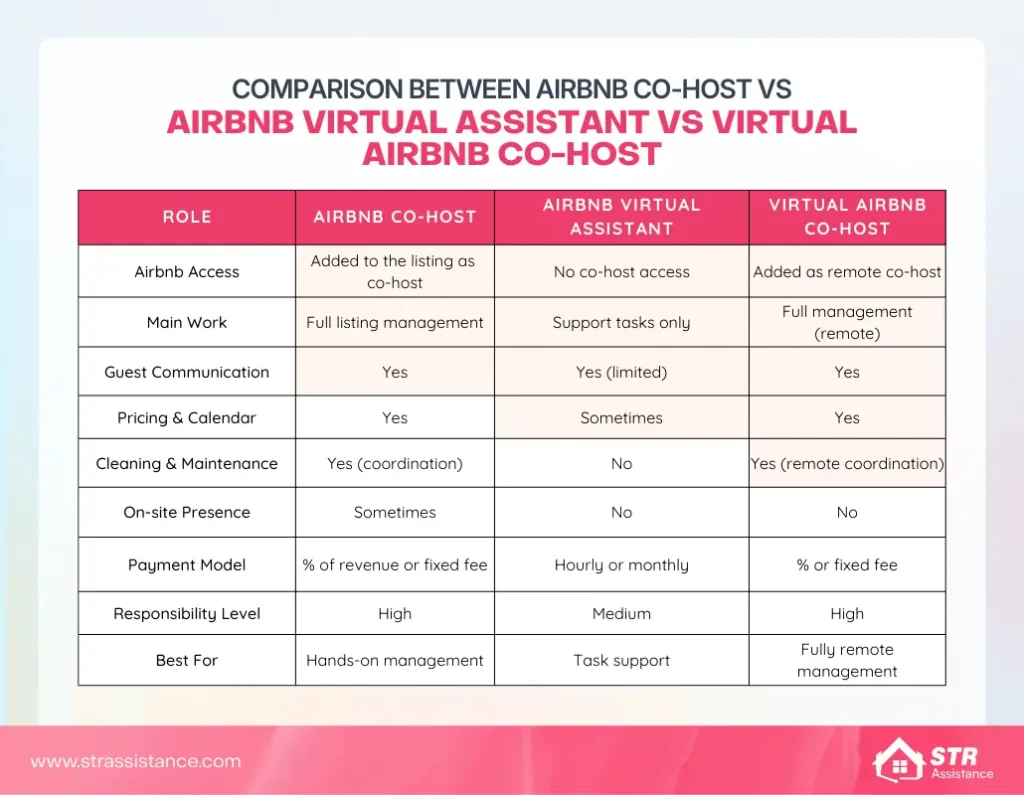
An Airbnb Co-Host usually works locally and takes care of hands-on tasks like cleaning, coordination, and guest support. An Airbnb Virtual Assistant (VA) works fully remotely and focuses on online tasks such as guest messaging, bookings, review management, and pricing updates. A Virtual Airbnb Co-Host sits in between, managing the listing remotely while handling communication and overall operations without being physically present.
Can You Become a Remote Airbnb Co-Host?
Yes, becoming a remote Airbnb co-host is possible and a popular, low-barrier way to enter the short-term rental industry without owning property.
Here’s a basic remote Airbnb co-host workflow:
- Booking Confirmed – Receive the booking and check the calendar to avoid double bookings.
- Pre-Check-in Communication – Send automated welcome messages, house rules, and check-in details.
- Calendar & Pricing Update – Update availability and adjust pricing based on demand.
- Cleaning Coordination – Inform cleaners about check-out and next check-in times.
- Guest Support During Stay – Respond to guest messages and handle issues remotely.
- Check-out Follow-up – Confirm check-out and ensure cleaning is done on time.
- Review Management – Request reviews and reply to guest feedback.
- Reporting to Host – Share regular updates on bookings, revenue, and issues.
Final Thoughts – Is Airbnb Co-Hosting Worth It?
Airbnb co-hosting has become very popular, and virtual co-hosting is gaining even more attention as a strong career option. The pathway is simple, but it requires consistency, dedication, and strong willpower.
Start by educating yourself about the platform: how co-hosting works, what the limitations are, what skills are needed, and how you can adapt to handle ongoing responsibilities.
The best approach is to start as a virtual assistant, help family or friends with small tasks, and build your experience. If everything goes well, take the next step; by then, you’ll have a solid portfolio to join the co-host network.
Once you reach that stage, the possibilities grow, and you won’t need to look back and can work as a successful co-host.
Is the effort worth it?
Airbnb co-hosting is worth it, acting as a “game-changer” for individuals seeking flexible income without owning property. Co-hosts manage guest communication, cleaning, and listings for 10-25% of the revenue. Isn’t it a good career choice?