Airbnb needs government ID verification in many countries and runs limited background checks in the U.S. Whereas Vrbo’s identity verification is optional, and they focus more on guest history, reviews, and anti-party screening signals. Booking.com relies mainly on email, credit card verification, and AI fraud detection.
Comparing the top three rental platforms, Airbnb’s is somewhat stronger, but none of these platforms provides full protection on their own.
Today, we’ll be comparing the guest screening processes of Airbnb, Vrbo, and Booking.com, looking at how each platform provides security, where their strengths are, and where the gaps are. After the discussion, we will show how hosts can build their own manual screening process. And how our team supports hosts with expert guest screening to keep their rental business safe and secure.
Need Manual Guest Screening?
Protect your property from risks with streamlined screening, using both manual checks and automated tools for reliable bookings.
Airbnb Guest Screening
Airbnb guest screening means checking who your guests are before you accept their booking. This is a process for hosts to feel safe, protect their property, and avoid trouble during a stay.
Also, Airbnb is the only platform they do a criminal background check, though it is limited to the US and India.
There are 4 steps in the Airbnb guest background check:
Guest identity verification → Criminal background check (US) → Look for suspicious activity → Notifying the guests. Here is the details breakdown:
1. Identity Verification: For the background check, Airbnb asks guests to provide some personal information to confirm the guest’s legal identity and contact them. Information includes,
- Government-issued photo ID
- Email address
- Phone number
- Profile details
- Booking history
2. Profile Completion: Before booking any property on Airbnb, guests need to complete their Airbnb profile.
Guests upload a clear profile photo and a personal bio that introduces the guest. Airbnb hides guest photos until after a booking is confirmed to help reduce discrimination.
Note for hosts: While hosts can only see the profile photo once a booking is confirmed. Guests do not need to upload a photo to submit a booking request.
3. Background Check (Limited Scope): Does Airbnb do Background Checks?Yes, Airbnb does background checks, but how deep they go really depends on where guests are booking from. These searches usually go back about seven years.
Everyone using the platform, whether hosts or guests, Airbnb screens against the U.S. Treasury’s OFAC sanctions list. This is a government watchlist for terrorism and serious financial crimes. In the United States, Airbnb also checks state and county criminal records as well as state and national sex offender registries.
4. Predictive Risk Analysis: Airbnb doesn’t just stop at background checks; they also use intelligent algorithms to spot bookings that look risky before they even happen.
Also, Airbnb rolled out what it calls “anti-party technology.” After making its global party ban permanent in 2022, the system automatically blocks certain high-risk
individuals. For example, a 22-year-old local with no reviews is trying to book a giant house for one night.
In 2023, only 0.035% of bookings worldwide ended up turning into reported parties.
5. Decision & Notification: If a guest fails Airbnb’s screening, their booking may be automatically cancelled. Also, the guest is notified that Airbnb doesn’t share detailed reasons. Hosts only see that the booking was cancelled “for safety reasons.” Airbnb keeps background reports and sensitive guest data.
If a guest gets denied because of a background check, they’re not totally out of options. There’s an appeal process. If it turns out the report was inaccurate, Airbnb may reinstate the account.
Limitations of Airbnb Guest Screening
Here are the limitations Airbnb has for background checks for guests:
Airbnb’s background checks aren’t the same everywhere. Except for the U.S. and India, other countries just don’t have the same legal access or database systems available.
Another thing to know is that screenings usually happen after a booking is made. This is about 10 days before check-in, instead of right up front.
And finally, Airbnb mainly relies on names and dates of birth. It can sometimes miss things or flag the wrong person.
Strengths & Unique features
- Mandatory ID verification in select countries.
- Hosts can require guest account verification before booking.
- Access to host and guest reviews encourages accountability.
- Airbnb offers some control filters to hosts on who can book their listing.
- The platform’s global scale allows social proof from past stays.
Vrbo Guest Screening

First, Vrbo asks guests to provide identity information, but if they choose not to, they can still book a property without completing those details.
1. Request for Identity Verification: Vrbo first asks guests to confirm their identity, but it’s usually optional. Guests may be asked during account setup, before booking, or if a host requests it for extra security.
In most countries, an ID is not mandatory to book. But Spain makes it mandatory by law, and in Italy, hosts can ask for it.
Vrbo’s guest verification usually checks basic details like name, address, and date of birth (DOB).
2. Vrbo Background check: Vrbo doesn’t do regular criminal background checks. Instead, it focuses on identity details and trust signals like booking history and reviews.
Unlike Airbnb in the U.S., it does not run deep criminal screenings. At times, Vrbo may ask for a quick selfie to confirm the photo on an ID matches the person making the booking.
To prevent risky stays or parties, Vrbo also uses Cross-reference anti-party policy and reservation-screening technology. It looks at things like group size, when the booking was made, and how long the stay is. If something seems high-risk, the system alerts the host. Vrbo itself usually won’t cancel automatically.
3. “Identity Verified” Badge: Vrbo also checks a guest’s booking history, reviews from other hosts, and whether their profile is complete with details like a photo and bio.
When a guest passes verification, Vrbo adds an “Identity Verified” badge to their profile. This means Vrbo has matched key details, but hosts never see the actual documents. Guest email and phone number are shared only after a booking is accepted. Hosts do not need guests to complete verification before sending a request.
Note: Security hygiene for accounts. A quick note that Vrbo supports two-factor authentication for host/guest accounts (protects access and messages).
Limitations of Airbnb Guest Screening
Here are the limitations Vrbo has for background checks for guests:
- Vrbo’s screening is very limited. It doesn’t run detailed criminal checks, check sex offender lists, or catch fake IDs.
- Guests can even skip ID verification and still book instantly, which reduces your control.
- For international guests, Vrbo has very little data, and privacy laws in different places limit what information the platform can verify.
Unique features
- The Verification Badge signals verified identity for guests who opt in.
- More flexibility for hosts to perform their screening.
- Focus on traditional vacation home rentals vs. Airbnb’s shared space options.
Booking.com Guest Screening
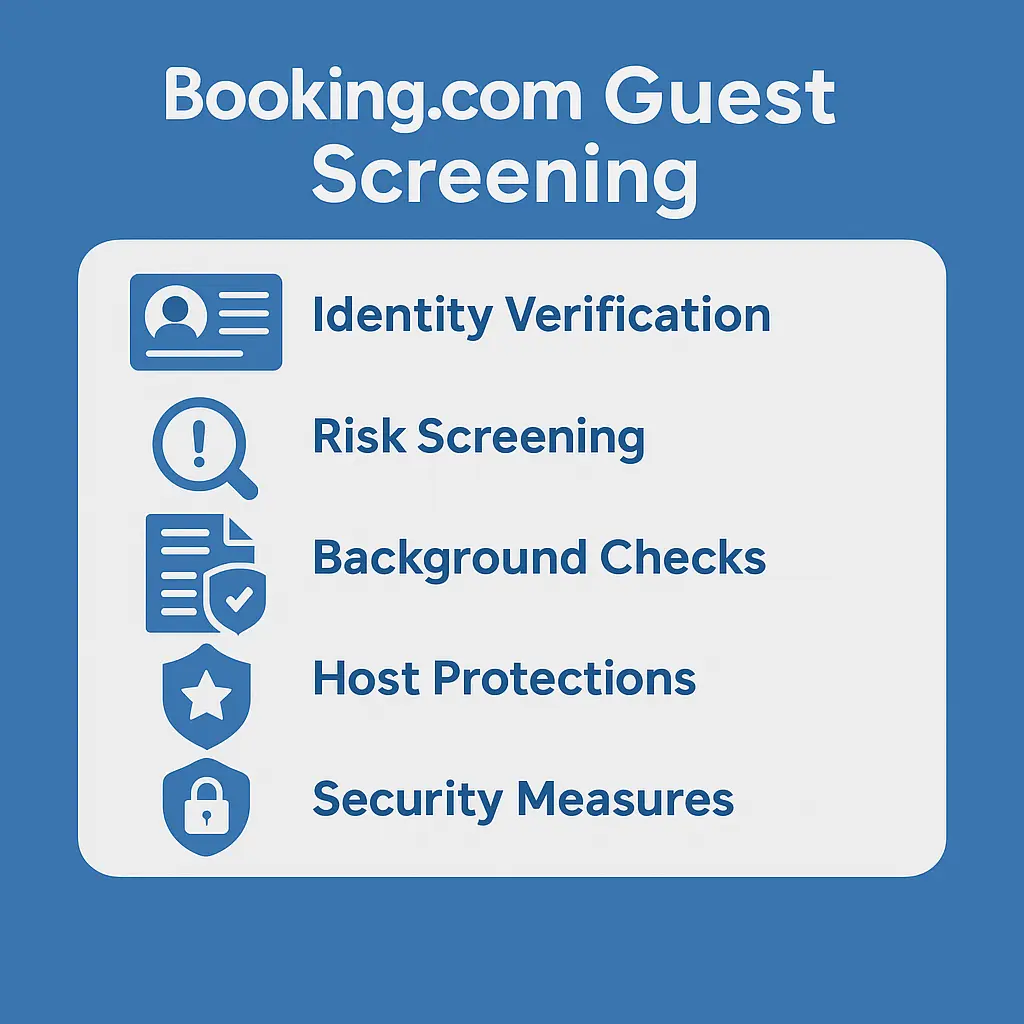
Booking.com’s guest screening is different from Airbnb and Vrbo. They focus more on payment security, trust signals, and AI-driven fraud detection.
1. Identity Verification: When signing up or booking, guests are required to provide basic details. Booking.com verifies identity mainly through.
Unlike Airbnb, Booking.com does not require a government-issued ID for every guest. Instead, they rely on financial and account data to confirm legitimacy.
2. Risk Screening: Booking.com uses AI and machine learning models to monitor and analyze guest behavior in real time. Their system looks for unusual booking patterns, suspicious messages, or mismatched payment details.
Additionally, all users are screened against global sanctions lists (like OFAC and other watchlists) to block high-risk individuals.
3. Booking.com Background Checks (Limited Scope): Booking.com does not conduct traditional criminal background checks or search sex offender registries. There is no seven-year record search like Airbnb does in the U.S. Instead, their focus remains on fraud prevention and payment legitimacy.
4. Host Protections: Since guest verification is lighter, Booking.com gives hosts control tools and safeguards, such as:
- Insurance coverage and liability protection (through its partner programs)
- In-app messaging system to track communications
Ability for hosts to set house rules - Option to block problematic guests from booking again
5. Security Measures: For account safety, Booking.com offers two-factor authentication for hosts. This protects access to bookings, payments, and guest communication.
Limitations of Booking.com Guest Screening
- No government ID checks required for every booking.
- No criminal background or sex offender database searches.
- Relies heavily on payment verification and booking history, which can miss risks unrelated to fraud.
- Hosts cannot always require stricter verification before accepting reservations.
Strengths & Unique Features
- AI-driven fraud detection and real-time risk analysis.
- Screening against global sanctions watchlists.
- Strong payment verification and fraud prevention systems.
- Hosts can block past problematic guests.
- Encourages community reporting to build a safer ecosystem.
Airbnb vs Vrbo vs Booking.com: Which Platform Has the Best Guest Screening?
Airbnb does a thorough guest criminal record check and reviews for the U.S. and India, which is more secure than the other two platforms. But Airbnb should apply the criminal background check for other countries too, as Airbnb claims 275 million active users in 2024.
Vrbo does adapt the badge system to verify rental guests, but because it is not mandatory, there is a chance guests can cause unwanted incidents or have a criminal background.
Lastly, Booking.com has the least secure guest screening process, but the AI and ML model is a different approach compared to the other two platforms. If Booking.com can take this AI integration to a more effective level, then it can become one of the best booking platforms.
Feature | Airbnb | Vrbo | Booking.com |
Verification strength | Strong (ID + background checks in the U.S.) | Moderate (ID optional, no routine background checks) | Weak (minimal ID checks) |
Fraud prevention | Decent, but not perfect | Limited, weak on fake IDs | Strong on payments, weak on IDs |
Host control | Some filters (e.g, verified ID) | Flexible (host can request ID in some regions) | Very limited control |
Transparency | Reviews and profiles are visible | Reviews and “Identity Verified” badge | Weak guest info, little transparency |
Where All Three Platforms Fall Short?
Verification ID check, background checks, risk detection, and host control. With this combination, rental platforms can ensure a safe guest screening process. But unfortunately, none of the renowned rental booking platforms, Airbnb, Vrbo, and Booking.com, facilitate such a foolproof screening process.
Only the booker is screened: All of the platforms only check the person who makes the booking, but what about the whole group? There can be extra guests, or even party crashers who are not verified at all.
Checks happen just once: Most ID checks are done at signup or when booking. After that, there’s no re-check before arrival. In between, there is a gap where stolen accounts or fake details can slip through.
Payment doesn’t prove identity: Can the host confirm that the person paying and the person staying are the same? Prepaid and virtual cards make it even harder to connect the payment to the actual guest.
Easy to dodge bans: If someone is banned, it’s simple to create a new account with a fresh email or phone number. There’s no shared blocklist across platforms, so repeat offenders can keep slipping back in.
Weak account security: Account takeovers are risky. Two-factor authentication isn’t applied everywhere. Today, device checks are so basic that they won’t stop stolen logins from being abused.
No history for new users: New guests often have no reviews or track record. Still, platforms push them straight into “Instant Book,” leaving hosts with no context or reassurance.
Where All Three Platforms Fall Short?
Even though platforms have gaps in their screening systems, hosts can add more protection by doing their own checks. Check these few simple steps that can go a long way.
Tip 1: Set clear house rules: Many hosts do not have clear house rules, which can cause problems. List important rules upfront, like no parties, quiet hours, or a minimum age requirement. If the guest agrees to these rules before booking, the chance of having a problem becomes low. State your deposit policy clearly, along with how claims will be handled.
Tip 2: Use rental agreements: Ask guests to sign a rental agreement after booking. This can be a host lifesaver. Hosts, if preferred, agreements can be uploaded as a PDF and signed electronically. Thus, hosts get legal protection if something goes wrong.
Tip 3: Check guest profiles and communication: Look for a complete profile with a photo and bio. Pay attention to how guests write messages. Their tone, detail, and willingness to answer questions can be strong signals. Many hosts hire a virtual assistant to look for these tiny details.
Tip 4: Ask for trip details: A simple question like, “What brings you to town?” helps you spot red flags. Confirm the number of guests and the purpose of their stay to ensure it matches your house rules.
Tip 5: Do a light background check yourself: You don’t need to go overboard, but checking a guest’s name on Google, LinkedIn, or social media can give you basic information.
Tip 6: Leverage platform tools:Airbnb already provides built-in guest screening options such as ID verification, background checks (in select regions), and reservation filters. These features are a good first layer of protection. On top of that, you can use specialized guest screening tools like Superhog, Autohost, Safely, or Chekin.
How STR Assistance Helps Hosts with Guest Screening?
Need Manual Guest Screening?
Protect your property from risks with streamlined screening, using both manual checks and automated tools for reliable bookings.
We talked about how hosts can try to do manual guest screening. There are a lot of tiny details hosts need to include in their process, such as checking social media activity or setting clear house rules. Even asking basic questions and observing how guests respond can give you an idea of their behavior. But can you realistically do all of this on your own? STR Assistance can do it on your behalf.
We are a short-term rental virtual assistant company. We have dedicated virtual assistants for Airbnb and other short-term rental platforms.
Working with hosts, property owners, and partners, not just clients, we’ve seen the problems that come with unwanted guests. Situations can get worse if you’re unlucky with criminal guests. But our short-term rental virtual assistants, skilled and knowledgeable in rental rules and country-specific laws, have handled these situations effectively.
Plus, we offer more so you can stay stress-free:
- Custom guest vetting questions
- Rule communication & reminders
- Rental agreement enforcement
- Security deposit handling
Are you facing problems because of not having a proper guest screening process? Or do you want to protect yourself before anything happens?
Let’s talk and discuss first. Contact us.
Conclusion
It is clear that none of the platforms has a “perfect” guest screening system. Each has its strengths but also clear gaps.
- Airbnb offers the most structured process with ID verification, limited background checks, and predictive risk analysis. But its checks vary by country and still miss things.
- Vrbo is lighter on screening and focuses on optional identity verification and trust signals.
- Booking.com is strong on fraud detection and payment security, but very limited on identity verification or criminal checks.
For hosts, they can not fully depend on any rental platform. The best approach is to combine manual screening methods with the use of tools or to seek expert help.
STR Assistance provides expert guest screening as part of our STR VA services. We help hosts filter out risky guests and keep your short-term rental business safe.