- Key Takeaways
- Short-term stays offer four standard cancellation policies: Flexible, Moderate, Limited, and Firm, with full-refund deadlines of 24 hours, five days, 14 days, and 30 days before check-in, respectively.
- Eligible short-term bookings qualify for a 24-hour full-refund grace period after confirmation if the reservation was made at least seven days before check-in.
- Reservations of 28 consecutive nights or more follow Airbnb’s long-term cancellation policies, which have separate rules for Firm and Strict options.
- Cleaning fee refunds depend on the booking date and cancellation terms. For bookings made on or after April 21, 2025, cleaning fees follow the cancellation policy outside the free-cancellation period.
- Stricter cancellation policies do not guarantee revenue protection because covered reservation issues and qualifying Major Disruptive Events may override the standard terms.
- Airbnb may recover refunds from future host payouts if a host has already received payment for a reservation that is later refunded.
- Host cancellations can result in penalties of 10%, 25%, or 50% of the reservation amount, depending on the cancellation timing, with a minimum fee of US$50.
- Host cancellations may also lead to blocked calendar dates, loss of Superhost status, or other account consequences.
- Changes to cancellation policies apply only to new bookings, while pending requests and confirmed reservations retain their original cancellation terms.
Airbnb’s cancellation policy depends on the length of the stay and the tier system for both long-term and short-term stays, where hosts may receive compensation if they cancel without a valid reason, while guests may receive a full, 50%, or partial refund based on the cancellation policy tier selected by the host. Hosts also receive payouts according to the applicable policy.
An Airbnb study shows that hosts switching from Strict to Firm saw an average 9% increase in bookings. Meanwhile, almost two-thirds of active listings offered Flexible or Moderate cancellation policies.
Confused about which tier system is suitable for your listing? You are not alone, as hosts remain concerned because cancellation rates below 1% can impact Superhost status. Our experienced Airbnb VAs deal with hosts and help fix their cancellation policy setup. We have seen tons of cases where hosts lost their Superhost status because they could not stay compliant with Airbnb’s cancellation policy.
But do not worry. Today, we will break down the entire Airbnb cancellation policy for hosts, explain how the tier system works, explain how Airbnb compensates both guests and hosts under different terms, what happens when you or the guest cancels, and how you can set up the right policy for your listing. Lastly, if all of this seems confusing, we have your backup with our Airbnb virtual assistant, who can help you manage cancellation risks and set up the right policy.
Guest Cancellation Policy vs Host Cancellation Policy
Guest Cancellation Policy vs Host Cancellation Policy: the difference is who cancels. The guest cancellation policy has rules for the guest’s refund and the host’s retained payout. Airbnb’s Host Cancellation Policy sets the consequences when a host cancels a confirmed reservation.
Aspect | Guest cancellation policy | Host Cancellation Policy |
|---|---|---|
When it applies | The guest cancels a confirmed booking. | The host cancels a confirmed booking or is responsible for the cancellation. |
Who sets it | The host selects from Airbnb’s available policies. | Airbnb sets the rules; hosts cannot choose their own penalty terms. |
Short-stay options | Flexible, Moderate, Limited, and Firm, plus certain invitation-only options. | No selectable tiers; fees depend on cancellation timing. |
Long-stay treatment | Separate long-term Firm or Strict policies apply to stays of 28 nights or more. | For stays of 28 nights or more, the fee calculation uses the non-refundable portion at cancellation, limited to the following 30 days. |
Guest’s refund | Depends on the selected policy, cancellation timing, and applicable exceptions. | If the host cancels before check-in, the guest is entitled to a full refund. |
Host’s financial outcome | The host may retain some or all of the booking payment under the selected terms. | The host receives no payout for the cancelled reservation and may owe a separate cancellation fee. |
Host cancellation fees | Airbnb’s host-cancellation penalty does not apply to an ordinary guest-initiated cancellation. | Generally 10%, 25%, or 50% of the applicable reservation amount, depending on timing, with a US$50 minimum. |
Calendar impact | Cancelled dates normally reopen for replacement bookings. | Airbnb may block the cancelled dates. |
Exceptions | Covered reservation issues or Major Disruptive Events can override the selected terms. | Airbnb may waive fees or other consequences for documented valid reasons or qualifying Major Disruptive Events. |
Airbnb Guest Cancellation Policy
- General cancellation rule: Guests can cancel a reservation if their plans change. The refund amount is generally determined by the host’s cancellation policy for that specific reservation and can vary by listing.
- Free or full-refund cancellation: Some hosts choose a cancellation policy that allows guests to cancel for free. Guests must cancel before the deadline stated on your reservation to qualify. Cancellation deadlines are based on:
- The listing’s local check-in time, or
- 3:00 PM if no check-in time has been specified.
- Partial or no refund: Some listings are non-refundable or partially refundable after certain dates. The refund can never be more than the amount guests have already paid at the time you cancel. Airbnb allows you to check the refund amount before or after canceling.
- When the host’s cancellation policy may not apply: In certain rare situations, guests may qualify for a refund regardless of the reservation’s cancellation policy. These include:
Significant problem with the reservation, like the home, service, or experience is significantly different from what was advertised.
- For home reservations, this falls under Airbnb’s Rebooking and Refund Policy.
- For services and experiences, Airbnb has a separate Refund Policy for Services and Experiences.
Major Disruptive Event includes government travel restrictions or a declared public health emergency at the listing location.
- If there is a problem during the stay. Airbnb may also step in to assist, including potential support through AirCover for guests.
- If guests cancel after check-in, they are expected to leave the property immediately.
- Other services booked at the home: canceling the home reservation doesn’t automatically cancel those services. Guests need to cancel the services separately or make other arrangements with the service host.
- For long-term stays, like a reservation for 28 nights or more, Airbnb’s long-term cancellation policy applies.
Airbnb Cancellation Policy Tiers Explained
Airbnb has four standard cancellation policy tiers for short stays of fewer than 28 nights: Flexible, Moderate, Limited, and Firm. For long-term stays of 28 or more consecutive nights, Airbnb offers two cancellation policy tiers: Firm and Strict. All standard tiers, including Firm, include a 24-hour full-refund window after booking, provided the reservation was confirmed at least seven days before check-in. Here, there are additional invitation-only policies, and separate long-stay policies exist that we will be talking about later. Separately, when a host cancels, there are three penalty tiers: 10%, 25%, and 50%, depending on when the host cancels.
Note: Before you get confused, understand that Airbnb uses “Firm” as the name of two separate cancellation policies: one for short stays and one for long stays. The reservation’s length determines which applies. Firm short-term stays 27 nights or fewer. Firm long-term stays: 28 consecutive nights or more.
Short-Term Stay/Standard Policies (< 28 nights)
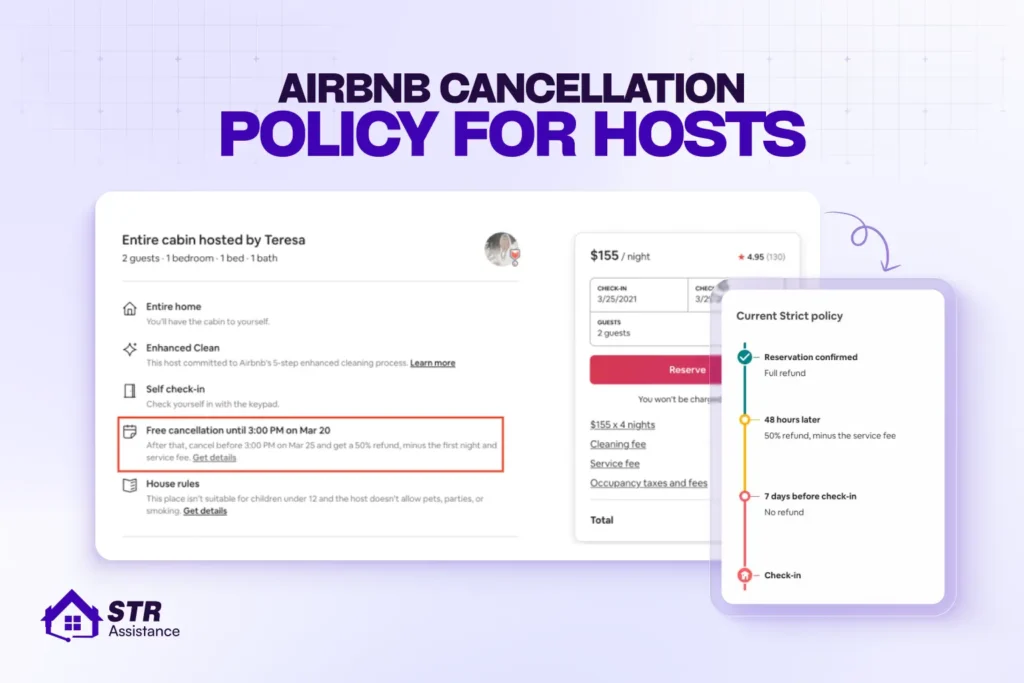
- Universal 24-Hour Grace Period: Full refund if cancelled within 24 hours of booking, provided you booked 7+ days before check-in.
- Flexible: Full refund up to 24 hours before check-in.
- Moderate: Full refund up to 5 days before check-in.
- Limited: Full refund up to 14 days before check-in; 50% refund between 7 and 14 days out.
- Firm: Full refund up to 30 days before check-in; 50% refund between 7 and 30 days out.
Long-Term Stay Policies (28+ nights)
- Firm (Default): Full refund if cancelled at least 30 days before check-in; within 30 days, the first 30 nights are non-refundable.
- Strict: Full refund only if cancelled within 48 hours of booking and at least 28 days before check-in.
Host cancellation fees depend on timing:
- More than 30 days before check-in: 10% of the reservation amount.
- More than 48 hours and up to 30 days before check-in: 25%.
- Within 48 hours of check-in or after check-in: 50% of the reservation amount for nights not stayed.
Let’s understand the tiers in more detail, because based on the criteria, you will be deciding which cancellation policy to set for your listing.

Flexible
With the flexible tier model, guests get a full refund if they cancel at least 24 hours before check-in, including tax. If the reservation is canceled later, the host is paid for nights already stayed plus one additional night; the remaining unused nights are refunded, and guests receive a refund of prorated taxes.
Moderate
In the moderate tier system, guests can get a full refund if they cancel at least five days before check-in. For later cancellation before arrival, the host receives payment for the first night plus 50% of the remaining nights.
When they cancel after check-in, the host receives payment for nights already stayed, one additional night, and 50% of the remaining unused nights.
Taxes are fully refunded for cancellation before arrival and proportionally refunded after check-in.
Firm
If the host chooses the Firm tier, then to get a full refund, guests have to cancel at least 30 days before check-in.
Between seven and 30 days before check-in, guests receive a 50% refund of the nightly accommodation charges, unless the eligible 24-hour grace period provides a full refund. Fewer than seven days before check-in means no refund of nightly accommodation charges; taxes are refunded.
After check-in, Airbnb states that no refund applies and the host receives payment for all nights.
Limited
This tier was introduced in the last update for the cancellation policy and applies to reservations booked on or after October 1, 2025.
The system provides a full refund to the guest when they cancel at least 14 days before check-in. Between seven and 14 days before check-in, a 50% refund of the nightly accommodation charges is provided, unless the eligible 24-hour grace period provides a full refund. Fewer than seven days before check-in, there will be no refund of nightly accommodation charges; taxes are refunded. After check-in, guests get no refund, and the host receives payment for all nights.
Here, many of our client hosts get confused between Limited and Firm. The main difference between Limited and Firm is the full-refund deadline: 14 days versus 30 days before arrival. Their subsequent short-stay refund rules are otherwise the same.
Long-Term Stay Policy
For reservations of 28 or more consecutive nights, the host should select a long-term policy instead of the short-stay policy. Hosts can choose between two options:
- Firm: Cancel at least 30 days before check-in.
- Strict: Cancel within 48 hours of booking and at least 28 days before check-in. Both conditions must be met.
The Non-Refundable Option
By offering discounts, hosts can set non-refundable options. Yes, you heard right: Airbnb has a non-refundable policy. In such scenarios, hosts get to set a discount, and in the search results, the discounted rate appears. Guests can either select the standard rate, which comes under the cancellation policy, or the discounted option is available which is non-refundable if they cancel. This means you get to keep the full payout for the nights.
Cancellation Policies for Certain Hosts by Invitation from Airbnb
There is another category that most hosts overlook, but we did not. Airbnb offers short-term, Super strict 30-day, and Super strict 60-day cancellation policies to selected hosts by invitation only. But Airbnb does not publicly disclose its selection criteria. Long-term Strict is a separate policy and is not listed as invitation-only.
Policy | Invitation required? |
|---|---|
Strict for short stays of 27 nights or fewer | Yes |
Super strict 30 days | Yes |
Super strict 60 days | Yes |
Strict for long-term stays of 28 nights or more | No, the page lists it as a selectable long-term policy, separately from the invitation-only options. |
What Happens When a Guest Cancels
If the guests cancel the reservation, one thing is for sure: the host won’t be charged anything as a penalty. For guest cancellation, Airbnb calculates the refund and the payout the host may get based on the cancellation policy hosts set up for their listing.
Before Check-In
We have already discussed in detail the tier plans, and guests get either a full refund or not based on the chosen tier of a host. For standard short stays of 27 nights or fewer, the tiers are Flexible, Limited, Moderate, and Firm. But all of the rules are outside the eligible 24-hour booking grace period. That grace period provides a full refund when the reservation was confirmed at least seven days before check-in.
If your concern is the cleaning fee, it is not always refunded simply because the guest cancels before arrival. An important note: for reservations booked on or after April 21, 2025, it is fully refunded during the free cancellation period.
The good news is Airbnb unblocks the dates shortly after the guest cancels. If you are owed a payout, Airbnb generally releases it 24 hours after the original scheduled check-in. Many pre-arrival cancellations start with Airbnb check-in issues, such as guests who never receive their check-in instructions, so fix those early.
After Check-In
When a guest cancels mid-stay, the guest has to leave the property immediately. For such cases, the refund calculation is different between nights already used and the remaining nights.
Nights already stayed are non-refundable because the guest has already used the place. The cancellation policy decides how the unused nights are treated, as we already talked about the tier system.
- Flexible: Payment for nights already stayed plus one additional night; subsequent unused nights are refunded.
- Moderate: Payment for nights already stayed, one additional night, and 50% of the remaining unused nights.
- Firm or Limited: Payment for all booked nights; the standard policy provides no refund after check-in.
When a Guest Asks for a Refund Instead of Cancelling
- The difference between a cancellation and a refund request
- What you can offer outside your policy, and that Airbnb leaves this to your discretion
- When Airbnb steps in regardless of what you decide
Airbnb's Host Cancellation Policy: What Happens When You Cancel
When hosts themselves cancel the reservation without any “Valid” reasons categorized by Airbnb, hosts face penalties, blocking of dates for those specific days, and impact on Superhost status. Plus, you will lose the payout entirely.
Here is the penalty that is calculated on a percentage basis.
- 10% of the reservation amount if canceled more than 30 days before check-in (minimum $50 USD).
- 25% if canceled between 48 hours and 30 days before check-in.
- 50% if canceled 48 hours or less before check-in (or after check-in) for unstayed nights.
We understand the policy is a bit strict for hosts if they can cancel, but when you know what a last-minute cancellation costs and how to avoid one, you can save yourself from most of the situations. We have covered the guide in detail with tricks; just go through it, and you will have a clearer idea than before.
When You Can Cancel Without Penalty
After knowing that cancellation can cost you a penalty and Superhost status, you are concerned about what if there is an unavoidable situation! Airbnb has a policy for that too under Valid reasons like war, government issues, or major property damage, where Airbnb can waive the penalty if you can provide strong evidence.
Valid Reasons Airbnb Recognizes
For home hosts, Airbnb’s have Valid reasons categories where you can cancel the booking without penalty, but you won’t get the payout either.
- Major property damage or emergency repairs outside your control, such as a gas leak or burst pipe.
- Serious personal illness that prevents you from hosting.
- Proof that a guest intends to break one of the house rules included in your listing, hold an unauthorized party, or violate Airbnb’s Party and Events Policy.
- A qualifying major disruptive event, such as mandatory government travel restrictions.
The Major Disruptive Events Policy
You won’t be penalized in situations of government declaration, war, or any natural disaster when you have to cancel and have no choice. But personal illness, flight cancellations, non-binding travel advisories, and foreseeable seasonal weather are not covered by this policy.
Here is what Airbnb mentions as disruptive events.
- Government-declared public-health emergencies and epidemics.
- Mandatory government travel restrictions.
- War, terrorism, and other hostilities.
- Prolonged, widespread outages of essential utilities.
- Unforeseeable natural disasters and severe weather.
The Documentation Requirement
You just simply say the reason for canceling the reservation and expect Airbnb not to penalize you. You have to provide proper documents; Airbnb then reviews them and comes to a conclusion.
- Evidence before or after cancellation. Examples include photos or videos of property damage, documentation of emergency repairs, a doctor’s letter for serious illness, or guest messages showing an intention to violate listed rules.
- For a cancellation caused by an API software-provider problem, Airbnb specifically requires evidence of the outage or incident for waiver consideration.
You have to contact the Support to cancel if the check-in is in 24 hours. This seems a bit of a hassle, but to avoid the penalty and consequences, you have to do it. If you are super busy, we recommend having an Airbnb virtual assistant by your side who can handle all of these without you being involved.
When Your Cancellation Policy Can Be Overridden
Though there is the cancellation policy strictly maintained by Airbnb, we have seen several situations where the policy can be overridden. If the policy is overridden, it does not guarantee you can retain payment in every situation. Airbnb mentions two grounds for an override: a qualifying Major Disruptive Event or an issue covered by its Rebooking and Refund Policy for Homes.
Situations Where Airbnb Can Refund Regardless of Your Tier?
A qualifying Major Disruptive Event same as the hosts’ events, where a host can cancel without any penalty. Covered events such as mandatory evacuation orders, unforeseeable natural disasters, or prolonged, widespread utility outages must affect the reservation location, occur after booking, and prevent or legally prohibit the stay.
Airbnb may provide a full or partial refund when you fail to give the guest access, the accommodation is unsafe, there is a lockbox code, the key is missing, or an unresolved smart-lock problem, or not reasonably clean and sanitary, or it differs significantly from the listing.
A host cancellation before check-in: If you cancel the confirmed reservation, the guest will get a full refund. Your guest-cancellation tier does not protect your payout when you are cancelling.
Note: Guests generally must report reservation issues within 72 hours of discovering them and provide evidence. Wherever feasible, they should notify the host and try to resolve the problem first, and if they cannot, the case moves into Airbnb dispute management.
What Happens If You Have Already Been Paid?
If Airbnb approves an overriding refund, your payout is reduced by the amount refunded to the guest. If you already got the payment, then Airbnb can recover the amount automatically by deducting it from your next scheduled payout or payouts. Adjustments may also affect co-host payouts.
What Changed in Airbnb's Cancellation Policies
June 6, 2024 – Major Disruptive Events Policy: Airbnb replaced the Extenuating Circumstances Policy. The new policy focuses on qualifying major events at the reservation location, not just the events affecting a guest’s ability to travel there.
In the latest update, October 1, 2025 – Guest Cancellation Policies: Airbnb introduced a 24-hour full-refund window for eligible short stays booked at least 7 days before check-in. It also introduced the Limited policy. In this tier, there is free cancellation up to 14 days before arrival. Rules may vary by region.
How Your Cancellation Policy Affects Revenue
Airbnb claimed that the reason for the cancellation policy change was the restructuring of revenue, not just simplifying the system. Statistics show that 40% of guests consider a listing with free cancellation their top priority, so it can impact your listing too.
You have to be clever, and the safest way is to go for dynamic pricing with a specific policy for each listing and change the policy from time to time. If you think you can save your payout with a Strict or Firm policy, then know that guests prefer listings with free cancellation. This can reduce the number of bookings, and a strict policy is one of the reasons your Airbnb is not booking. Or if you go for Flexible or Moderate, your listing visibility will be high, but what happens to the cancellation rate?
While working with our host clients to set up their cancellation policies, we follow these rules that impact revenue.
Flexible
- Revenue Effect: Boosts search conversion and total booking volume because guests feel zero risk but offers the least protection against pre-arrival cancellations.
- Guest attraction: Airbnb says closer-to-arrival cancellation flexibility can encourage bookings.
- The Risk: Creates high calendar volatility. A cancellation 10 days out leaves you scrambling to rebook a high-demand date, often at a discount.
- Listing performance: May help turn interested visitors into bookings.
- Visibility and Airbnb SEO: Do not claim an automatic ranking boost, but your listing can benefit through improved booking performance.
Moderate
- Revenue Effect: A middle ground that encourages bookings while giving you a 5-day buffer.
- The Risk: Guests can still pull out days before arrival.
- Revenue: Provides more late-cancellation protection than Flexible. Outside the five-day full-refund window, a pre-arrival cancellation normally leaves you with the first night’s payment plus 50% of the remaining nights.
- Guest attraction: Guests can be attracted with the full refund until five days before arrival.
- Visibility and Airbnb SEO: Do not have any direct ranking advantage. But your listing performance can get better with more booking conversion and more revenue.
Firm
- Revenue: Offers the strongest cancellation protection among these four standard short-stay options.
- The Risk: Became the default baseline after Airbnb phased out the standard Strict policy globally.
- Guest attraction: Since the cancellation policy is strict, it may make it less attractive to travelers with uncertain plans.
- Listing performance: Can protect hard-to-replace dates. But if rebooking is flexible, then there is a chance to lose potential guests to competitors’ hands.
- Visibility and Airbnb SEO: Firm does not automatically mean lower ranking.
Limited
- Revenue: Retain 50% for cancellations between seven and 14 days before check-in, and all accommodation charges when cancellation is fewer than seven days away.
- Guest attraction: More accommodating than Firm for guests whose plans may change between 14 and 30 days before arrival. But less accommodating than Moderate or Flexible.
- Listing performance: Worth testing where you need roughly two weeks to replace cancelled bookings.
- Visibility and Airbnb SEO: Do not directly impact a listing boost.
Non-Refundable Option (Discounted rate for zero refunds)
- Revenue Effect: Maximizes baseline revenue during peak dates (holidays, local festivals).
- The Risk: Displeases planners who expect a safe stay.
How to Choose the Right Cancellation Policy
To choose the cancellation policy, it will differ for new and experienced hosts. For new hosts, choose a policy that is secure and should not cause you much financially from last-minute cancellations. For this, Firm and Strict are suitable options.
For experienced hosts, select a cancellation policy based on 5 things. Consider your property location and demand, how flexibly the listing gets rebooked if it gets cancelled, the listing visibility in Airbnb SEO, the occupancy rate, and your income security. Professional hosts do not try to find a safe option. Always focus on choosing a policy that depends on the flexibility of rebooking.
There is also an option for short-term and long-term stays with two different cancellation policies, so consider that too.
Here is a tier-based setup recommendation for hosts that would make choosing the cancellation policy easier.
- If you are confident enough that your listing will get rebooked because of the high-demand location, then choose the Flexible tier. Or, for quieter times to attract guests, this tier works better.
- If you are not into last-minute cancellations and accommodate guests who need refundable bookings, check the Moderate tier
- Limited or Firm tier is more suitable for properties where a cancellation can be costly, for large group accommodation, or when there is very little time for a rebooking option
We have prepared a checklist for you that will help you choose the right cancellation policy for your listing.
- Location & Booking Window: Urban properties with short booking windows (2–4 weeks out) work better with Flexible or Moderate policies. Rural, luxury, or seasonal properties that fill months ahead should use Limited or Firm policies.
- Market Competitiveness: Stricter policies protect your revenue, but flexible policies rank better in search and secure more total bookings.
- If you are new and need bookings more than you need protection: Start with Flexible, or Moderate if losing the entire stay to a late cancellation becomes difficult to recover.
- If your property is in high demand and rebooking is easy: Consider Flexible.
- If you are in a seasonal market with a short peak: Consider Limited or Firm for peak dates.
- If your turnover costs are high: Consider Moderate as a starting point, but choose Limited or Firm if you commit substantial non-refundable costs more than five days before arrival.
- If you take mostly long stays: Choose a long-term Firm for greater booking flexibility, or long-term Strict if you need tighter pre-arrival protection.
- If you run multiple properties with different demand profiles: Use different tiers by listing rather than one portfolio-wide default.
Airbnb Cancellation Policy Examples
The tiers can be confusing, and you may not be able to decide which listing should go under which policy. Here is an example based on different scenarios that easily explains and clarifies your idea.
A Guest Cancels a Week Before Check-In
You manage a city apartment. A guest books four nights at $150 per night, plus a $60 cleaning fee. The total is $660 before taxes and Airbnb fees. They cancel exactly seven days before the scheduled check-in time.
These amounts include the cleaning fee: it is fully returned during the free-cancellation period and follows the percentage refund outside it.
Under Flexible, you return the entire $660 but have a week to find another booking. Under Firm, you retain $330 whether or not a replacement guest books. Exactly seven days matters to get a 50% refund. Under Firm and Limited, cancellation fewer than seven days before check-in normally produces no accommodation refund.
Policy | Guest refund | Host retains | Explanation |
|---|---|---|---|
Flexible | $660 | $0 | Cancellation is more than 24 hours before check-in. |
Moderate | $660 | $0 | Cancellation is more than five days before check-in. |
Limited | $330 | $330 | Exactly seven days falls within its 50% refund window. |
Firm | $330 | $330 | Exactly seven days falls within its 50% refund window. |
A Guest Cancels on the Day of Check-In
A couple books your coastal cottage for three nights at $180 per night, plus $60 cleaning, a total cost of a $600 booking. At 10 a.m., they cancel ahead of a 3 p.m. check-in.
For this example, the $60 cleaning fee is spread across the three nights, making each night’s combined value $200.
Flexible and Moderate still provide some refund for a late pre-arrival cancellation. But Limited and Firm retain the full booking amount at this point. The cleaning fee is not automatically returned in full simply because the guests never arrived.
Airbnb normally reopens the cancelled dates, but whether you can resell that night depends on local demand and whether the property is ready.
Policy | Guest refund | Host retains |
|---|---|---|
Flexible | $400 | $200: one night |
Moderate | $200 | $400: one night plus 50% of the other two |
Limited | $0 | $600 |
Firm | $0 | $600 |
A Guest Cancels Mid-Stay
A guest books your apartment for five nights at $120 per night. There is no separate cleaning fee. The total is $600 for the reservation. After staying two nights, they cancel and leave before the third night begins.
The two nights already used are counted separately from the three unused nights. Flexible and Moderate: determine how many of the unused nights you can get. Firm and Limited normally provide no refund after check-in. But remember, a covered property problem can override these ordinary rules.
Policy | What you retain | Guest refund for unused nights |
|---|---|---|
Flexible | $360: two stayed nights plus one additional night | $240 |
Moderate | $480: two stayed nights, one additional night, plus 50% of the final two nights | $120 |
Limited or Firm | $600: all five booked nights | $0 |
You Have to Cancel Because the Property Is Unavailable
This is a common situation for hosts who do not manage their Airbnb calendar across every channel. You found an unsynced calendar that has created a double booking. Your Airbnb guest is due tomorrow for four nights at $200 per night. With an $80 cleaning fee, the reservation amount is $880.
Because you cancel within 48 hours of check-in, the standard host cancellation fee is 50% of $880, or $440. You also lose the payout for the cancelled booking. These are separate financial consequences.
Airbnb explicitly identifies double booking as a situation in which the host can be responsible for the cancellation. Losing Superhost status or facing suspension is not an automatic outcome of every individual cancellation.
The four consequences are:
- Cancellation fee: Airbnb normally deducts $440 from your next payout or payouts.
- Lost booking payout: You receive no payout for the cancelled $880 reservation.
- Calendar restriction: Airbnb may block those dates, preventing another Airbnb booking for the same listing.
- Status or account consequences: Your Superhost eligibility may be affected; unjustified cancellations can also lead to listing or account suspension or removal.
What to Do Before Cancelling
- Tell the guest promptly that you cannot honor the stay, without asking them to cancel for you.
- Contact Airbnb Support, particularly if check-in is within 24 hours or you believe an exception applies.
- Gather evidence of the cause—such as photos of emergency damage, repair documentation, or evidence of a software-provider outage.
- Cancel promptly once you know you cannot host, so the guest has as much time as possible to make other arrangements.
How to Set or Change Your Cancellation Policy
Airbnb offers flexibility to set different short-term stay cancellation policies for different dates directly from your Airbnb calendar. This help to stay safe during peak seasons, or depending on your listing visibility. If you remove a date-specific policy, those dates revert to the listing’s default short-stay policy.
However, the policy setup is easy, and you can do it from your phone or desktop.
Click Listings → Listing editor → Your space → Cancellation policy → Edit → Select → Save
The important rule is that changes apply only to new reservations received after the update. This is not applicable to pending requests or confirmed bookings. You cannot make an existing guest’s cancellation terms stricter simply by changing your settings.
Also, check regional requirements because not every policy option or refund rule is the same worldwide. Airbnb publishes location-specific cancellation rules. Check the guidance applicable to your listing and any relevant local consumer-protection requirements before deciding what you can enforce.
When to Review Your Policy?
- After each season: Assess cancellation losses, replacement bookings, and net revenue.
- After a demand shift: Reconsider whether you can still refill cancelled dates reliably.
- After an Airbnb policy change: Check whether refund windows, available tiers, or regional rules have changed.
- Before opening peak dates: Confirm that your date-specific settings reflect your intended protection.
How We Help Hosts Manage Cancellation Policy and Risk
To avoid booking cancellations caused by unexpected situations on the host’s end, you need to keep your calendar synced, stay updated on cancellation policies, maintain proper documentation, and communicate transparently with guests.
To handle cancellations from the guest’s end, you also need to set up a suitable cancellation tier system that can vary depending on the listing or the season.
So, it’s not a one-time task. You need to be proactive to maintain a 1% cancellation rate and your Superhost status. So managing cancellation policies and risks alone can be tough. But having an Airbnb VA who stays updated on every change and has experience handling last-minute cancellations can save you.
At STR Assistance, we provide individual VAs and dedicated Airbnb VA teams for hosts’ property management, from a single listing to multiple properties. Our trained VAs begin by maintaining proper documentation, communicating proactively with guests, setting up suitable cancellation policies for your listings, and keeping calendars synced. They also monitor last-minute changes and respond promptly to help you manage unexpected situations.
How do we make this claim? Our experience handling over 50,000 guest communications reflects our ability to work with different types of guests and handle a wide range of situations.
If you want to hand over a significant part of your workload and enjoy greater peace of mind, our co-hosting service can be your reliable partner.
Contact us today to discuss your situation if your cancellation rate is above 1% and you’re unsure what to do next.
Frequently Asked Questions
There is no single best policy. The right choice depends on your location, demand, booking window, occupancy, rebooking potential, and how much cancellation risk you can absorb.
Generally, changes apply to future bookings. An existing reservation usually remains subject to the cancellation policy that applied when it was booked.
No. A guest cancellation policy mainly determines what happens when the guest cancels. If you cancel as a host, separate Airbnb host cancellation rules and penalties may apply.
You may be able to offer a guest a refund voluntarily, but this does not change the cancellation policy itself or automatically create a new policy for future bookings.
Airbnb retired Strict for new selections under its October 2025 policy changes. Existing listings generally moved to Firm, subject to regional rules and eligibility.
Limited is a newer cancellation option that allows guests to cancel for free up to 14 days before arrival, subject to the applicable regional rules.
No. The 24-hour full-refund window applies only to eligible short-stay bookings made at least 7 days before check-in. Regional rules may vary.
Yes. Using different policies for different listings can make sense when your properties have different demand, booking windows, locations, or rebooking potential.
The treatment of the cleaning fee depends on the applicable cancellation and refund rules for the reservation. Check the specific booking's refund breakdown rather than assuming it is always refundable.
Yes, in certain circumstances. Airbnb may provide a refund under policies such as its Major Disruptive Events Policy or when a guest experiences a qualifying problem with the reservation.
It depends on your cancellation policy and when the guest cancels. Under stricter policies, you may still receive some or all of the payout for the cancelled nights.
Bookings of 28 nights or more are treated as long-term stays and follow Airbnb's long-term cancellation policies, which are different from the rules for shorter stays.