Quick Answer
You can earn through Airbnb without owning a property by using Airbnb rental arbitrage, where you take a lease and list the property on Airbnb. You can also offer Airbnb co-hosting services or become an Airbnb virtual assistant. If you come from a marketing background, you can provide Airbnb marketing services, and if you have a tech background, you can set up automation and tech systems for hosts.
Airbnb is a platform where anyone can earn, even if you don’t own a property. You can become a partner to a host and work as a co-host, or step in as a property manager. Do you have a specific skill, like marketing or photography? This could be your chance to earn through Airbnb by offering marketing services for rental businesses or professional photography for properties.
Honestly, there are many ways to earn from Airbnb without owning any property. Owning a property requires investment, ongoing maintenance costs, and other expenses that not everyone wants to take on.
You can avoid these challenges by choosing other professions where you can still work with Airbnb or other short-term rental platforms. If you are a beginner, student, side hustler, investor, or aspiring manager, these options are a great fit.
A bit worried about how to start? Or which way is for you? How much can you earn, or how much do you need to invest? Don’t worry, we are here to guide you through everything.
Who are we, and how can we help you? STR Assistance is a short-term rental virtual assistant company. We have a team of trained Airbnb VAs and Virtual Airbnb co-hosts who were once in the same position as you. They found us, learned the right skills with our support, and today they’re working successfully in the short-term rental industry. You can be one of them, too.
Stick with us!
Can You Really Make Money on Airbnb Without Owning Property?
Yes, you can definitely make money on Airbnb even if you do not have any property like the thousand others out there.
Individuals are working remotely as an Airbnb virtual assistant, as physical presence is an obstacle. Many are offering professional photography or videography services of properties for the hosts. Even you can start hosting by taking a lease of properties.
There is low risk, minimal investment, but you can scale fast. But be careful about the legal policies, country, and local specific laws before starting your business. Or else you may get compensated.
12 Proven Ways to Make Money on Airbnb Without Owning Property
This section does not talk so much. Add one or two lines and look at the 12 method, then talk about it now, we are discussing every method or way in details

1. Airbnb Rental Arbitrage
Rental arbitrage is when someone rents or leases a property long-term from a landlord and then lists it on Airbnb or other short-term rental platforms as an earning source without owning a property. This can be a clever way to earn from the rental industry if you rent property in tourist-heavy areas.
For example, if your rent is $1,200 and your Airbnb bookings get $2,000 after fees, then you can make a good profit.
This model works because you’re not buying real estate or taking on a mortgage, which is also costly. If you manage the property well and handle the guests, then you can earn. For this, you need to have good Airbnb and short-term rental platforms, setting good price, list properties nicely, and communicate with guests properly.
You may need to invest in decorating the property or make some modifications to set a good price. And then you are good to go start earning from your rental business.
But there are proper steps and legalities to do it.
How Airbnb Rental Arbitrage Works (Step-by-Step)
With rental arbitrage, you start by signing a long-term lease and getting clear approval from the landlord to use the property as a short-term rental. Once approved, you may need to invest in decorating the property or make some modifications to set a good price.
- Find a Landlord: Look for mid-sized apartment buildings or individual property owners who may be open to subletting. When pitching, focus on benefits for the landlord. You can guarantee rent, higher monthly payments, or better care of the property. Websites like Craigslist, Zillow, and local Facebook groups are common places to find leads.
- Get Written Permission: Always get written approval, like a lease agreement, and include a subletting clause or addendum in the lease that clearly allows short-term rentals and Airbnb use. Online sites like Rocket Lawyer can help you with Legal templates, but double-check local laws and regulations. You also need a local short-term rental compliance plan with permits, registration, taxes, and HOA rules if applicable.
- Furnish the Property: You may need to spend $5,000 and $15,000 per unit to fully furnish the space, depending on the decorations or bringing new furniture. Most hosts use durable, affordable items from IKEA or Amazon for buying beds, linens, kitchenware, and smart locks. Focus on high-usage items like towels and bedding. There is an option to rent furniture from companies like CORT, too. Furnishing the property can significantly improve bookings and performance by up to 40%.
- Manage Bookings: Use Airbnb’s dashboard and dynamic pricing tools like PriceLabs or Beyond Pricing to adjust rates. Hosts outsource or contact local cleaning services that can cost $30–$50 per turnover. For managing everything remotely, set up smart locks or keypad systems. Most important is review management to get good reviews from the guests; otherwise, you won’t be able to scale your rental business.
Benefits of Airbnb Rental Arbitrage
- Predictable Costs: Long-term leases keep rent (often around $2,000 per month), utilities, and insurance stable, making expenses easier to plan and profits more predictable.
- Scale Fast: You can grow quickly by repeating the same setup across 5–10 units in one building without needing money to buy properties.
- High Control: Hosts control pricing and guest selection that can save 10–20% property management fees.
You will get to see three categories: Cleanliness, Communication, and Observance of House rules, where the host can give stars ranging from 1 to 5. These reviews give a quick insight into the guest.
Cons of Airbnb Rental Arbitrage
In Airbnb rental arbitrage, there are additional upfront costs. If the property does not get booked, there is a risk of losing money in the upfront investment. Also, income can drop during the low season, but you still need to pay the rent.
How Much Can You Make with Airbnb Rental Arbitrage?
Top U.S. markets like Miami or Nashville make $3,000-6,000 monthly revenue at 70% occupancy and $150/night averages, minus $2,000 rent. Occupancy above 65%, dynamic pricing, and low voids boost net by 20-30%.
Realistic Examples
- Beginner (1 unit, Austin): $4,200 revenue – $3,200 costs = $1,000 profit.
- Scaled (5 units, Orlando): $25,000 revenue – $15,000 costs = $10,000 profit.
- High-End (Miami luxury): $8,000 revenue/unit – $4,000 costs = $4,000 profit, but risks higher voids in off-seasons.
2. Joint Airbnb Venture
Without property ownership, you can go for joint Airbnb ventures where you can partner with property owners or investors and share responsibilities and profits from Airbnb listings.
The collaboration works like one party handles management, and the other provides capital or properties. The revenue is split 50/50 or based on contributions. You can pitch the owners as they can earn a passive income without daily work.
How to Start a Joint Airbnb Venture
- Create a contract that shows revenue splits (commonly 50/50 or 60/40), management fees (10–20% if used), and decision-making rights.
- Use Airbnb’s co-host invite feature to share access to calendars, messaging, and payouts.
- Connect through BiggerPockets, Airbnb, Facebook groups, or local real estate investing meetups.
- Fix the roles clearly, such as the owner provides the property and insurance, and you manage pricing, marketing, cleaning, and guest communication.
- The model scales by adding more partner properties, with many operators targeting around 70% occupancy across all units.
Income Potential from Joint Airbnb Ventures
Earnings in a joint Airbnb venture depend on the revenue split, property performance, and how many units you manage. Most partnerships use a 50/50 or 60/40 profit split.
For example, if a property generates $4,000 per month and you receive a 50% share, your income would be around $2,000 from a single unit. Managing 3–5 partner properties can realistically bring in $6,000–$10,000 per month without owning real estate.
3. Airbnb Co-Hosting
An Airbnb co-host works like a partner of the property hosts and, based on the hosts’ requirements, handles property management tasks from guest communication, property listing, to revenue optimization. It stays under full control of the host, what level of tasks they want to handover to the hosts, and the co-host charges either a fixed monthly amount or 10-30% of commission.
So, this can be another great profession to start earning in Airbnb, all it will take is learning the skills and getting familiar with the property management tasks.
What does a Co-host Actually Do?
- Guest Communication: A co-host communicate friendly manner as the first impression. They start by answering questions fast, solving problems calmly, and making guests feel cared for before, during, and after their stay.
- Cleaning Management: Ensures every turnover is hotel-level clean by coordinating cleaners. They check quality and fix small issues before the next guest arrives.
- Listing Management: The co-host for Airbnb updates photos, descriptions, and rules to keep the listing optimized and competitive.
- Booking & Calendar Management: Manages availability, avoids double bookings, and adjusts calendars across platforms to keep occupancy high.
- Supplies & Staging: Restocks essentials and stages the space thoughtfully so guests can walk into a place that feels comfortable and ready.
- Revenue Optimization: Uses pricing strategies, local demand insights, and seasonal trends to maximize income, too.
Why Co-Hosting is Perfect for Beginners?
- You do not need to invest in property or to furnish the property. The entire investment is on the Airbnb hosts. All you need to do is help the host or property owner with the management tasks and take care of the guests.
- Since you are not leasing the property, you do not need to worry about the rent.
- Also, the properties are not yours, so no extra stress.
- There is low financial risk, as you only need to invest in your skills and to reach out to the hosts to get a job, through organic or paid marketing of your co-hosting service.
How to Find Co-Hosting Clients?
- Join active groups like “Airbnb Hosts” or “Airbnb Arbitrage & Co-Hosting” where you can post services or respond to owner queries. There is a FB page, “Short Term Rental Hosts,” that features daily posts from hosts.
- You can attend meetups via Meetup.com. Search “real estate investing [your city]”) or BiggerPockets.com events. In these platforms, investors discuss STR opportunities.
- Engage on Reddit’s r/airbnb_hosts (reddit.com/r/airbnb_hosts) and r/ShortTermRentals by commenting on “need co-host” threads.
- Cold outreach by sending email or DM landlords from Zillow or Craigslist listings: “Hi [Name], I saw your property at [address]. As a Superhost managing 5+ Airbnbs, I can boost your occupancy by 25% via dynamic pricing and guest handling, for a 20% fee on extra profits.”
- Approach apartment managers at complexes via LinkedIn (search “property manager [city] Airbnb”). Or check local REIA (Real Estate Investors Association) events listed on nationalreia.org.
How Much Can an Airbnb Co-Host Earn?
Most co-hosts charge 10–30% of the booking revenue. If a listing makes $3,000/month and you charge 20%, you earn $600/month from that one property. Working with 3–5 properties can bring in a solid part-time or full-time income without owning any real estate.
4. Airbnb Virtual Assistant
Airbnb virtual assistant is a very popular profession that many individuals are choosing as a way to earn through Airbnb. An Airbnb VA works like a virtual partner for the host, handles administrative tasks, communicates with guests, coordinates with cleaners, optimizes listings, or any other property management-related tasks.
The main benefit is that you neither need a property nor need to attend a physical office. From a remote location, you can work on a project basis, charge monthly or weekly, or customize the pricing by communicating with the host.
What Does an Airbnb VA Do?
- The VA communicates with the guests from the moment the guest interacts with any query. They continue the communication from booking, before entering the property, during their stay, and with follow-ups. They maintain a fast response time, so the guests always feel valued.
- Airbnb Calendar management is another responsibility of the VA, where they update the calendar regularly and prevent double booking.
- The VA does the pricing optimization based on the location, season, and festivals using smart tools.
- They do the Airbnb dispute management. For this, the VA needs to be knowledgeable about the rules and how to overcome the situations.
- Cleaning scheduling is important because it involves coordinating with local cleaners and setting proper turnover times so every guest arrives at a clean property. Airbnb VA does the cleaning management tasks.
- Guests need proper guidance about house rules and policies, and an Airbnb VA provides a guidebook to guests or creates one based on the host’s requirements.
Why This Is a Trending Career Path?
- Remote work
- Zero cost to start
- Clients worldwide
How Much an Airbnb VA Can Earn
Airbnb virtual assistants (VAs) can earn $1,500–$6,000 per month by handling remote tasks like guest messaging, pricing, and calendar management for multiple hosts.
Most charge $5–$35 per hour. Full-time VAs working with 5–10 clients can make $4,000+ per month. Many VAs charge on a per-property basis, typically $50–$100 per property, especially for basic messaging and calendar management.
Let’s Talk to Your Airbnb VA
5. Airbnb Property Management (Remote or Local)
If you live near a tourist spot or there are any property owners who have listed their property in Airbnb and do not have any help, you can pitch to them to manage their property. For this, you have to be physically present and handle daily operations like guest communication, bookings, pricing, and cleaning coordination.
If you want to work from the comfort of your home, that is remote setup, you can still manage host properties by using software, smart locks, surveillance cameras, and so on.
However, things can be a bit confusing here as you may think og Airbnb co-hosting and property management is same. But there is a clear difference, as a co-host usually helps with limited tasks, and the owner stays involved. A property manager takes full responsibility for the listing and operations as the main point of contact.
What Does an Airbnb Property Manager Do?
An Airbnb property manager handles the day-to-day operations of a rental. Common duties include:
- Managing guest messages, questions, and check-in details
- Coordinating cleaning and restocking supplies between stays
- Handling bookings, calendars, and pricing updates
- Making sure the property is well-maintained and reporting issues
- Ensuring guests have a smooth stay and asking for reviews
What You Need to Start?
- Build Your Expertise: Learn Airbnb rules, pricing strategies, guest experience standards, and local short-term rental and local regulations.
- Choose Your Path: Decide whether you want to work solo, freelance, or build a scalable operation.
- Join a Company: Work with an established Airbnb management company to gain experience and steady clients.
Start Your Own Property - Management Company: Register a business, create service packages, and pitch directly to property owners.
- Become an Airbnb Co-Host: Partner with hosts through Airbnb’s co-host feature to manage listings with low risk.
- Cleaner Network: Build relationships with reliable local cleaners to ensure fast turnovers and consistent quality.
- Automation Tools: Use Airbnb tools like Airbnb Inbox, Hostaway, PriceLabs, and smart locks to manage operations efficiently.
How Much Do Property Managers Earn?
Airbnb property managers charge 25%–40% of revenue, which can mean $2,000 to $10,000+ per month per property. Solo managers often earn around $45,000 per year per property after costs.
Managing 20+ properties can bring in $100,000 to over $1 million per year. In the UK, managers usually charge 5%–25%, earning about £200–£2,500 per month per unit.
6. Providing Cleaning Services to Airbnb Hosts
Airbnb hosts most of the time find it difficult to do turnover cleaning. And you can turn this chance into a money-making business. Also, there is a high demand for this Airbnb cleaning service. Once a host trusts you, they usually stick with you long term.
You just have to be very punctual to provide the cleaning service between guest check-outs and check-ins. The cleaning service includes deep cleaning, changing linens, and restocking essentials.
This business helps you make money on Airbnb without owning any property because you are offering a service, not a space. Airbnb hosts need cleaners every time a guest leaves. You get paid per clean or per unit. Also, you can work with multiple hosts at the same time.
How Much Can You Earn?
Cleaners typically earn $40–$100 per turnover. Managing 10–15 turnovers per month can bring in around $3,000–$6,000, depending on frequency and location.
Add-On Services You Can Offer
- Laundry
- Re-stocking supplies
- Mini-inspections
- Damage reporting
7. Providing Airbnb Upsell services
Airbnb upsell services are add-on experiences or conveniences offered to guests before or during their stay. This is a clever way hosts use to earn more from each booking without increasing nightly rates.
You can earn without owning property by partnering with hosts on a revenue split, often 50/50 or 70/30, depending on who delivers the service.
You can offer airport pickup, local tours, grocery stocking, transport, guided tours, welcome services, and special decorations! For the extra comfort and hassle-free stay, guests willingly pay extra.
Or you can be a bit more creative by offering a bucket of flowers with chocolates, or something based on local traditions, as a welcome gift. You can also connect with local vendors to offer regional food or unique local items. These small, thoughtful touches make the stay more memorable and give hosts a strong reason to work with you and offer your upsell service to guests.
How Much Can You Earn?
Upsell partners often earn 30–70% profit shares. Simple add-ons like tours, stocked groceries, or airport pickups can bring in $500–$3,000 monthly depending on demand and partnerships.
8. Airbnb Marketing Services
Today, only listing properties on Airbnb does not get anyone a bunch of guests. Hosts need to do the marketing right, hence they search for marketing experts. If you are someone from a marketing background or have a bit of experience, why not give it a try?
You can offer services like,
- Airbnb Content Marketing: You can offer digital marketing services by creating clear, engaging listing descriptions, house rules, and local area content that improve conversions.
- Airbnb Social Media Marketing: Promote listings on Instagram, Facebook, and TikTok using reels, posts, and local hashtags to attract travelers outside the Airbnb platform.
- Airbnb SEO: Optimize titles, descriptions, and amenities with the right keywords for listing optimization so it ranks higher in Airbnb search results and gets more visibility.
- Airbnb Direct Booking Website: Build simple, mobile-friendly websites that help hosts accept direct bookings, reduce Airbnb fees, and build repeat guests.
- Create an Airbnb Guidebook & Sell: Design digital or printed guidebooks with local tips, food spots, and experiences that improve guest experience and can be sold as an add-on.
- Airbnb Graphic Design: Create listing images, infographics, welcome cards, and branded visuals that make properties look professional and trustworthy.
- Airbnb Administrative Services: Handle guest messaging, calendar updates, review replies, invoicing, and reporting so hosts save time and stay organized.
How Much Can You Earn to Provide Airbnb Marketing?
Marketing professionals charge $300–$2,500 per project, depending on scope—such as full listing optimization, social media strategy, or direct booking website setup. Monthly retainers typically range from $500–$1,500 per host, especially when managing ongoing content, ads, and performance tracking. Established marketers working with 5–8 hosts can earn between $4,000–$10,000+ per month, and those offering bundled services like SEO + social media + direct bookings often secure higher retainers.
9. Offering Airbnb Coaching or a Consultant
Did you know,
- There are over 1,500 Airbnb consultant-related gigs on Upwork and Fiverr, most with 4.8-star ratings. Searches for “Airbnb consultant” are up 35% year over year.
- On YouTube and Reddit, Airbnb content gets 200,000+ views, and r/airbnb_hosts sees 50+ weekly posts asking for coach recommendations.
- New 2025 regulations have brought in 20% more new hosts, and about 70% of hosts struggle to perform well without professional help.
This shows the demand of expert and professional Airbnb coach or a consultant, which can be a way for you to earn from Airbnb. Especially for those who have a background in hospitality, hotel management, business, marketing, real estate, or property management.
All you need to create an online website with your personal branding, showcase your certificates, or previous clients’ testimonials. Then market and promote your service to the target audience, which is the Airbnb hosts, and try to get clients.
How Much Can You Earn as an Airbnb Coach or Consultant?
Airbnb coaches typically charge $500–$2,000 per client, depending on whether they provide one-on-one consulting, strategy development, or a full business setup. Online group programs and workshops can generate $3,000–$10,000 per month, while niche experts who offer specialized guidance in arbitrage, scaling, or pricing can charge premium rates. Many established consultants also create digital courses or subscription communities, adding recurring monthly revenue on top of coaching fees.
10. Providing Photography, Videography & Staging
Professional photography, videography, and staging can boost Airbnb listings by 20–40% in bookings and nightly rates, especially in crowded 2025 markets where competition is high. Many new hosts (about 70% of the 2025 influx) lack photography skills.
Because of this, Airbnb hosts are willing to pay more for professional photographers and videographers who can present their property in professional photos at its best. Strong visuals help listings stand out, build trust, and attract higher-paying guests.
So, if you are a photographer or videographer, this is a good time to niche down your service for higher earnings. Pitch directly to hosts and share strong samples. You can create a small project using a friend’s or family member’s property to build your portfolio.
You can also offer services like 360-degree property videography, along with professional editing and polished final delivery, which makes hosts happier and more likely to work with you long term.
How Much You Can Earn?
Providers of Airbnb photography, videography, and staging services earn $2,000-$12,000 monthly by charging $200-$1,000 per shoot. Pros average $500/shoot (photos + edits), with video/staging add-ons at $300-800.
11. Airbnb Affiliate Marketing & Referrals
Airbnb affiliate marketing and referrals mean earning commissions by sending new users, hosts, or guests to Airbnb or Airbnb-related services. You promote Airbnb experiences, listings, tools, or host services through blogs, social media, YouTube, email lists, or communities, and get paid when someone signs up or books through your link, like Amazon affiliate marketing.
For example, you may recommend Airbnb hosting tools, co-host services, cleaning companies, pricing software, or even Airbnb itself, where referral programs apply. When someone clicks your link and takes action, you earn a commission.
Platforms You Can Promote
- Smart Locks: Promote smart locks used by Airbnb hosts for self-check-in, security, and remote access management.
- Property Management Tools: Recommend tools that help hosts manage bookings, pricing, guest messages, and reviews more efficiently.
- PMS Systems: Share full property management systems that automate calendars, channel syncing, reporting, and team coordination.
- Airbnb Accessories: Promote high-demand accessories like key safes, smart thermostats, noise monitors, bedding, and welcome kits.
Income Potential from Airbnb Affiliate Marketing & Referrals
You can earn from Airbnb affiliate marketing and referrals $500 to $5,000+ per month in mostly passive income by promoting hosting tools like PriceLabs (20–30% commissions), Guesty, and other short-term rental software.
Airbnb’s direct guest affiliate program ended in 2021, but host tools and service referrals are still very profitable. Bloggers, YouTubers, and creators with 10,000+ followers do especially well, as referrals now drive about 40% of short-term rental software sales, supported by 1M+ new hosts joining in 2026.
12. Offering Airbnb Automation & Tech Setup Services
Airbnb property management tasks are huge and need continuous attention, where hosts try to find tools or ways to reduce their manual work. Those who are from a tech background can make this a golden chance to earn by creating some tools that hit the host’s pain points and help them ease their burden.
There are a lot of examples, such as instead of managing messages, check-ins, pricing, and cleanings themselves, hosts use software and smart devices to automate daily tasks. This model works because many hosts are busy, manage multiple listings, or live far from their properties. You can offer them any tech setup that reduces their manual effort. For hosts managing several units, creating multi-unit listings on Airbnb can also make it easier to organize and present multiple properties under the right listing structure.
Owners and hosts are willing to pay for this because automation reduces mistakes and speeds up responses. Faster replies, smooth self-check-ins, and consistent cleaning schedules directly affect rankings and revenue.
Tools You Can Set Up
- Smart locks
- Auto-messaging systems
- Auto-messaging systems
- Channel managers
- Cleaning automations
How Much Can You Earn?
Earnings depend on your service level. One-time setup fees usually range from $300 to $1,500 per property, while ongoing support or optimization can bring $100–$500 per month per listing. Managing multiple clients can turn this into a steady, scalable income without owning any property.
How to Choose the Best Method for You
There are different ways we have shown you how you can earn from STR businesses or by using Airbnb without owning a property. But how do you know which one is right for you? We are making this easy for you with a quick comparison.
If you want to invest little or nothing, then go for a co-hosting service or become an Airbnb virtual assistant. The earnings from these roles can be quite high. But if you are interested in arbitrage or working as a cleaner, then the investment and skills required will be higher.
| Method | Investment | Skill Needed | Earnings | Difficulty |
| Arbitrage | Medium | Medium | High | Hard |
| Co-Hosting | Low | Medium | High | Medium |
| VA | Zero | Medium | Medium–High | Easy |
| Cleaner | Medium | Low | Medium | Easy |
| Photography | Medium | High | Medium | Medium |
| Automation | Low | Medium | Medium | Medium |
How Much Money Can You Make Without Owning Property?
This depends on which way you want to go to earn from Airbnb without owning any personal property. For example, co-hosting for ¾ properties, you can make approximately $2000. An Airbnb coach can earn near $5000. Lets breakdown.
- Co-hosting 3 Properties: For example, you manage listings for 20% fee, and each listing at $4,000 revenue gets an $800 fee ($2,400 total). Subtract $200/month tools/marketing = $2,200 profit.
- Calculation: ($4,000 rev/unit x 3 x 20%) – $200 expenses = $2,200 net.
- VA with 5 Hosts: Handle messaging/pricing remotely at $20/hour for 40 hours/host monthly, you get
- $4,000 gross – minimal costs ($200 software) = $3,800 profit.
- Cleaner Example: Service 10 units at $40/turnover, 20 turnovers/month: $8,000 gross. You need to deduct approximately $1,500 for supplies, gas, and team.
- Calculation: 10 units x 20 x $40 – $1,500 = $6,500 net.
- Arbitrage Recap: If someone takes a lease for a single unit and sets pricing at $150/night. For 21 nights, the revenue would be,
- $150/night x 21 nights (70%) = $4,500.
- Now subtracting the additional costing, the new profit remains,
- $4,500 revenue – $3,200 (rent $2k, fees $800, cleaning $400) = $1,300 profit.
- Coaching or Consulting: Charge $997 for 8-week courses; 5 clients/month = $5,000. Low overhead ($500 ads/tools) = $4,500 profit. Top consultants earn $20k via YouTube funnels.
- Calculation: 5 x $997 – $500 = $4,470 net.
- Affiliate Marketing: Promote PriceLabs/Guesty via blogs: 20% commission on $5k/month referrals = $1,000. Passive at scale hits $10k with audiences.
- Automation & Tech Setup: $1,500/project for smart locks/PMS integration; 5/month = $7,500 – $500 tools = $7,000. Recurring maintenance adds 20%.
Legal Requirements You Must Know Before Starting
When you are involved with rental business or Airbnb operations, you must know what legal documents you need to have, or else you can face fines of up to $50,000 or eviction based on the country’s specific rental laws.
Here, check the legal requirements, and we are highlighting some country-specific laws too. But it is best to search separately in each country or localities online Government websites.
Rental Agreement Permission: Get written sublet approval in lease addenda that specifies short-term rentals (STR), guest caps (e.g., 2/night), and liability shifts.
U.S. (Miami): Airbnb can earn about 15% higher rent, but by 2025, around 70% of apartment buildings ban short-term rentals, according to Zillow.
UK (London): Airbnb is limited to 90 nights per year unless you get council approval. Many leases clearly mention this rule.
Business license: Register as an LLC or sole proprietorship for co-hosting or arbitrage. Most cities charge $100–$500 per year for STR permits.
New York: Platform registration is mandatory ($250+ by Jan 2025). Unregistered listings can face $1,000 fines.
U.S. (Austin, TX): Requires an OT-1 license costing $450/year. Rentals are capped at 30 nights. In 2024, violators were fined up to $2,000.
- Short-term Rental Laws
Local laws decide, - How many nights can you rent
- How many guests are allowed
- Safety rules like fire alarms and CO detectors.
Many platforms now automatically block listings in non-compliant areas. For example, Barcelona’s 2025 ban forced around 5,000 arbitrage hosts to exit the market.
Tax Obligations: Short-term rental income must be reported quarterly. In the U.S., hosts file Schedule E and can deduct expenses like cleaning (often up to ~60% of revenue). Platforms issue a 1099-K once earnings exceed $600. In the UK, hosts pay 20% income tax after the £1,000 tax-free allowance.
Insurance Considerations: Standard renter’s insurance usually does not cover short-term rentals. You’ll need commercial hospitality insurance (around $1,000–$2,000 per year) that includes $1M liability and guest injury coverage. Airbnb’s $1M Host Guarantee helps, but it doesn’t cover everything.
Tools You Need to Run an Airbnb Business Without Owning Property
When you start with your new Airbnb business, it may seem scattered or a hassle sometimes, but if you use the right Airbnb tools, then you work more organized and save a lot of time.
- Pricing tools: These help you set the right nightly price by watching demand, seasons, and local listings, so you don’t underprice or scare guests away.(Examples: PriceLabs, Beyond Pricing, Wheelhouse)
- Guest messaging automation: They send instant replies, check-in info, and reminders for you. So, guests feel taken care of even when you’re offline. Examples: Hospitable, Hostaway, Smartbnb)
- Cleaning scheduling tools: These tools tell cleaners exactly when to show up and what needs to be done after each checkout. You can avoid missed or late cleanings. (Examples: Turno/TurnoverBnB, ResortCleaning, Breezeway)
- Calendar sync tools: They keep all your booking calendars in sync across platforms, so you don’t get double bookings or last-minute chaos. (Examples: Guesty, Hostaway, Lodgify)
- Smart lock integrations: Guests can check in using a code instead of keys, and you can change access remotely without being on site. (Examples: August Smart Lock, Schlage Encode, Yale Assure)
- Noise monitoring tools: They alert you when noise gets too loud, helping you stop party problems before neighbors complain. (Examples: Minut, NoiseAware)
- Guest screening tools: These help spot risky bookings by checking guest history and behavior, giving you more peace of mind before accepting stays. (Examples: Autohost, Safely)
Common Mistakes Beginners Make (And How to Avoid Them)
We understand that starting an Airbnb or short-term rental business can be overwhelming, you may be stressed out. There are some common mistakes that beginners make, and knowing them you can easily avoide from the beginning.
- Starting without permission: Many beginners jump in without checking the rules from owners, HOAs, or local laws. This can shut your business down fast. Always get written permission and confirm short-term rental rules before listing anything.
- Underpricing your services: New hosts often charge too little just to get clients, but this leads to burnout and low profits. Price is based on the value you provide, not fear. It’s easier to lower prices later than to raise them.
- Not using automation tools: Doing everything manually wastes time and causes mistakes. Automation handles messages, pricing, and schedules so nothing slips through. Start simple, then add more tools as you grow.
- No cleaner backup: Relying on one cleaner is risky when they cancel or get sick. Always have a backup ready, even if you rarely use it. A missed cleaning can ruin reviews fast.
- Poor communication: Slow or unclear replies make guests nervous and lead to bad reviews. Set clear expectations and respond quickly, even if it’s just to say you’ll follow up. Good communication solves most problems before they grow.
- Overpromising; Saying yes to everything sounds good, but it often leads to stress and unhappy guests. Be honest about what you can deliver. It’s better to underpromise and impress than disappoint.
Real Success Stories: People Making Money on Airbnb Without Owning Property
Here are two real-life success stories where people shared how they made money from Airbnb without having any property from Reddit.
$10k Monthly Arbitrage Model
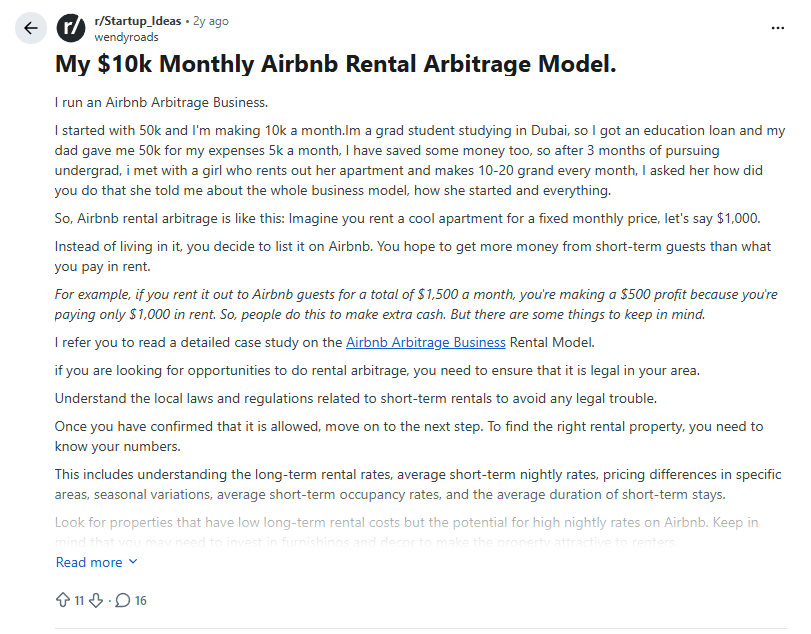
A user on r/Startup_Ideas shared a simple, repeatable system. They leased 5 units in tourist areas, spent about $10k total on furnishing, and reached 75% occupancy at $200 per night. After around $12k in expenses, they made a roughly $10k profit per month. Others copied this model in Orlando, starting with about $7k per unit. Read details about “$10k Monthly Arbitrage Model
” case study.
UK Rent-to-Rent Success
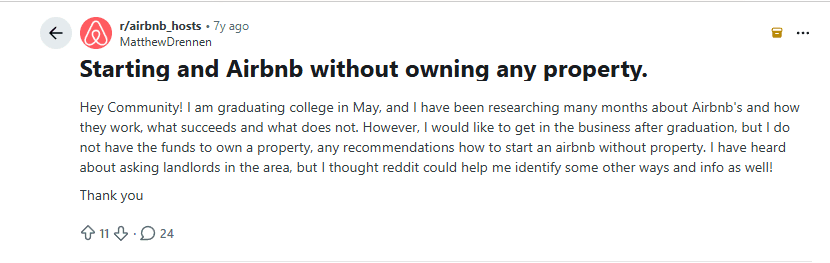
On r/airbnb_hosts, another user explained a rent-to-rent approach. They secured 3 apartments by offering landlords 25% higher rent. Instead of profit splits, they used joint ventures. They take 25% of revenue, earn about $2k per unit per month, and around $6k total. They preferred this over 50/50 splits because it’s safer during slow or empty months. Read details about the “UK Rent-to-Rent Success ” case study.
STR Assistance: From Zero Investment to a 50+ Member Airbnb VA Team
We also want to share our own journey, because STR Assistance itself is proof that it’s possible to build an Airbnb business without owning any property.
STR Assistance began with zero investment. We did not lease properties or buy real estate. Instead, we focused on learning the Airbnb platform first — understanding guest communication, pricing optimization, listing management, and Airbnb content marketing. With just these skills, we realized we could support hosts and earn directly through short-term rental services rather than property ownership.
In the beginning, our team consisted of only two members, both handling guest messaging, calendar updates, review management, and basic pricing strategies for a few hosts. Those early tasks helped us build confidence, gather experience, and understand real-world Airbnb operations.
As we improved and delivered consistent results, hosts began referring us to other hosts. That allowed us to scale without advertising or owning any properties. Today, STR Assistance has grown into a full-service short-term rental virtual assistant company with 50+ trained Airbnb VAs and co-hosts working daily with hosts across different platforms and locations.
Our growth shows that:
- owning property is not required
- practical skills are enough to start
- the Airbnb industry has strong demand for virtual support
- scaling is possible through referrals and performance
This journey reflects exactly what we teach in this guide — with the right skills, consistency, and understanding of the platform, anyone can build a business within the short-term rental space without purchasing or leasing a single property.
How Can You Get Your First Airbnb Income Within 30 Days Without Owning Property?
You have to be consistent from the beginning and walk through a plan to get your first Airbnb income. Some may get fast success, but for others, success may come a bit late. We have made you a 4-week path where first you need to choose the model, set up tools, promote your service, and scale. Here is the detailed guide for you.
Week 1 → Choose model
We have talked about 12 ways on how you can start your Airbnb business without needing any property. First things first, you need to choose which way you want to move forward. How to do this? We have explained each way, you can give a quick check on the section, and note down things you like and you do not like on the individual model. Then filter out what you want to do.
Week 2 → Setup tools
Next step, based on your chosen model of Airbnb business, you should start setting up tools. For example,
For Airbnb co-hosting, you need the Airbnb host dashboard, pricing tools (PriceLabs, Beyond Pricing), channel manager (Hostaway, Guesty), guest messaging tools, etc.
Airbnb virtual assistants need Airbnb account access (co-host role), unified inbox (Hostaway, Hospitality), dynamic pricing tools, or calendar & booking management tools.
Week 3 → Get Your First Client/Property
Now promote your Airbnb service, set the target audience, and reach out to them to get your first client or your first lease property. How to do it?
- Join Airbnb host & real estate Facebook groups.
- Reach out to local landlords and property owners.
- Message Airbnb hosts with low reviews or poor listings.
- Use cold outreach (email, LinkedIn, Instagram DMs).
- Partner with real estate agents and brokers.
- List your services on freelance platforms.
- Attend local networking events or property meetups.
Week 4 → Automate & Scale
In week 4, set up basic automation for messaging, pricing, and cleaning. This way, the operations will run. Deliver consistent results for your first client. When you start getting clients, ask for a testimonial. This authentic feedback you can later use to get more hosts.
Final Thoughts — The Easiest Way to Start?
If you ask us which would be the easy way to start earning through Airbnb without owning property that has demand, we would say become a Aibnb co-host or Airbnb VA. These professions have great demand with the rising popularity of Airbnb or other STR platforms. Also, there is a lower risk and the least investment you need.
But there are other ways also available, such as providing Airbnb upsell services, or becoming a professional photographer for the properties, Airbnb affiliate marketing, or Airbnb tech setup. For all these, you do not need any property.
The decision is totally on you, which is feasible for you to start. You may start with Airbnb photography, but end up being an Airbnb full-time virtual assistant. Whatever it is, try to gain knowledge on the STR business, connect with other people in the same field, and stay consistent.