- Key Takeaways
- Airbnb does not approve damage claims only because damage happened. The host has to prove it with clear evidence.
- The strongest claims include original photos, before-and-after proof, receipts, invoices, and Airbnb message records.
- Timing matters a lot. Claims filed quickly after discovering damage have a much higher chance of approval.
- Before-and-after photos are one of the most important parts of the claim because they show the damage was new.
- Airbnb checks if the issue is real damage, normal wear and tear, or something that already existed before the guest stayed.
- Costs must be reasonable. Vendor quotes, repair invoices, and replacement receipts help support the amount being claimed.
- Smoke odor claims need stronger proof because odor cannot be shown in a normal photo. Professional remediation invoices are very important here.
- If a claim is denied or reduced, hosts should appeal by fixing the exact issue Airbnb mentioned, not by sending the same evidence again.
- A proper documentation system makes the whole process easier and gives hosts a better chance of recovering damage costs.
Airbnb verifies damage claims through a case manager review of host evidence and guest response. They check photo authenticity, timestamps, causation, and timeline. Hosts who file within minutes of discovering damage, and stay inside the 14-day window, have significantly better odds of approval than hosts who wait.
You file a damage claim, attach a few photos, and wait. A few days later, you get a decision: full approval, partial reimbursement, or denial. It’s not always clear why Airbnb landed where it did.
That’s because most hosts submit claims without ever seeing the other side of the process. Knowing exactly how Airbnb verifies damage claims is what separates hosts who win reimbursement consistently from hosts who guess and hope.
Airbnb Approval Rate:
- Within 10 minutes of discovering damage: 91%
- After 10 minutes: 57%
The 2026 policy update added new layers to that review, including a ban on AI-generated evidence and a formal definition of what counts as verifiable proof.
Today, we’ll show exactly what happens after you submit a claim, the six criteria Airbnb checks to verify damage claims, what evidence gets approved versus rejected, and what to do if your claim doesn’t go the way you expected.
Quick Answer: How Airbnb Verifies Damage Claims?
Airbnb verifies damage claims by reviewing evidence from both the host and guest, and comparing before-and-after documentation. The case manager classifies whether the issue is damage or normal wear, evaluates the claimed cost against depreciation, and checks that photos and receipts are authentic and unedited.
A Community Support case manager handles this review manually rather than through full automation. They look at what the host submitted, anything the guest says in response, and the timeline of when the claim was filed relative to checkout.
If the evidence clearly supports the host, the claim moves toward approval. If it’s unclear or contradicted by the guest’s response, the case manager may ask for more documentation before deciding.
What Changed in Airbnb's Damage Verification Rules in 2026
Airbnb’s April 2026 update banned AI-generated evidence, formally defined what counts as verifiable proof, tightened smoke odor and linen stain requirements, and excluded consumables from claims entirely.
Here’s what a case manager now looks for during verification, and what’s different from before.
AI-Generated Evidence Is Now Banned
Airbnb prohibits AI-generated, AI-enhanced, or upscaled photos and receipts. Original, unaltered camera files are required.
This followed a fraud case in Manhattan, where a host submitted AI-generated photos to support a damage claim and a guest identified the fabrication. The update changed how case managers technically verify photos, which we cover in the evidence authenticity section below.
"Legitimate and Verifiable Evidence" Now Has a Formal Definition
Evidence must be true and accurate, not doctored or falsified in any way, including by AI, with clear proof the guest caused the damage. Previously, this term existed informally. Now it has specific requirements.
Smoke Odor and Linen Stain Verification Tightened
Smoke odor claims now need a professional remediation invoice from a licensed cleaning or HVAC company. Linen stains only qualify if they need professional cleaning. A generic cleaning receipt won’t work. We cover the specific smoke odor verification rule in detail further down.
Consumables Formally Excluded
Toiletries, coffee pods, dish soap, and lightbulbs are now explicitly defined as consumables and are not eligible for reimbursement.
What Happens After You Submit a Damage Claim
After you submit a claim, the guest gets 24 hours to respond. If the guest doesn’t pay in full, you can escalate to Airbnb. A case manager then reviews the case, which can take several days to three weeks depending on severity.
Throughout this whole process, neither side gets charged without advance notice and a chance to respond.
Key Variations
Claim Type | Total Processing Time |
Small claims (compensation, lost keys) | 5-7 business days after resolution |
Large claims (damage/repairs with documentation) | 1–2 months on average |
Major damage (e.g., $8,000+) | 2-4 months minimum |
Airbnb's 6 Verification Criteria for Damage Claims

Airbnb checks every damage claim using six criteria: whether the evidence is real, before-and-after proof, the type of damage, whether the cost makes sense, depreciation, and whether the host has a pattern of repeat claims.
These are not six separate processes. There are six ways the same case manager looks at one set of evidence. Understanding each one tells you exactly what to document and why.
1. Evidence Authenticity
Airbnb checks whether photos and documents are original and unaltered. The case manager at file metadata to confirm they weren’t AI-generated, upscaled, or edited.
Original smartphone photos carry embedded metadata, including the date, time, and sometimes GPS location at which the photo was taken. AI-enhanced or upscaled images often strip or alter that metadata in ways that are detectable on review. A screenshot has no usable metadata at all. The host must submit the raw camera file, not a screenshot, not an edited copy.
For the evidence authenticity, a case manager often checks these stuff,
- Airbnb case managers check EXIF metadata (date/time/camera model/GPS)
- Visible timestamp overlay, burns timestamp into image (not just metadata)
- GPS tracking, showing the exact location where the photo was taken
- AI-enhanced photos strip or alter EXIF data → automatic flag
- Screenshots have no EXIF data → rejected
- Required: Original camera files with intact metadata
Case managers review evidence differently based on timing
- File within 10 minutes → 91% approval
- File after 10 minutes → 57% approval
- 34-percentage-point gap driven by timing, not damage reality
- Case managers view delayed claims as suspicious
2. Before-and-After Proof
Airbnb looks for photos of the same area before the guest’s stay and after checkout. The photos should match as much as possible, ideally taken from the same angle, so Airbnb can see that the damage is new.
Without a pre-stay photo, the case manager has nothing to compare the damage to. That makes it much harder to prove the issue was not already there. From the claims we have seen go through review, this is usually the most important piece of evidence.
3. Damage Classification
Airbnb decides whether the issue is real damage, normal wear and tear, or something that was already there. Only damage caused by the guest can be reimbursed.
For example, a carpet that has slowly changed color over a year is different from a fresh red wine stain with a clear edge. Case managers are looking for damage that happened suddenly and clearly, not something that built up over time.
4. Cost Reasonableness
Airbnb checks whether the amount you are asking for matches the real cost to repair or replace the item. Vendor quotes and receipts are usually the best proof.
If the amount is close to a professional quote, the review is usually smoother. But if the amount looks too high compared to the item’s real value, it can slow down the claim or reduce the payout, even if the damage is real.
5. Depreciation Calculation
For older items, Airbnb usually lowers the reimbursement based on the item’s age and expected lifespan. They pay closer to the current value, not the original price.
That is why a five-year-old sofa usually will not be reimbursed at the price it cost when new. Sending the original purchase receipt helps the case manager calculate depreciation more fairly instead of relying on an estimate with no proof behind it.
6. Repeat Claim Patterns
Airbnb also checks whether a host has filed several similar claims before. If the same type of damage keeps coming up, the claim may get reviewed more closely.
This connects to Airbnb’s reasonable care expectation. If the same appliance or fixture keeps appearing in claims, the case manager may wonder if it is a maintenance issue instead of guest-caused damage each time. Keeping basic maintenance records helps protect you here.
How Airbnb Handles Disputes (Host vs Guest Evidence)
When a guest disputes a damage claim, Airbnb reviews counter-evidence like “no damage” photos or claims of pre-existing damage. Then they compare it against the host’s submission using a clear priority order. When the evidence is genuinely unclear, with no strong photo and no clear documentation, Airbnb tends to favor the guest.
Verification runs both directions. A guest who disputes a claim is just as important as the hosts.
- “No damage” photos: A guest may submit their own checkout photos showing the area looking fine, which the case manager compares against the host’s after photos.
- Pre-existing damage claims: The guest argues the damage was already there, which is where the host’s pre-stay photo becomes important.
- Messages or disputes: Anything said in the Airbnb message thread, including admissions, denials, or context, gets reviewed alongside the photos.
When evidence conflicts, Airbnb checks these criteria:
- Timestamped host pre-stay photos: The strongest evidence, an Airbnb case manager’s check EXIF metadata (date/time/camera model/GPS).
- On-platform messages: If you communicate about the issue with the guest through the Airbnb messaging system, this evidence is more valuable because they’re timestamped and cannot be edited retroactively.
- Third-party reports: Cleaner statements, vendor invoices, or repair quotes that corroborate the host’s account.
We had a case where a guest shared their own checkout photos to show the bathroom was clean and disputed a cracked tile claim. The photos were real, but they were wide shots and missed the corner with the crack.
We compared the host’s pre-stay photo, showing that the corner was intact, with a matching post-stay photo showing the new crack clearly. Once the side-by-side was shared, the case manager approved the claim within four days. The guest’s evidence wasn’t fake; it just didn’t show the right area.
What Evidence Gets Approved vs Rejected
Approved evidence includes original timestamped photos, video walkthroughs, professional invoices, and on-platform messages. And the rejected evidence includes AI-edited images, screenshots without metadata, and off-platform communication.
Knowing this list before you document anything saves you from collecting evidence that won’t actually count.
Approved Evidence Types
You can make a personalized checklist of what evidence Airbnb gives for approval.
- Pre-stay video walkthrough, a short clip of each room before the guest arrives.
- Cleaner damage report, a written note from whoever found the damage, with the date and time.
- Vendor repair or replacement invoices, ideally on company letterhead.
- On-platform Airbnb messages, any conversation about the damage kept inside the app.
- Inventory checklists, a record of what was in the property and its condition before the stay.
- Photos: Original camera files only, no AI enhancement
- Timestamp: GPS + date/time in EXIF metadata scanstay
- Before photos: Timestamped, before guest arrival
- After photos: Same angle/location, checkout day
- Repair quote: Professional invoice with company letterhead
- Causation proof: Evidence shows the guest directly caused damage to the street
Rejected Evidence Types
Airbnb does not support vague evidence, since people can misuse the AI and technology to alter the evidence. Check the list of rejected evidence. Over 43% of every Airbnb claim is not recovered, and these can be one of those reasons.
- AI-generated or edited images, including basic brightness or clarity enhancements, run through an AI tool.
- Missing timestamps or metadata, which includes most screenshots.
- Off-platform communication, texts, or calls outside the Airbnb app carry no verifiable record.
- Non-itemized cleaning invoices, a vague “extra cleaning, $200” line doesn’t hold up.
- Estimates without proof, a number you came up with yourself, with no vendor backing it.
- Post-cleaning photos, images taken after the area has already been cleaned or repaired, don’t establish the original condition.
- Normal wear and tear. Gradual deterioration, aging materials.
- Pre-existing damage. Can’t prove occurred during the guest’s stay.
- Natural disasters. Earthquakes, hurricanes, floods, tornadoes.
- Mold/mildew. Open windows + humidity causing mold.
- Neighbor property. Shared hallways, condos, and public land.
- Cash/valuables. Currency, bullion, livestock, and most original art.
- Utility overuse. Triple-digit electricity bills.
- Mysterious disappearance. Items vanish without forced entry evidence.
Special Cases That Require Additional Documentation
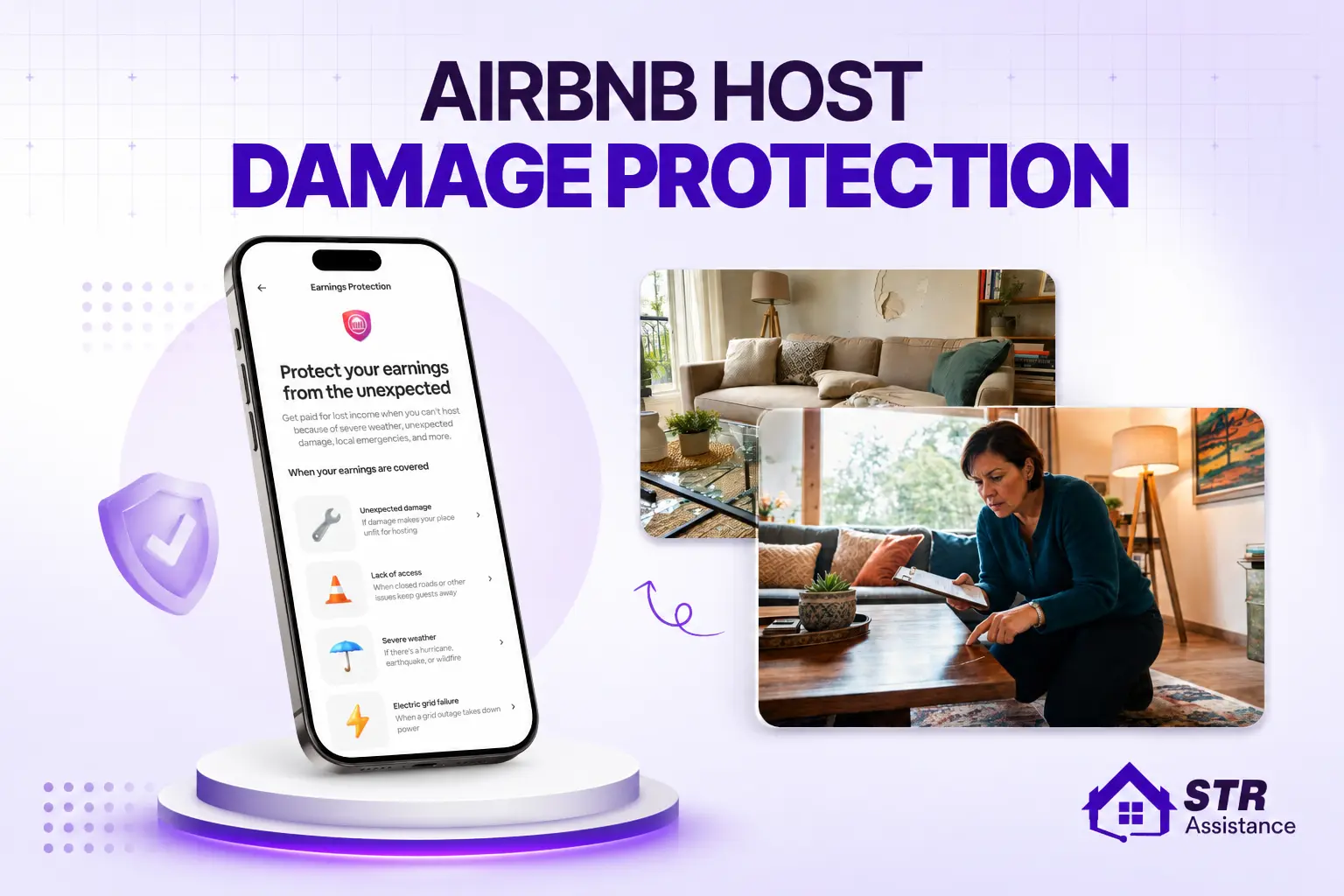
Smoke odor, deep cleaning, biohazard, and high-value item claims require more than standard photo evidence. These cases need a professional or third-party report confirming the scope and cause. For the full breakdown of what AirCover covers and excludes, see our guide on Airbnb Host Damage Protection.
These categories get extra scrutiny because they’re harder to verify visually and have historically been more prone to inflated or unsupported claims.
- Smoke odor claims: Require a professional remediation invoice specifying the affected area, covered in detail below.
- Deep cleaning claims: Need an itemized invoice describing exactly what was cleaned and why it went beyond normal turnover.
- Biohazard or contamination claims: Require a specialist cleanup service invoice, not a standard cleaning receipt.
- High-value item damage claims: Need proof of ownership and value predating the stay, like a purchase receipt or appraisal, not just a photo of the broken item.
Smoke Odor Claims (Strict Verification Rule)
Smoke odor claims are checked very carefully. The strongest proof is a professional remediation invoice from a licensed cleaning or HVAC company. The invoice should clearly show the affected area, what work was done, and how the smoke odor connects to the guest’s stay.
This is one of the most strictly reviewed claim types under the 2026 rules because odor cannot be photographed the same way a broken lamp or damaged furniture can.
The invoice should include the service date, a clear smoke odor removal description, and the company letterhead. It should also say which rooms were treated, what method was used, such as ozone treatment or professional deodorizing, and the service date should be close enough to the guest’s checkout to connect the issue to that stay.
Evidence types for smoke odor claims:
- Cigarette butts, ash, or burn marks
- Physical evidence on surfaces
- Smoke detector alerts
- Alertify or Minut timestamped alerts
- Professional remediation invoice
- Dated service from a licensed company
- Cleaning team written statement
- Odor documented on arrival
- Vape cartridges or pods found
- Physical items left in the property
- Residue on windows or mirrors
- Oily coating from vaping
- Smoke staining photos
- Walls or ceilings with smoke residue
- Replacement receipts
- Items that absorbed odor, such as pillows, curtains, or upholstery
What you can claim:
- Only actual documented costs can be claimed.
- Claimable items:
- Remediation costs
- Cleaning costs
- Replacement items
- Lost revenue
- Each one needs a receipt.
There are many instances we have seen at STR Assistance related to smoke odor. Even though we maintain a strict non-smoking policy and mention it clearly to guests, sometimes guests do not follow it.
In one recent case, a group of four people came to travel and stayed for about three days. After they left, our cleaning team found cigarette butts on the balcony and burn marks on the deck railing.
Since we are careful about before-and-after photos and use smoke detector tools, we were able to easily claim compensation for the host and succeed.
Airbnb Damage Claim Timeline
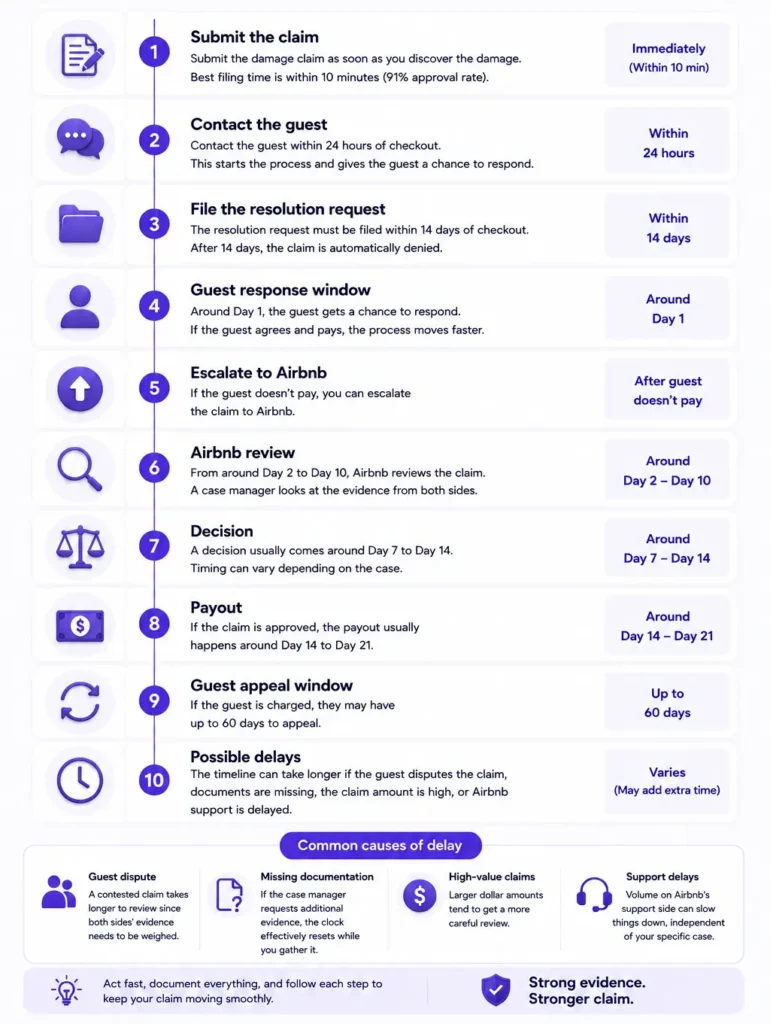
A typical Airbnb damage claim moves through submission, guest response, possible escalation, case manager review, decision, and payout. This takes around two to three weeks, though delays can happen.
Here’s a realistic breakdown, though individual cases vary based on complexity and how quickly each side responds.
- Step 1: Submit the claim. Submit the damage claim as soon as you discover the damage. The best filing time is within 10 minutes of discovering the damage, which carries a 91% approval rate.
- Step 2: Contact the guest. Contact the guest within 24 hours of checkout. This starts the process and gives the guest a chance to respond.
- Step 3: File the resolution request. The resolution request must be filed within 14 days of checkout. After 14 days, the claim is automatically denied, with no exceptions.
- Step 4: Guest response window. Around Day 1, the guest gets a chance to respond. If the guest agrees and pays, the process moves faster.
- Step 5: Escalate to Airbnb. If the guest doesn’t pay, you can escalate the claim to Airbnb.
- Step 6: Airbnb review. From around Day 2 to Day 10, Airbnb reviews the claim. A case manager looks at the evidence from both sides.
- Step 7: Decision. A decision usually comes around Day 7 to Day 14. Timing can vary depending on the case.
- Step 8: Payout. If the claim is approved, the payout usually happens around Day 14 to Day 21.
- Step 9: Guest appeal window. If the guest is charged, they may have up to 60 days to appeal.
- Step 10: Possible delays. The timeline can take longer if the guest disputes the claim, documents are missing, the claim amount is high, or Airbnb support is delayed.
Common causes of delay include:
- Guest dispute: A contested claim takes longer to review since both sides’ evidence needs to be weighed.
- Missing documentation: If the case manager requests additional evidence, the clock effectively resets while you gather it.
- High-value claims: Larger dollar amounts tend to get a more careful review.
- Support delays: Volume on Airbnb’s support side can slow things down, independent of your specific case.
How to Respond When Airbnb Denies or Reduces Your Damage Claim
Roughly 43% of Airbnb damage claims are denied or reduced. If your AirCover claim is denied or reduced, you can appeal by addressing the exact reason given, adding new evidence rather than duplicates, and referencing Airbnb’s policy where relevant.
Working through the damage claim process for years and knowing the rules in depth, we help hosts document appeals by citing the specific Airbnb policy clause that applies. This works more effectively when the case manager reviews the evidence.
Common Reasons to Be Denied
A denial or reduction doesn’t mean the final word. Knowing the common reasons behind it helps you understand exactly what an appeal needs to fix.
Main reasons AirCover claims fail:
Reason | % of Denials |
|---|---|
Insufficient documentation (wrong format, poor sequencing, missing evidence) | 50% |
Wear and tear (gradual deterioration, aging materials) | 20% |
Pre-existing damage (can’t prove during guest’s stay) | 13% |
Insufficient proof (format or sequencing issues) | 10% |
Outside coverage scope (AirCover exclusions) | 7% |
Common claim rejection reasons in practice:
- Depreciation applied: the item’s age significantly reduced the payout versus what you expected
- Wear-and-tear classification: the case manager read the damage as gradual deterioration rather than a sudden guest-caused event
- Missing evidence: no pre-stay photo, no receipt, or evidence that doesn’t clearly link to the guest’s specific stay
- Cost too high: the requested amount didn’t match a reasonable market quote
- Policy exclusions: the claim fell into a category Airbnb doesn’t cover, like normal wear, consumables, or acts of nature
How to Appeal?
- File your appeal within 30 days of the original decision.
- Respond to the exact rejection reason stated in Airbnb’s decision, not a general re-explanation of the damage.
- Add missing evidence, not duplicates of what you already submitted.
- Include vendor quotes or receipts if cost was the issue.
- Strengthen damage proof if classification or causation was the issue, ideally with a clearer before-and-after pair.
- Reference the specific policy clause if you believe the decision misapplied Airbnb’s own terms.
Important: If a normal appeal doesn’t fix the issue and you believe Airbnb made the wrong decision, you can request a supervisory review through Airbnb’s Trust & Safety channel. This can help in cases where the decision was based on something unfair, like an inflated or unsupported counter-claim. It shouldn’t be your first step, but it’s an option when the case genuinely needs another level of review.
How Hosts Can Build a Documentation System That Meets Airbnb's Verification Standards
A good documentation system for Airbnb claims has three parts: a pre-stay routine, a post-stay routine, and a habit of keeping all guest communication on Airbnb.
Each part connects back to Airbnb’s verification criteria above, so this isn’t just general advice. It’s the type of system that helps a claim get approved.
Pre-Stay Documentation System
Before each guest arrives, photograph every room. Start with a wide shot, then take close-up photos of valuable items and anything that can easily get damaged, like kitchen appliances, bathroom fixtures, and furniture surfaces.
This usually takes about five minutes and helps prove the condition of the property before the stay. Save the photos in a dated folder for each booking so you can find them quickly if you need them later.
Example folder structure:
📁 [Listing Name]/
📁 2026-Guest-Bookings/
📁 2026-01-15_Guest-JohnDoe/
📁 Before-Checkin/
📁 During-Stay/
📁 After-Checkout/
📁 Evidence-for-Airbnb/
📁 Repair-Quotes/
📁 Guest-Communication/
Post-Stay Documentation System
After checkout, before any cleaning starts, repeat the same photo walkthrough from the same angles.
If your cleaner is the first person at the property, ask them to photograph anything unusual before they touch or move it.
This helps prove both timing and before-and-after condition, since the photos are much stronger when the angles match and they’re taken right after checkout.
Guest Communication System
Keep every damage-related conversation inside the Airbnb messaging system. Avoid text messages or phone calls for anything important.
Airbnb messages are easier to use as proof because they stay on the platform. A simple habit: if a guest mentions damage by text, ask them to confirm it through the Airbnb app so it’s properly recorded.
Example timeline to track per claim:
- Guest checked in: [date]
- Damage discovered: [date]
- Claim filed: [time after discovery, ideally under 10 minutes]
- Cleaners arrived and documented damage: [date]
- Repair quote received: [date]
- Resolution request filed: [date]
How STR Assistance Helps Hosts Meet Airbnb's Damage Claim Verification Requirements
Need Help for Damage Issues?
At STR Assistance, we’ve helped hosts and property managers with Airbnb co-hosting, virtual assistant support, guest communication, and dispute handling for years. Damage claims are especially stressful for hosts when evidence is missing or the claim isn’t filed the right way, and that’s the gap we help close.
We help hosts build a proper system for damage claims: documentation, guest messaging, evidence organization, and filing, so the claim is clear, complete, and ready for Airbnb’s review from the start.
Airbnb looks at every damage claim through the same verification points covered above: before-and-after proof, evidence quality, cost reasonableness, and whether the damage is actually guest-caused. Our team prepares every claim with these requirements in mind from the beginning.
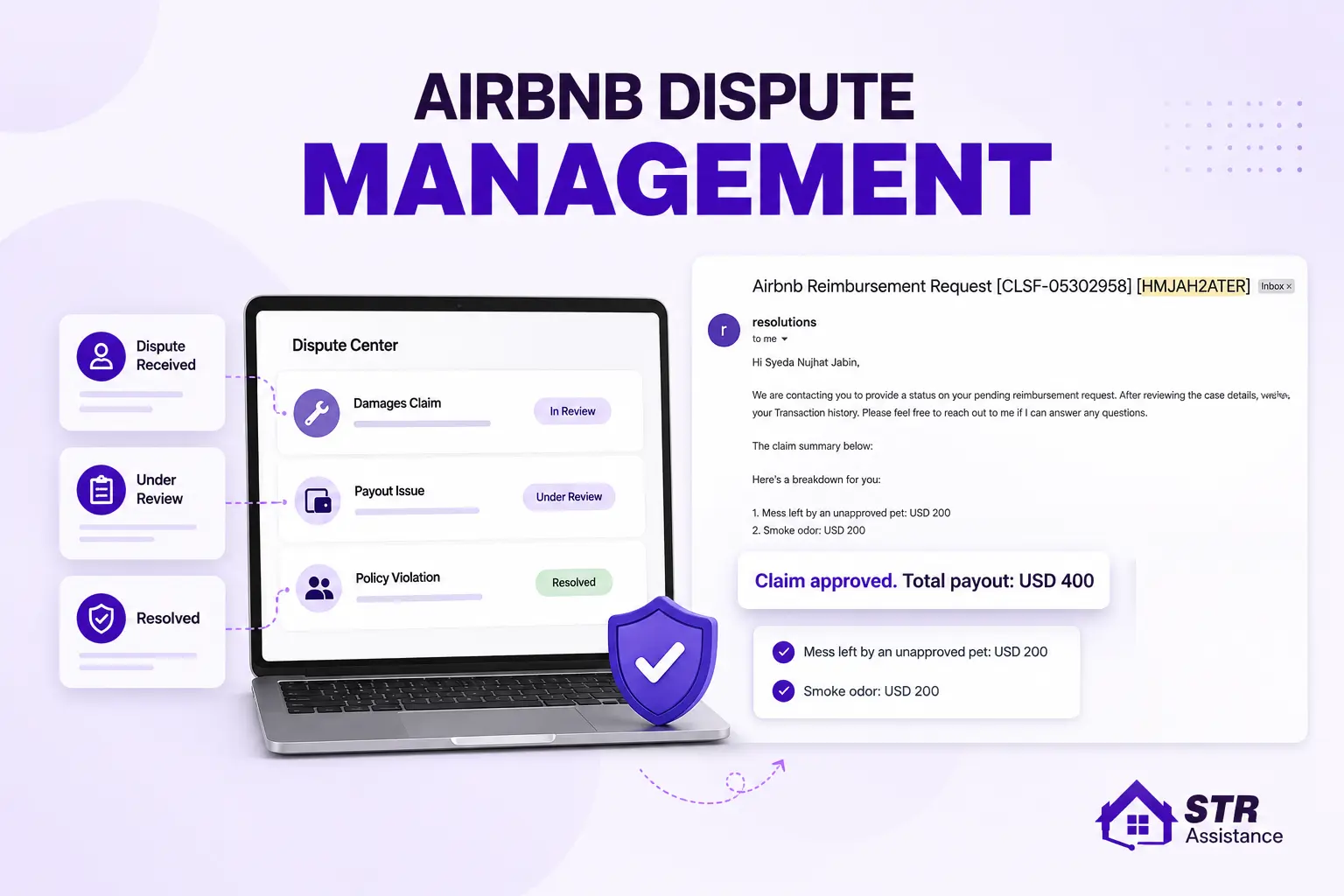
We’ve supported hosts with a 98% approval success rate across 800+ managed properties, having handled 300+ Airbnb damage and dispute cases. For a deeper look at how we handle disputes broadly, see our guide on Airbnb dispute management.
Whether you have one property or many, we follow the same steps for every AirCover claim:
- Pre- and post-stay photo systems with timestamped photos for each booking
- Organized photo records by reservation, so evidence is easy to find when needed
- Claim-specific evidence preparation, including remediation invoices, itemized lists, receipts, repair quotes, and notes
- Damage-related communication kept inside Airbnb’s messaging system
- Appeal and escalation support when a claim is denied or reduced
- Clear responses based on the exact reason Airbnb gave for the denial or reduction
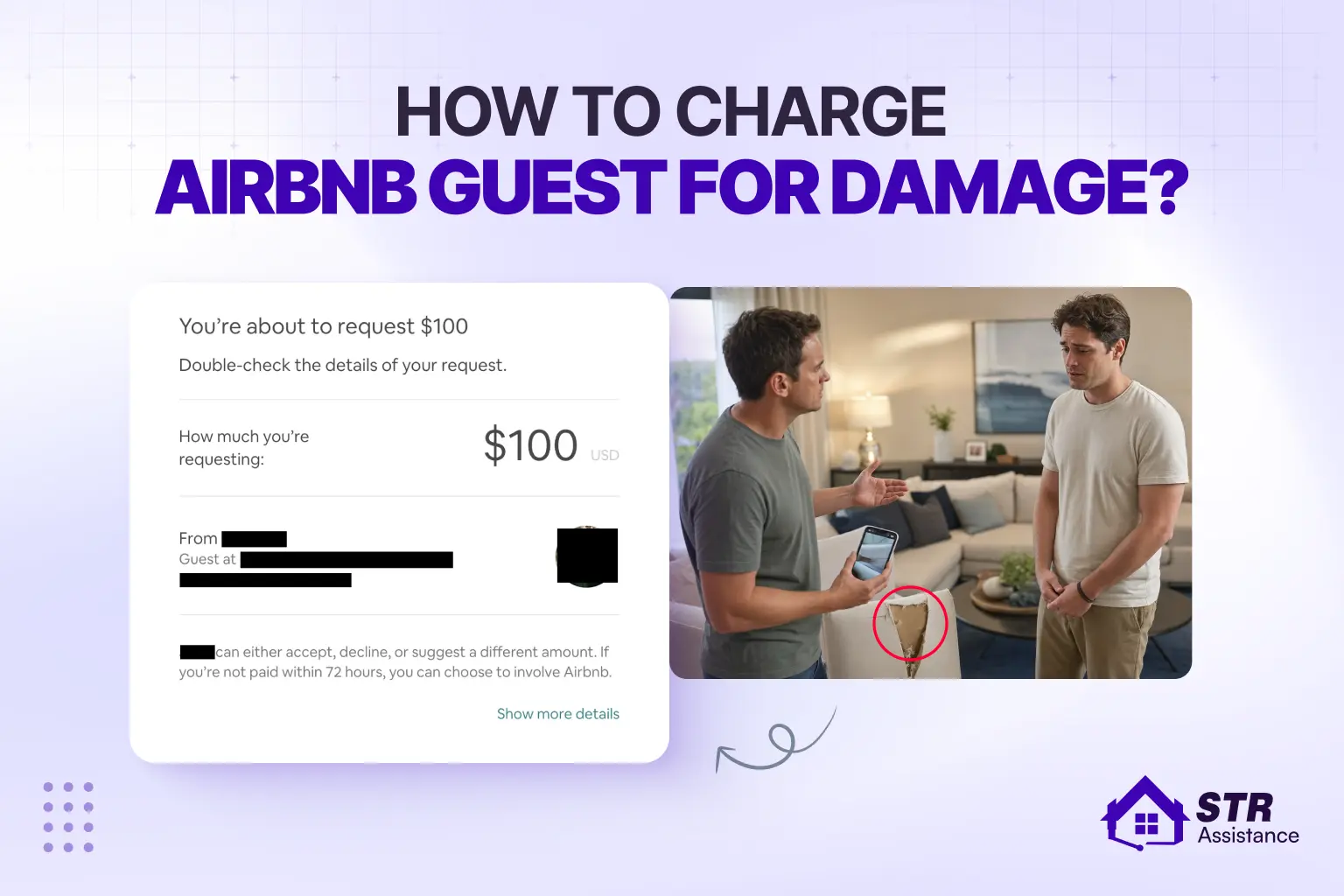
If you’re working out what to actually charge a guest once damage is confirmed, our guide on how to charge an Airbnb guest for damage walks through that calculation. And if a guest simply refuses to pay after Airbnb’s decision, see what happens if a guest doesn’t pay Airbnb damages for what comes next. For hosts who want the entire claims process handled end to end, our Airbnb virtual assistant team manages documentation, filing, and follow-up on your behalf.
Conclusion
Airbnb damage claims become much easier to understand when you know what Airbnb is really checking. They look at whether the evidence is real, whether there are before-and-after photos, whether the damage was caused by the guest, whether the cost is fair, and whether the claim has the right support behind it.
The hosts who usually get better results are not just lucky. They are prepared. They already have photos from before the stay, they document damage right after checkout, they keep messages inside Airbnb, and they collect proper receipts or invoices.
Good documentation can make the difference between a claim being approved, reduced, or denied. That is why having a simple system for photos, evidence, guest communication, and claim filing is so important.
FAQ: Airbnb Damage Claim Verification
Most claims move through case manager review within a few days to two to three weeks from submission to payout. Disputed claims, missing documentation, or high-value amounts typically take longer, since they require more careful review.
No. Airbnb reviews evidence from both sides and can side with the guest if the host's documentation is weak or the guest provides credible counter-evidence. When evidence is unclear on both sides, the outcome tends to favor the guest, since the burden of proof sits with the host.
Yes. As of the April 2026 policy update, Airbnb explicitly bans AI-generated, AI-enhanced, or upscaled photos in damage claims. Case managers check file metadata for signs of editing, and altered or missing metadata can trigger an automatic rejection of that evidence.
Airbnb applies depreciation based on the item's age and expected lifespan, landing somewhere between the original purchase price and current fair market value. Submitting the original receipt gives the case manager accurate data to calculate from, rather than estimating against you.
Airbnb weighs both sides, generally prioritizing timestamped host pre-stay photos first, on-platform messages second, and third-party reports third. When the conflict can't be clearly resolved by the evidence, the decision tends to favor the guest.
Yes. A partial approval can be appealed within 30 days by addressing the specific reason for the reduction, often depreciation or insufficient cost evidence, and submitting new documentation rather than resubmitting what you already provided.
The most common reasons are depreciation on older items, a requested cost that didn't match a reasonable market quote, or evidence that only partially supported the full amount claimed. Reviewing the specific reduction reason Airbnb provides is the first step before appealing.
Yes. The guest receives the initial reimbursement request and has 24 hours to respond. If the case escalates, the guest may also be asked for additional notes or evidence as part of the case manager's review before a final decision is made.
There's no fixed number, but Airbnb does review repeat claim patterns as one of its verification criteria. Frequent claims for the same type of damage at the same property can prompt closer scrutiny and questions about whether the issue is actually a maintenance problem rather than guest-caused damage.