Quick answer:
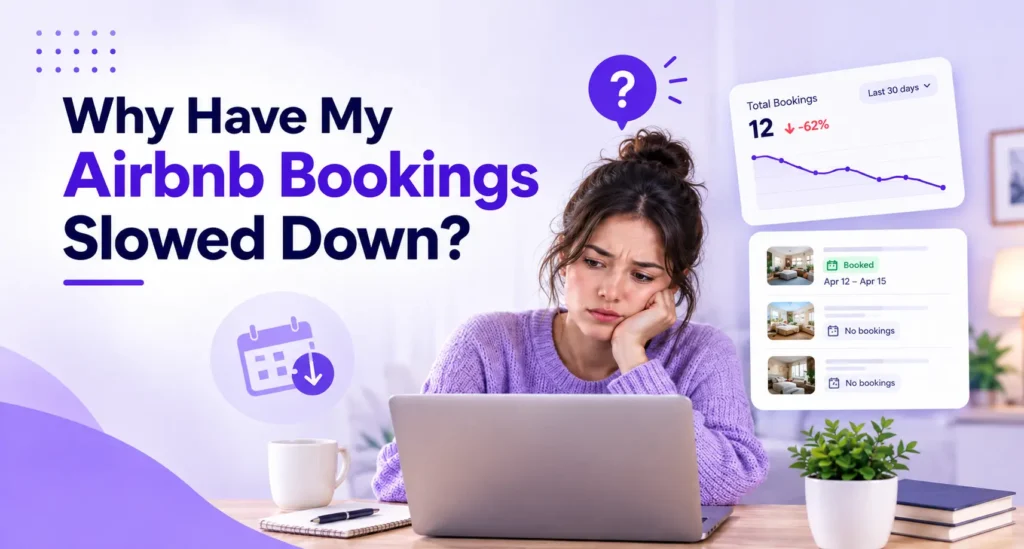
If your Airbnb used to book well and has slowed down, something changed, either your listing, the market around you, or Airbnb’s algorithm itself. The most overlooked 2026 factor is booking velocity: Airbnb now weighs how recently you’ve been getting bookings, not just your historical rating, so a quiet stretch can compound on itself. Before changing anything, figure out whether the slowdown is seasonal (temporary, will likely correct itself) or structural (something specific changed and needs fixing). Reacting by randomly dropping your price or swapping photos without diagnosing first usually wastes time.
You check your calendar and it’s emptier than it used to be. Not zero bookings, just fewer than before, with longer gaps between them. That’s a different problem than never having booked well in the first place, and it deserves a different diagnosis. If your listing has never really taken off, our guide on why your Airbnb isn’t booking at all covers that scenario specifically.
Our short-term rental virtual assistant team sees this pattern regularly with established listings: a host had steady bookings for months, then things quietly dropped off with no obvious single cause. In most cases, it’s not one dramatic thing. It’s a combination of smaller shifts, on the listing side or the market side, that add up.
Below are the 10 most common reasons bookings slow down after a good run, and what to do about each one.
1. Host Factors
Airbnb’s algorithm rewards hosts who respond quickly, and slow response time directly costs you visibility. The 2026 benchmark for competitive hosts is under 5 minutes, not the 24-hour window many hosts still aim for. Even a few missed booking requests in a slow month can drag your response rate down fast.
Beyond response speed, consistency in how you communicate matters. Guests notice when a host who used to reply within minutes starts taking hours, and Airbnb’s system notices too. A few other host-side factors that quietly erode bookings over time:
- Not keeping up with what guests currently expect (fast Wi-Fi, workspace setup, specific amenities) while competitors add them
- Not tracking what nearby listings are offering, so your property gradually falls behind on pricing or features without you noticing
- Losing the personal touches that build repeat bookings and good reviews: a proper welcome message, helpful local recommendations, being reachable when something comes up
2. Decrease in Rental Demand
Demand for short-term rentals shifts for reasons that have nothing to do with your listing. Off-peak months (after summer, deep winter) naturally see fewer bookings. Broader shifts also play a role: travel patterns changed permanently after the pandemic in ways that vary heavily by destination, and the rise of remote work has shifted some demand from short business trips toward longer stays.
Economic conditions matter too. During periods of tighter household budgets, guests trade down to cheaper options or skip trips entirely, and rising costs for flights and fuel push some travelers toward closer, cheaper alternatives.
None of this means something is wrong with your listing. It means the pool of travelers actively booking has temporarily shrunk, which is a market condition, not a listing problem.
3. Oversaturation of Listings
Sometimes bookings slow down simply because more properties entered your market. More listings means more choice for guests, and your property has to work harder to stand out in a crowded search result.
This gets worse when nearby listings are functionally similar to yours: same size, similar price, comparable amenities. Guests comparing near-identical options default to whichever has better photos, more reviews, or a lower price, and price wars follow. Hosts undercut each other trying to stay competitive, and the whole local market’s average nightly rate drifts down.
The way out of this isn’t necessarily competing on price. A property that offers something distinct, whether that’s a unique layout, a specific amenity, or a location advantage, doesn’t get lost in the comparison the way an identical listing does.
4. The Time of Year May Be Off-Season
Seasonal dips are one of the most predictable reasons bookings slow down, and they’re often mistaken for a listing problem when they’re really just timing. Ski destinations peak in winter and go quiet in summer. Beach properties see the reverse. Weather uncertainty in shoulder seasons compounds this further.
If your slowdown lines up neatly with a seasonal pattern you’ve seen in previous years, this is likely at least part of the explanation, not a sign something broke.
5. You're Using a Fixed Price Year-Round
A static nightly rate that never adjusts is a common, quiet cause of slowing bookings. Priced too high during quiet periods, you lose guests to cheaper alternatives. Priced too low during high-demand periods, you leave money on the table without necessarily gaining more bookings, since demand was already there regardless of price.
Dynamic pricing adjusts your rate based on actual demand signals: local events, seasonality, day-of-week patterns, and how far out a guest is booking. This keeps your price competitive automatically rather than requiring you to manually track and adjust it. If you’d rather not manage this yourself, our Airbnb dynamic pricing service handles it directly.
6. Lack of Recent 5-Star Reviews
Reviews remain one of the strongest trust signals on the platform, and listings with strong recent ratings consistently outperform those without.
Two things matter here beyond just having good reviews historically. First, recency: a listing with excellent reviews from a year ago but nothing recent doesn’t carry the same weight as one with strong reviews from the last few weeks, since Airbnb’s 2026 ranking increasingly favors recent guest activity over older reputation. Second, how you handle any negative feedback: a thoughtful, professional response to a critical review often matters more to future guests than the review itself. Our guide on how to respond to guest reviews covers how to do this well.
7. Your Listing Isn't Optimized or Updated
A listing that isn’t actively maintained gradually loses ground, even if nothing about the property itself has changed.
Old or low-quality photos are the most common culprit; guests scroll past a listing that looks dated compared to fresher competitors. An unclear or thin description leaves guests uncertain about what they’re actually booking, and Airbnb’s 2026 natural language search now matches guest queries directly against your description text, so vague language costs you visibility as well as conversions.
Airbnb’s search system also favors listings that show signs of active management. A calendar that hasn’t been touched in weeks, a description that hasn’t been refreshed, or a title that’s identical to what you launched with years ago all signal a listing on autopilot, which the algorithm treats differently than one being actively maintained.
Your title plays a bigger role here than most hosts realize. If yours hasn’t been revisited recently, our guide on Airbnb listing title examples is worth a look, and the same applies to your description, covered in our Airbnb listing description examples guide.
Keeping your calendar current matters for the same reason: an outdated calendar reads as inactivity, both to guests and to the algorithm.
8. Increased Guest Expectations
What guests expect as standard has risen, and a listing that hasn’t kept pace loses ground even without doing anything differently.
Flexibility is a big one. Guests increasingly favor listings with more forgiving cancellation terms, since it removes risk from booking ahead. A strict policy that used to be fine can now cost you bookings against competitors offering more flexible terms.
Price sensitivity works alongside this. With Airbnb’s pricing now shown as an all-in guest-facing rate since the December 2025 fee restructuring, guests compare totals more directly than before, and listings priced noticeably above comparable options stand out for the wrong reason.
Beyond price and policy, expectations around amenities have shifted too: sustainability features (energy-efficient appliances, reduced single-use plastics) matter to a growing share of travelers, and higher-end touches (hot tubs, premium toiletries, better coffee setups) have moved from differentiator to expectation in competitive markets.
9. Lack of Visibility Into Airbnb's Ranking Factors
Airbnb’s search ranking depends on a combination of signals, and not knowing where you stand on each one makes it hard to diagnose a slowdown. The factors that matter most in 2026 include:
- Response time and response rate
- Booking velocity, meaning how recently and consistently you’ve been getting booked, not just your historical performance
- Accurate, complete listing information
- Guest reviews and ratings, weighted toward recent activity
- Calendar and pricing management
- Instant Book status
- Booking lead time
- Superhost and listing health status
Booking velocity is worth calling out specifically, since it’s a newer emphasis many hosts haven’t adjusted for. Host community reports throughout 2026 point to Airbnb weighting recent booking activity more heavily than before, on top of historical ratings. In practice, this means a quiet stretch can make the next booking harder to get, not just the current one, since the algorithm reads recent inactivity as a signal too. Breaking that cycle usually means treating any of the fixes below as urgent rather than optional.
Our full breakdown of how Airbnb’s algorithm actually ranks listings covers all of these factors in depth, and our guide on becoming a Superhost covers that specific status requirement if it’s part of what’s slipping.
10. Localized Negative Press
Coverage that discourages travel to your area, whether that’s a safety concern, a weather event, or negative press about the destination generally, can suppress demand regardless of anything you’ve done with your listing.
This is one of the few reasons on this list that isn’t fixable at the listing level. If a well-known travel publication raises concerns about your area, the resulting dip in interest usually resolves as the news cycle moves on, rather than through changes to your property or pricing.
Fixing a Slowdown Without Making It Worse
Before working through fixes, resist the urge to change everything at once. Dropping your price, swapping your photos, rewriting your description, and turning on aggressive discounts simultaneously makes it impossible to tell what actually worked, and if bookings do pick back up, you won’t know which change to keep doing.
A more useful approach: pick the one or two reasons above that most plausibly explain your specific situation, fix those first, and give it a couple of weeks before layering on more changes.
Practical fixes worth prioritizing:
- Complete any missing profile or listing verification steps
- Reduce your minimum-stay requirement if it’s excluding shorter bookings
- Remove or reduce extra-guest fees that make your total price less competitive
- Adjust your calendar availability, opening dates you may have blocked unnecessarily
- List on additional platforms (Vrbo, Booking.com) to reach guests who don’t search Airbnb exclusively, or set up one of the direct booking website platforms to take commission-free reservations that don’t depend on Airbnb’s ranking
- Refresh photos, description, and amenities list rather than leaving them untouched for years
- Switch to dynamic pricing if you’re still on a fixed rate
- Get your response time under 5 minutes
- Offer flexible check-in and check-out windows where practical
- Be upfront about any quirks in the space rather than letting guests discover them at check-in
How STR Assistance Helps When Bookings Slow Down
Boost Your Airbnb Bookings Now
Most hosts who come to us with a slowdown already suspect something is wrong; they just can’t isolate what changed. We start the same way every time: check response time, review recency, calendar activity, and pricing against the local market, then narrow down which of these actually shifted.
One host’s bookings had dropped by roughly half over two months. Nothing about the property had changed, but their calendar had drifted to a 60-day minimum-advance-booking window they’d set during a busy period and forgotten about, quietly filtering out most last-minute searches. We reopened the window, and bookings picked back up within the next two weeks.
Our short-term rental virtual assistants handle this kind of ongoing monitoring so a slowdown gets caught in days, not months. If you’d rather have this managed continuously, our Airbnb listing management service covers exactly this.
Conclusion
A booking slowdown after a good run is almost never one single cause. It’s usually a combination of a few smaller shifts, on your side or the market’s, that compound over time.
Start by ruling out the obvious: is this seasonal, or has something specific changed? Check your response time, your review recency, your calendar activity, and whether your pricing still matches the local market. Fix the most likely one or two causes first rather than changing everything at once, and give each change a real chance to show results before moving to the next.
The listings that recover fastest aren’t the ones that panic and overhaul everything. They’re the ones that diagnose accurately and fix the right thing first.