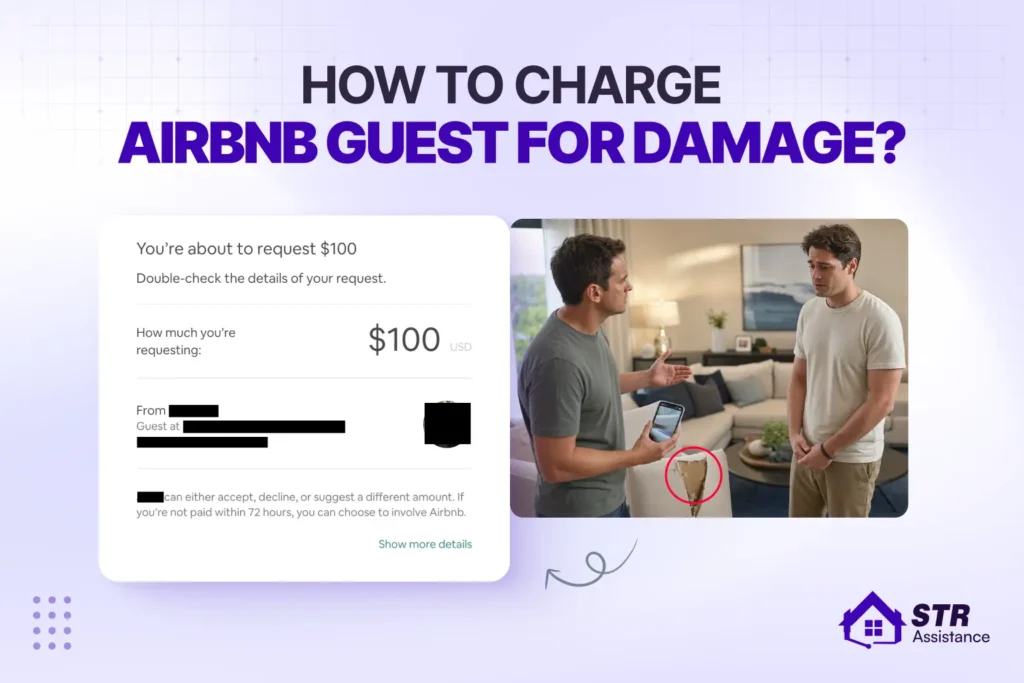
- Key Takeaways
- You can charge guests. The Resolution Center handles direct charges, and AirCover backs you up if the guest refuses, up to $3 million per incident.
- Document before you touch anything. Cleaning or repairing before documenting can sink your claim, and AI-edited photos are formally banned as of April 20, 2026.
- The 14-day rule has a hidden trap. Your real deadline is 14 days from checkout, or your next guest’s check-in — whichever is sooner.
- Depreciation reduces older claims. Airbnb pays based on current value, not what you originally paid.
- Most hosts only have AirCover. Airbnb doesn’t let most hosts collect a security deposit on the platform directly.
- Contact the guest first. It’s required before Airbnb steps in, and it’s the fastest way to get paid without a dispute.
Airbnb lets hosts charge guests for damage through the Resolution Center, with AirCover as a backup if the guest refuses to pay. The process comes down to fast documentation, an accurate cost estimate, and filing within Airbnb’s 14-day window.
You walk into your property after a guest checks out, and there it is. A cracked sink, a burn mark on the counter, a missing lamp. Your first instinct is to message the guest and demand payment.
Slow down. When you know how to charge an Airbnb guest for damage properly — in the right order, with the right evidence — that decides whether you get reimbursed or end up covering the cost yourself. Airbnb has the rules, but the process has deadlines, evidence standards, and April 2026 updates that changed what counts as proof.
Here’s some context worth knowing before you panic: damage claims are rare. A regional analysis of over 20,000 bookings by Avada Properties across Pigeon Forge and Gatlinburg found that damage claims occurred in just 0.71% of Airbnb stays, and Airbnb approved roughly 56.75% of the claims filed. Rare, but expensive when they happen — and easy to lose if the paperwork isn’t right.
Hi, I am Nujhat, Head of Operations at STR Assistance and a specialist in Airbnb dispute management. I’ve personally handled 300+ Airbnb damage claim and dispute cases for hosts, with a 98% approval success rate. No vague statements or theories — based on my direct experience, I’ll show you how to calculate a fair charge, how to file a claim through the Resolution Center, what to do if the guest refuses to pay, and how Airbnb’s April 20, 2026 rule changes affect what gets approved.
Can You Charge an Airbnb Guest for Damage?
Yes. Airbnb lets hosts request reimbursement for guest-caused damage directly through the Resolution Center. If the guest does not pay the charges, Airbnb Host Damage Protection under AirCover for Hosts covers up to $3 million USD per incident.
These are two separate processes. Charging a guest directly means sending a reimbursement request through the Resolution Center — the guest pays from their own payment method if they agree. An AirCover claim kicks in when the guest declines. Airbnb Support then reviews the case under Host Damage Protection. Stage one is between you and the guest. Stage two is Airbnb deciding who’s right.
One important boundary: Airbnb’s own Ground Rules state that hosts cannot charge guests fees simply for failing to do checkout tasks like taking out the trash or starting the dishwasher. You can leave an honest review reflecting it, but this kind of specific failure isn’t a billable item on its own. The charge has to be for actual damage, a missing item, or cleaning that goes beyond normal turnover.
How Common Are Damage Claims, and How Often Do They Get Approved?

Damage claims are relatively rare on both Airbnb and Vrbo. A regional analysis by Avada Properties covering 20,000+ bookings in Pigeon Forge and Gatlinburg (Smoky Mountains region, 3-night average stay) found claims were filed in just 0.71% of Airbnb stays and 0.43% of Vrbo stays. When a claim is submitted, approval rates are strong: 56.75% approved on Airbnb and 68.29% approved on Vrbo.
Most hosts won’t deal with damage claims often, but if you host long enough, it will happen at some point. Short stays are slightly more likely to result in claims, while booking lead time has little impact.
One misconception worth clearing up: many hosts and guests believe Airbnb provides insurance for property damage. AirCover is not insurance — it’s a host protection program. That distinction matters, because it means proper photos, records, and documentation aren’t a nice-to-have. They’re the entire foundation of a claim.
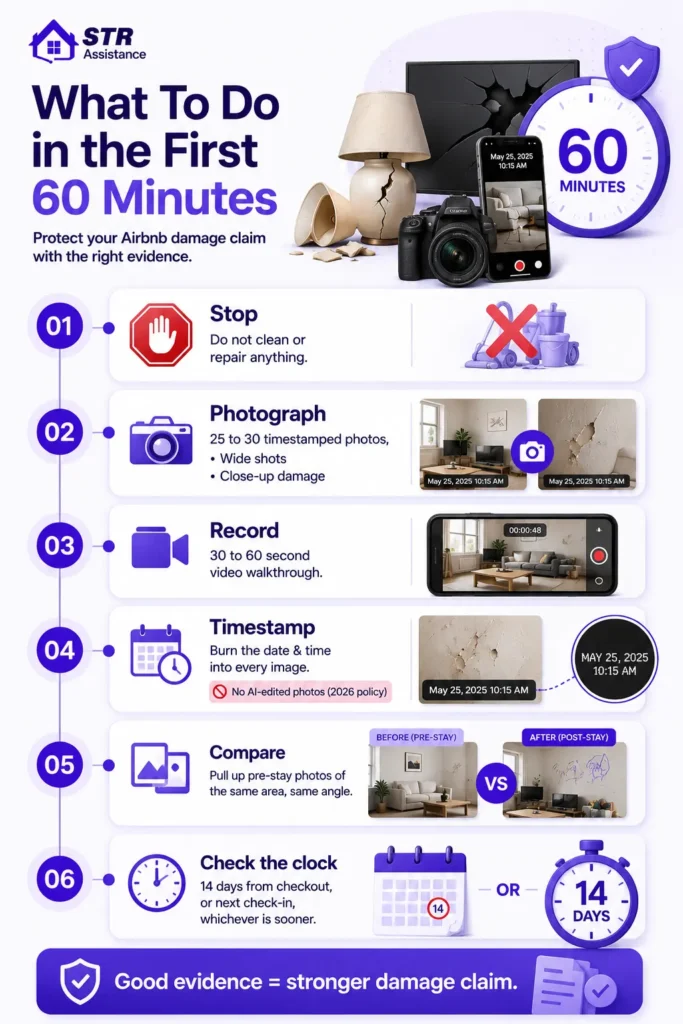
What to Do in the First 60 Minutes After Discovering Guest-Caused Damage
When a guest damages the property or an item inside it, the cleaning team is usually the first to discover it. Most of the time, without proper Airbnb cleaning management coordination, cleaners will clean up or fix the issue before anyone documents it — and the claim dies right there.
At STR Assistance, we handle this differently. Our dedicated cleaning management team pre-alerts cleaners about damage protocols and instructs them to notify us before touching anything. We then gather all necessary photos, timestamps, videos, and supporting documents before any cleanup begins.
This is exactly what you should do when you find damage. Do not clean or repair anything yet. Document the damage first with photos, videos, and timestamps — because once the evidence is altered, the claim becomes much harder to prove.
Your first instinct may be to fix the issue before the next guest arrives. Doing that destroys the only evidence you have. Instead, follow these three steps.
Document Everything Immediately
Take 25 to 30 timestamped photos from multiple angles, plus a short video walkthrough, before touching anything.
- Take wide shots and close-ups. Include a cleaner’s written note if they found it.
- Timestamp everything using an app that adds date and time into the image. Or photograph your phone’s lock screen first, then the damage — the lock screen timestamp anchors the sequence.
As of the April 20, 2026, policy update, Airbnb explicitly bans AI-generated, AI-enhanced, or upscaled photos in damage claims. That includes innocent edits like brightness correction through an AI-powered photo app. Submit the original camera files. If a photo looks even slightly “cleaned up,” it can trigger an automatic rejection.
This ban didn’t appear randomly. It followed a documented August 2025 case in which a Manhattan superhost submitted AI-generated photos as part of a $16,000 damage claim — the fraud was spotted when a guest noticed the same coffee-table crack appearing in different positions across different images. Airbnb tightened the framework in response. Now every host works under the stricter standard.
Compare Against Your Pre-Stay Photos
Pull up your check-in photos of the same area and compare them side by side with what you’re seeing now.
Do before-and-after pairs at the same angle and lighting wherever possible. These are the strongest pieces of evidence you can submit. Without a pre-stay photo, Airbnb can’t confirm that the damage wasn’t already there — and unresolved doubt usually breaks against the host.
Check Your Timeline Carefully
You have 14 days from checkout, or until your next guest checks in — whichever comes first is your claim window. Check your calendar before doing anything else.
If your next guest arrives the same day, your real window might be a few hours, not two weeks. Set a calendar reminder the moment you discover damage.
How to Calculate the Right Amount to Charge
Charge for the actual cost of repair or replacement, backed by a vendor quote or paid receipt — never a number estimated from memory.
Airbnb reviews the amount as closely as the evidence. A request matching a professional quote moves through fast. A round number with no backup invites a reduced payout, and an inflated number can drag down an otherwise solid claim. On the Airbnb Community Forum, one host described requesting $600 for damage that, on review, looked padded — and Airbnb came back with a lower negotiated figure. The lesson: quote what it actually costs, not what you wish it cost.
Repair vs Replacement
Claim a repair cost when the item can be fixed and still function normally. Claim full replacement only when the item is beyond repair.
For example, a small crack in a countertop that can be resurfaced for around $200–$500 is usually a repair claim. If the countertop is shattered and requires a new slab costing $1,500–$4,000 or more, it becomes a replacement claim.
In either case, get a written quote from a contractor or vendor — preferably on company letterhead. Professional quotes are approved faster than handwritten estimates.
Understanding Depreciation
Airbnb reduces reimbursement for older items based on their current value, not what you originally paid.
A five-year-old sofa won’t be reimbursed at its original purchase price. Airbnb applies depreciation based on age and expected lifespan, which is why a $1,200 sofa sometimes gets a $400 offer. Submitting the original purchase receipt gives Airbnb accurate numbers to depreciate from, rather than guessing against you.
Calculating Cleaning Charges
Cleaning charges only qualify when they go beyond your normal turnover — pet accidents, biohazard situations, or smoke odor needing professional remediation.
Your standard cleaning fee already covers regular turnover. Some hosts build a specific hourly rate for excess cleaning directly into their house rules — for example, a stated $40 per hour for cleaning beyond the normal scope. That way the rate is disclosed upfront rather than negotiated after the fact.
As of the April 20, 2026 update, smoke odor specifically requires a professional remediation invoice — a standard cleaning receipt won’t be accepted.
Charging for Missing Items
To charge for a missing item, you need proof it existed — an inventory record or photo — plus a receipt or listing showing its replacement cost.
An up-to-date inventory list with photos and approximate values makes this fast. If the item was stolen rather than just missing, note any evidence of forced entry, since Airbnb treats documented theft differently from simple disappearance.
What Not to Include in Your Damage Charge
Airbnb’s Wear and Tear Policy (Help Center Article 279) spells out what doesn’t qualify. Leave out normal wear and tear, anything that looks pre-existing, claims you can’t back up with evidence, and items Airbnb now formally classifies as consumables.
- Wear and tear from regular use — faded fabric, minor scuffs, everyday marks.
- Pre-existing damage already visible in your before photos.
- Unsupported claims with no photo or quote behind them.
- Consumables — as of the April 20, 2026 update, this formally includes toiletries, coffee pods, cleaning supplies, and lightbulbs. If a guest finishes the shampoo, that’s on you.
- Utility overuse — a guest running the AC constantly. A higher electricity bill isn’t a billable damage item under AirCover.
- Shared or common-area damage — a condo hallway or building lobby. AirCover only covers your listing and belongings, not shared property.
Experienced hosts usually don’t file claims for every small item. A broken $40 bed frame often isn’t worth pursuing, especially when it’s difficult to prove which guest caused it. The same applies to $15 towels and everyday linens. Even when hosts use $40–$50 premium towels, it often makes sense to budget for replacements through cleaning fees or nightly rates rather than filing reimbursement requests.
Most hosts reserve formal claims for more expensive damage — broken furniture, cracked tiles, damaged walls, or other issues where the repair or replacement cost makes the process worthwhile.
A new 2026 duty to know about: the April 20, 2026 update also introduced a “reasonable care” expectation. Hosts are now formally expected to take reasonable steps to prevent damage in the first place — clear house rules, guest screening, working smoke detectors, proper appliance instructions. If Airbnb determines you didn’t exercise reasonable care, that can weigh against a claim’s approval even when the evidence is otherwise strong.
Should You Approach the Guest Directly or Go Straight to Airbnb?
Always message the guest directly first when you find damage. Use Airbnb’s own messaging system to keep the evidence on the platform and everything transparent to Airbnb.
Contacting the guest is a required step before Airbnb gets involved, and most guests who caused accidental damage will agree to pay without escalation. The process doesn’t work by going straight to Airbnb without contacting the guest first — Airbnb expects you to attempt direct resolution before stepping in.
Keep the first message factual:
“Hi [Name], hope you had a great stay. During checkout inspection, we noticed [damage], shown in the attached photos. The repair quote came to $[amount]. Could you confirm you’re able to cover this through the Resolution Center?”
No blame. Just facts and a clear ask.
If the guest agrees, send the reimbursement request for the agreed amount and they pay directly — no Airbnb involvement needed. If they decline, ignore the message, or only offer part, you move to escalation.
Direct admission happens more often than hosts expect. Hosts have reported guests messaging to admit fault — for example, after leaving an iron face-down on a bedspread and burning it — and paying the requested amount without any pushback. When that happens, the Resolution Center request becomes the easiest part of the whole process.
How to File a Damage Charge Through Airbnb's Resolution Center
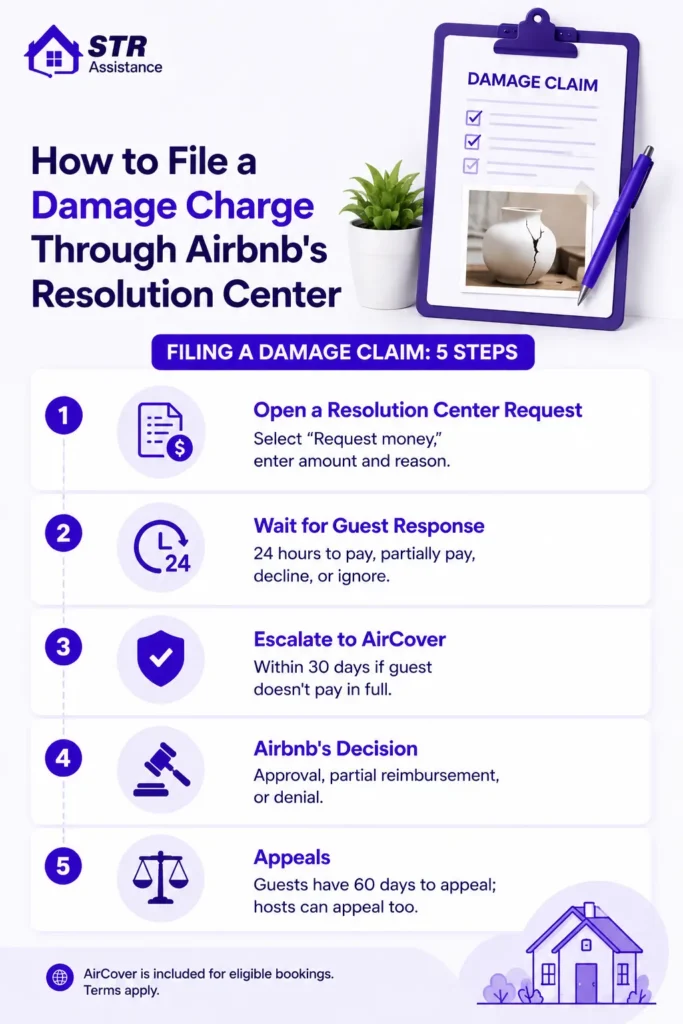
Filing through the Resolution Center has five stages: open the request, wait for the guest’s response, escalate to AirCover if needed, receive Airbnb’s decision, and appeal if the outcome is wrong.
Here’s what happens at each stage and what you need to do.
Step 1: Open a Resolution Center Request
From the reservation, select “Request money,” choose damage or unexpected cleaning as the reason, and enter the amount based on your quote. Open the request and attach all evidence before submitting — photos, video, quote, message thread — so everything is ready in one go.
Step 2: Wait for the Guest Response
The guest has 24 hours to respond: pay in full, pay part, decline, or do nothing. Full payment closes the request automatically. Anything less opens the door to escalation.
Step 3: Escalate to Airbnb AirCover
If the guest doesn’t pay in full, click the option to involve Airbnb — within 30 days of the damage. Your full evidence package matters most here: photos, video, quotes, message thread, and itemized description.
Step 4: Airbnb's Decision
Airbnb reviews both sides and issues a decision: full approval, partial reimbursement (often reduced for depreciation), or denial. If approved, the guest’s payment method is charged, or AirCover pays out directly. Airbnb’s own policy states hosts will not be charged, and guests will not be charged, without advance notice and a chance to respond first.
Step 5: Appeals Process
Guests have 60 days to appeal a charge after being billed, and hosts can appeal a denial or reduction too. Submit any new evidence, reference your case number, and ask what additional documentation would change the outcome.
What If the Guest Refuses to Pay?
If a guest refuses, ignores, or only partially pays a damage request, you have four ways forward: escalate to AirCover, let Airbnb charge the guest’s payment method, pursue the guest in small claims court, or in rare cases, sell the unpaid debt to a collection agency.
Most cases resolve at the AirCover stage. But it helps to know the full picture.
- Escalate to AirCover. This is your first and most common path. Airbnb reviews the evidence and can reimburse you directly under Host Damage Protection, up to $3 million per incident.
- Let Airbnb charge the guest’s payment method. If Airbnb determines the guest is responsible, they can charge the card on file after giving the guest notice and a chance to respond or appeal.
- Pursue the guest directly. AirCover is contractual, not insurance — which means nothing stops you from pursuing a non-paying guest separately. Small claims court is the most commonly used route, since it’s inexpensive and doesn’t require a lawyer for modest amounts.
- Sell the debt to a collector. Rare and usually reserved for larger unpaid amounts where AirCover doesn’t fully cover the loss. Some hosts use collection agencies as a last resort for significant, well-documented damage.
How Hosts Should Respond to Different Damage Situations
The right response depends on the situation. Minor accidental damage, major denial cases, party damage, last-minute discoveries, missing items, and smoke odor each call for a different approach.
In our work helping hosts manage damage cases day to day, matching the response to the situation — rather than using one template for everything — is what keeps both the payout and the guest relationship on good terms.
Minor Damage With Guest Cooperation
A guest admits to a small breakage and offers to pay. Send a simple Resolution Center request for the exact repair cost with photos attached. This is the easiest case — no escalation needed.
Major Damage With Guest Denial
Major damage, but the guest denies it. Lead with your before-and-after photo comparison, stay factual in messages, and escalate to Airbnb promptly with the full evidence package. Let the documentation make the case.
From STR Assistance’s files:
A host we work with in Arizona had a guest deny breaking a glass shower door, insisting it was “already cracked.” The host’s pre-stay photos from three days earlier showed the door in fully intact condition. We built a side-by-side comparison with both dates clearly visible, sent a calm, factual message referencing the timeline, and filed through the Resolution Center with a $280 glass repair quote attached. The guest stopped responding after that message. Airbnb reviewed the timestamped photos and approved the claim in full within five days. The before photo did all the work.
Party Damage
You may find multiple damaged items, evidence of unauthorized guests, and possibly noise complaints on the neighborhood side. Document everything — including evidence of the house rule violation itself. Call Airbnb directly for serious cases, since party damage often needs faster review than the standard Resolution Center process.
Damage Discovered Before Next Guest Check-In
A same-day turnover with new damage. Move fast: photos first, a quick repair estimate from your usual vendor, and file the Resolution Center request before the next check-in time. Speed matters more than polish here.
Missing Items
An item is gone after checkout. Pull your inventory record and any photos showing it in place. If there’s evidence of forced entry, note that separately — Airbnb treats documented theft differently from simple disappearance.
Smoke Odor Damage
Strong smoke smell after checkout, often from vaping in a non-smoking listing. Document with video, book a professional remediation service, and use their invoice as cost evidence. Under the April 20, 2026 rules, this is the only evidence Airbnb accepts for smoke claims.
How to Charge a Guest Without Triggering a Retaliatory Review
Keep your tone factual and non-accusatory, send the request after the guest has already left their review if possible, and let your evidence do the talking instead of your wording.
Retaliatory reviews happen when guests feel blamed or caught off guard. Avoiding that starts with timing and tone.
- Wait for their review window. Reviews typically lock in within 14 days. Sending the request after they’ve already reviewed removes the leverage entirely.
- Use neutral language. “We noticed” lands very differently than “you broke.”
- Keep it brief and factual. Short, evidence-backed messages tend to get a quick “okay, sorry about that.”
- You can respond to reviews. A calm, factual public response to a negative review often protects your listing more than the review damages it.
Security Deposit Claim vs AirCover Claim: Which to Use
Most Airbnb hosts can’t use a security deposit at all. Airbnb’s own policy states that most hosts are not permitted to charge security deposits — either through the Resolution Center or outside the platform. This makes AirCover the default and often the only option.
Some hosts using approved property management software can collect a security deposit outside Airbnb if it’s properly disclosed in the listing. For most hosts, though, this doesn’t apply. Here’s how the two compare.
Feature | Security Deposit Claim | AirCover Claim |
|---|---|---|
Setup required | Yes, via a connected PMS tool; most hosts aren’t eligible | No — automatic for every host |
Funds source | Pre-authorized hold on guest’s card | Resolution Center request, then AirCover backup |
Speed | Often faster — funds are already held | Depends on guest response and Airbnb review |
Coverage limit | Set by the host or platform | Up to $3 million per incident |
Best for | A small subset of software-connected hosts | Nearly all standard Airbnb hosts |
How STR Assistance Helps Hosts Recover Damage Costs
Let’s Talk to Your Airbnb VA
I’ve spent years in the short-term rental industry through STR Assistance, a company that supports hosts and property managers with trained Airbnb co-hosts and Airbnb virtual assistant services. Every day brings new challenges — and helping hosts recover damage costs is one of the areas where our team has built the deepest process.
At STR Assistance, we handle the documentation, messaging, and filing work behind every damage case, so hosts don’t lose claims to missed deadlines or weak evidence.
We’ve helped hosts handle 300+ damage claims to date. Recently, one of our highest approved recoveries was $900 for significant furniture and property damage. As soon as the host reported the issue, we guided them on the photos, evidence, and documentation needed and submitted the claim promptly.
We stay connected with hosts throughout the process — whether it’s a major claim or a smaller reimbursement in the $150–$200 range — helping gather documentation, organize evidence, and manage the claim submission from same-day discovery through to Airbnb’s final decision.
Our team follows a consistent workflow for every damage recovery case:
- Same-Day Damage Documentation — cleaner alerts, timestamped photos, video walkthroughs
- Resolution Center Filing — evidence packaging, itemized descriptions, quote attachment
- Guest Communication — factual, non-accusatory messaging to preserve host rating
- Escalation and Appeals — AirCover involvement, additional evidence submission, decision follow-up
- Multi-Property Tracking — case management across a host’s full portfolio
The Bottom Line: Documentation Beats Speed
Charging an Airbnb guest for damage is straightforward when you know the process. Message the guest first and try to resolve it directly before escalating through Airbnb.
Document the damage before you clean anything. Compare it with your pre-stay photos to confirm what changed. Check your claim deadline, because in some cases you have only a few hours to act — not the full 14 days. When calculating the charge, use a repair invoice or vendor quote rather than guessing.
The hosts who recover the most aren’t the ones chasing every dollar. They’re the ones who document consistently, communicate professionally, and know which battles are worth fighting. When a guest causes real damage, the system Airbnb provides exists for exactly this reason. Use it.
FAQ: Charging Airbnb Guests for Damage
You have 14 days from checkout, or until your next guest checks in — whichever comes first. With a same-day turnover, your real window could be just a few hours, and missing it invalidates the claim.
If the guest doesn't respond within 24 hours, you can escalate to Airbnb and request AirCover involvement, which reviews your evidence and may charge the guest's payment method directly.
Yes. If Airbnb determines the guest is responsible, they can charge the guest's payment method on file after giving notice and a chance to appeal. If that fails, AirCover can reimburse the host directly, up to $3 million per incident.
Airbnb applies depreciation based on the item's age, landing between original purchase price and current fair market value. Submitting the original receipt and a professional quote gives Airbnb accurate numbers to work from.
Your filing deadline becomes your next guest's check-in time, not the full 14 days. Take photos, get a preliminary estimate, and submit the Resolution Center request before that check-in time arrives.
Yes — which is why tone and timing matter. Factual, non-accusatory messages and filing after the guest's review window has closed both reduce this risk significantly.
A security deposit claim uses funds already held on the guest's card, but most Airbnb hosts aren't eligible — it's limited to certain software-connected hosts. AirCover is automatically available to every host, works through the Resolution Center, and covers up to $3 million per incident.
Yes, but as of the April 20, 2026 update, you need an invoice from a professional remediation service. A standard cleaning receipt won't be accepted, so document the odor with video and book remediation before filing.
Yes, damage from unauthorized parties is covered under AirCover, but the burden of proof is higher. You'll need to document the house rule violation (evidence of extra guests, noise complaints, neighbor reports) alongside the damage evidence. For serious party-related damage, call Airbnb directly rather than only filing through the Resolution Center.
The 14-day rule is strict. If you discover damage after the window closes, AirCover claims are generally invalid. Some hosts have had success pursuing the guest directly in small claims court for late-discovered damage, but this is outside Airbnb's protection framework. This is why proactive same-day inspection matters — every day past checkout weakens the claim.
Damage claims are uncommon — occurring in roughly 0.71% of Airbnb stays based on Avada Properties' regional analysis of 20,000+ Smoky Mountains bookings — and the approval rate for filed claims is around 56.75%. Strong documentation, timestamped before-and-after photos, and a quote that matches your request all push the odds in your favor.
Yes. If your claim is denied or reduced, request a written explanation, submit new evidence, and reference your case number in follow-up communication. Guests also have 60 days to appeal a charge, and the same appeal window applies to hosts disputing a decision.